
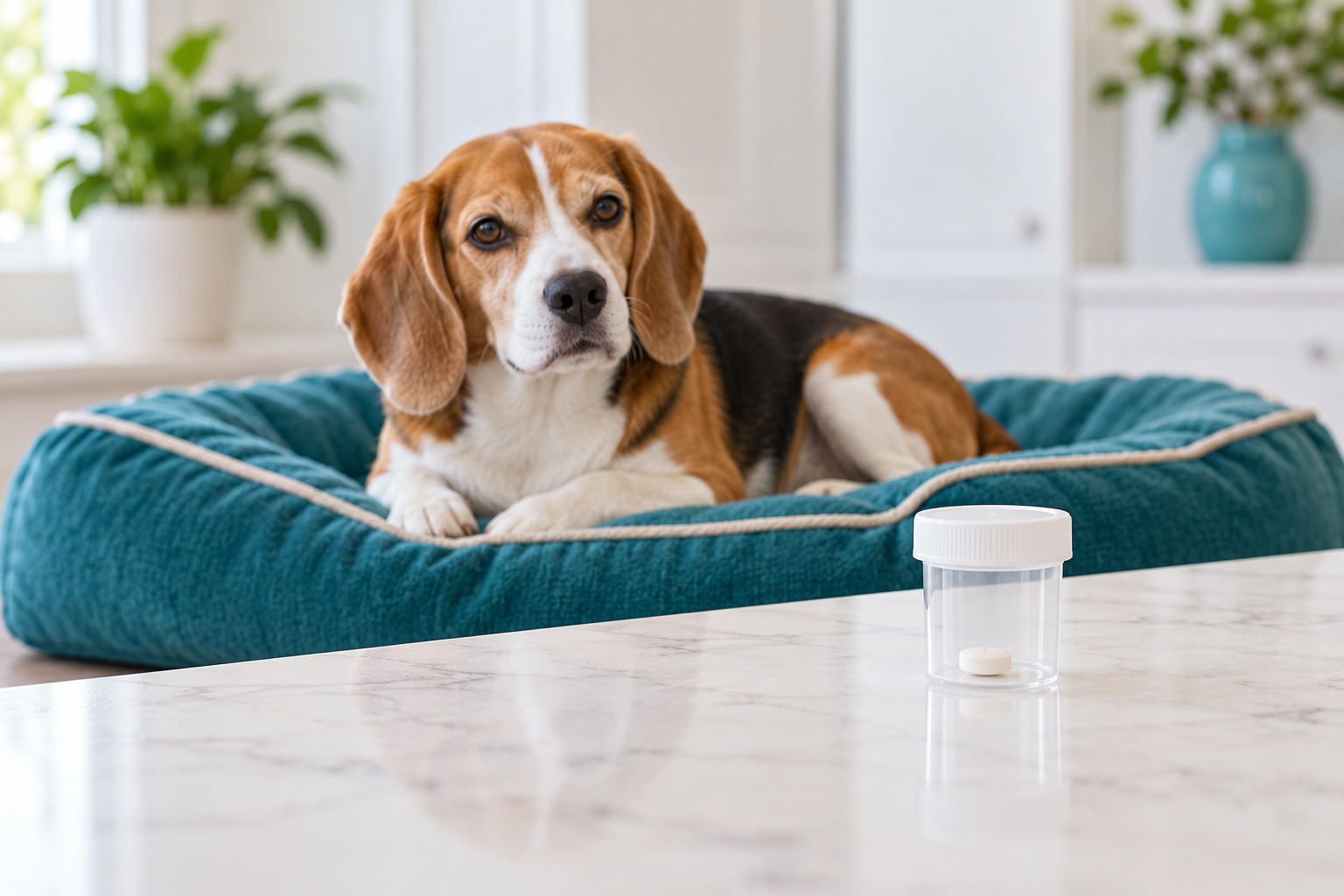
Check the instructions before trying again
If your dog spit out a pill, do not automatically offer another tablet or estimate a replacement from the pieces left behind. Check the product's written instructions for this exact situation. If they do not clearly cover what happened, contact the prescribing veterinary team for a next-dose plan.
The US FDA advises owners to ask what to do if an animal vomits or spits out medicine when discussing a prescription. The answer needs to fit that medicine and your dog.
This guide helps you describe the failed attempt and obtain clear instructions. It cannot determine how much medication your dog received.
Trouble breathing, blue or very pale gums, collapse, unresponsiveness, or a seizure needs emergency veterinary attention. Attempts to cough or gag with little sound, or squeaky breathing, can signal choking. Call an open emergency veterinary hospital immediately for first-aid directions while arranging urgent care; do not spend time completing a medication log first.
Describe the pill you can see, not the dose you assume
A useful account separates an observation from a conclusion. “I found a damp tablet” is an observation. “He received none of the medicine” is a conclusion you may not be able to establish.
Use the closest row below when you call. These are reporting categories, not instructions to repeat a dose.
| What happened | Useful wording for the clinic | Detail to include |
|---|---|---|
| You watched a tablet come straight back out | “It looks whole; I saw it leave his mouth.” | Whether it was wet, softened, chewed, or visibly damaged |
| You found crumbs or a smaller piece | “Some material is missing; the amount swallowed is unknown.” | A photograph and whether you recovered all visible pieces |
| Your dog ate around medicine hidden in food | “This food remains, and I can/cannot see the tablet.” | Whether the pill was whole, split, or mixed into the food |
| You found a tablet later | “I found this at this time; I cannot connect it confidently to one dose.” | Where it was found and which pets or people had access |
| Your dog vomited after medication | “The dose was offered at this time; vomiting happened at this time.” | What you saw in the vomit and how your dog is acting now |
A photo documents appearance; it does not measure the amount received. Do not turn “about half the tablet is left” into a calculated replacement dose.
For vomiting that continues or comes with other illness signs, use the separate guide to when a vomiting dog needs a vet. Still tell the clinic about the medication and its timing.
Prevent a second uncertain attempt
Put the medication away while you get advice, and keep recovered pieces or medicated food out of reach of animals and children. Tell anyone sharing care that this dose has an unresolved outcome.
If another dose may already have been given, or another animal may have eaten the missing tablet, call a veterinarian promptly rather than waiting for symptoms. Do not induce vomiting unless a veterinarian or animal poison-control professional specifically directs it. RECOVER's first-aid guideline advises professional assessment after suspected toxic ingestion and recommends against routine home-induced vomiting.
When the prescribing clinic is closed, use its after-hours contact or call an open emergency clinic for guidance. Say when the next dose is scheduled, especially if you have been told timing is critical. A message awaiting a reply is not a replacement-dose instruction.
Copy this failed-dose call sheet
Keep the container nearby so you can read the label instead of identifying the medication by color or shape.
Dog pill incident call sheet
- Dog's name, age, and current weight:
- Medication name, strength, and form from the label:
- Prescribed amount and schedule:
- Reason it was prescribed:
- Last confirmed successful dose, date and time:
- Today's attempted dose, date and time:
- Exactly what I observed:
- Recovered tablet, fragments, or food: description / photo available
- Vomiting, if any: time and observations
- Current behavior and symptoms:
- Other medications and relevant health conditions:
- Any additional attempts or possible access by another pet:
- Next scheduled dose:
- Person responsible for the callback:
Illustrative example: At 7:10 a.m., an owner offers a prescribed tablet in a small food portion. At 7:12, she finds a wet fragment. She records “fragment recovered, amount swallowed unknown,” photographs it, and calls the clinic. She does not record “half a dose given.”
Her partner sees that note and knows the clinic response is still pending. The record preserves both times, rather than replacing the attempted-dose time with the later callback time. This fictional example shows documentation only; it does not assign a treatment decision.
Leave the call with answers to four questions
Write the clinic's response beside the incident, with the person's name and the time of the conversation:
- What should happen now? Record the exact instruction, including whether to make another attempt and which tablet or preparation to use.
- When is the following dose? Read back the date and time so “later” or “tonight” does not remain ambiguous.
- What should we watch for? Record the signs that require another call and the after-hours destination.
- What if the next attempt also fails? Ask for a specific fallback and contact plan.
If the direction is unclear, read your understanding back before ending the call. Keep any written follow-up with the original label. A one-time instruction after this incident should not silently become the rule for every future refused dose.
Ask for a workable method before the next dose
Repeated rejection is worth discussing openly. Tell the team which step fails: your dog avoids the food, eats around the tablet, chews and drops it, or will not allow handling. Ask for a demonstration suited to your dog and this prescription.
Check whether food is allowed and what kind to use. Do not crush or split a tablet, open a capsule, or change the preparation unless the veterinarian confirms it is appropriate. FDA medication-safety guidance specifically cautions against altering tablets or capsules without veterinary direction.
For an antibiotic, ask how the failed attempt affects the remaining course. The AAFP/AAHA antimicrobial stewardship guideline calls for clear administration instructions, accurate treatment records, and veterinarian-directed timing and duration. Do not independently extend or shorten the course to account for a rejected tablet.
Write down the agreed method in enough detail that the next caregiver can follow it. If the team changes the prescription or formulation, have it confirm the new instructions instead of carrying over the old tablet directions.
Keep the incident visible until it is resolved
A completed reminder should not conceal a failed attempt. Keep the observation and clinic response together, then record the action actually taken and its time. For a shared household, the two-caregiver medication handoff guide explains how to assign the next dose to one person.
Pet Care Reminder's medication routines can keep schedules, shared notes, and completion history together. Use the clinic's confirmed plan for the next reminder. Keep an uncertain attempt explicit in the notes so an overdue alert does not prompt someone else to repeat it.
Sources
- Veterinary Medication Errors. US FDA technical safety guidance on medication instructions, rejected doses, tablet preparation, labeling, and prevention of accidental exposure.
- How to Practice Antimicrobial Stewardship. Section of the formal 2022 AAFP/AAHA guidelines covering administration teaching, treatment records, and prescribed antibiotic timing and duration.
- RECOVER Guidelines: First Aid for Dogs and Cats. Clinical Guidelines. Formal clinical guideline, published August 25, 2026, covering emergency recognition, choking, respiratory distress, and suspected toxic ingestion.