
Quick answer
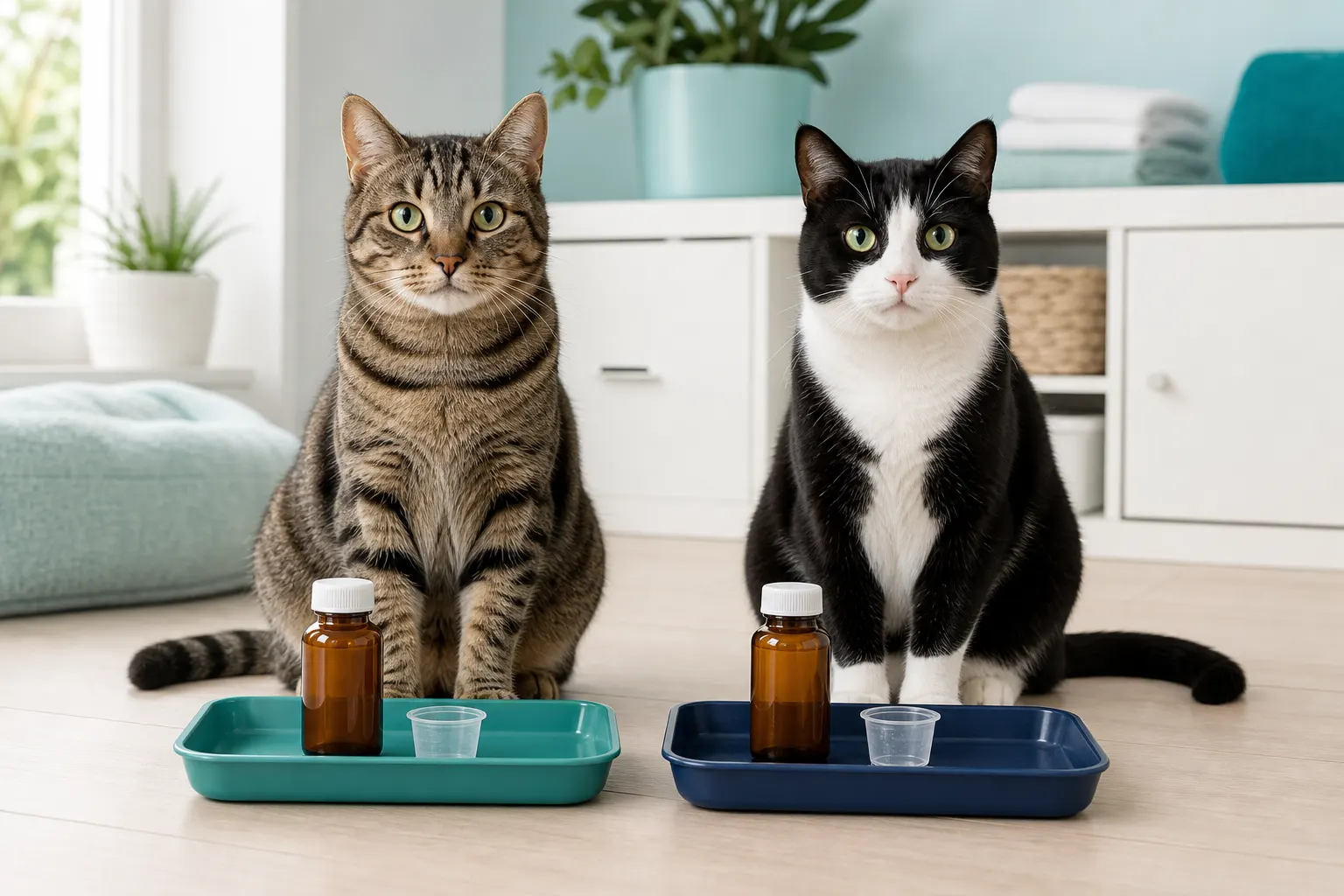
In a multi-cat home, give every cat a separate medication record and storage space, then medicate only one cat at a time in a closed room. Before each dose, match five details:
- The cat
- The labeled product
- The strength or formulation
- The amount and route
- The scheduled time
Bring only that cat's product and measuring device into the room. Keep the other cats away from medicated food, dropped tablets, open bottles, and fresh topical applications. Record the actual result immediately, including whether the full dose was swallowed, refused, spat out, vomited, partly given, or uncertain.
If you cannot confirm which cat received a product or how much was given, do not repeat the dose or double the next one. Contact the prescribing veterinary clinic for product-specific advice.
Why multi-cat medication needs a closed-loop system
Cats create tracking problems that a calendar alert cannot solve by itself. One cat may eat from another cat's bowl, groom a freshly treated housemate, hide when a bottle opens, or hold a tablet in the mouth and spit it out later. Cats with similar coats can also be confused during a rushed handoff.
A 2025 peer-reviewed study manually classified 1,023 veterinary medication-error narratives. Owners were associated with 340 of them, and administration was the most frequent error stage. Across all administration errors, wrong dose, frequency, or duration was the largest subcategory.
The practical lesson is to separate four events that often get blurred together:
- A reminder became due.
- A caregiver prepared a dose.
- One identified cat received it.
- The result was observed and recorded.
Only the last step closes the task.
Create one identity record per cat
Begin with a separate page or screen for each cat. Make it easy for a sitter or family member to identify the right animal without relying on memory.
Include:
- Full name and a recent clear photo
- Coat pattern, distinguishing marks, and collar details when relevant
- Microchip number in the health record, if available
- Current weight and the date it was measured
- Veterinary clinic and emergency contact details
- Allergies, previous medication reactions, and important health conditions
- Every current prescription, preventive, supplement, eye product, ear product, and topical treatment
Do not use household nicknames alone when two names sound alike. If cats are visually similar, write an observable difference such as "white patch under chin" or "black spot on left hind paw."
Weight is useful context for the veterinary team, but an old weight is not permission to recalculate a dose at home. Ask the clinic to update the direction when weight, health, or formulation changes.
Keep each cat's supplies physically separate
Choose one secure storage location that cats, children, and visitors cannot access. Within it, give each cat a separate closed bin, shelf section, or container.
Each cat's area should hold only:
- Medication in its original labeled container
- The measuring syringe, dropper, applicator, or other device supplied for that product
- The current veterinary instructions
- The active dose record
- Refill and recheck information
AVMA prescription-drug guidance calls for the animal's identity, drug, strength, dosage, route, and other directions to appear in the prescription and labeling record. Keep that label readable and attached to the original container.
Color can help you find the right bin, but color should never be the only identifier. A teal bin still needs the cat's written name and photo. Do not put loose tablets into a shared organizer, combine two cats' liquids, cover a dispensing label, or move one product's measuring device into another cat's bin.
Store refrigerated, light-sensitive, or otherwise restricted products exactly as directed. A cat-specific sealed container can remain inside the correct refrigerator area without losing the separation system.
Write instructions that another person can follow
Copy the current label and written veterinary direction instead of rewriting them as household shorthand.
| Field | What to record |
|---|---|
| Cat | Full name and identifying photo |
| Product | Name and strength from the label |
| Purpose | Why this cat receives it |
| Amount | Exact prescribed quantity for one dose |
| Route | Mouth, skin, eye, ear, or another prescribed route |
| Timing | Exact time or interval and food instruction |
| Dates | Start, review, and stop dates when applicable |
| Storage | Label or pharmacy requirement |
| Monitoring | Effects, tests, or observations the clinic asked you to track |
| Problem plan | Who to call after a refused, spat-out, vomited, missed, or uncertain dose |
Avoid directions such as "the usual pill," "a little liquid," "give at night," or "put some in food." They do not identify the formulation, amount, route, time, or response to an incomplete dose.
Ask the veterinary team to resolve any conflict between the bottle, discharge sheet, portal, and spoken instruction before the next dose is due.
Use a one-cat, one-room routine
Prepare the room before bringing in the cat. Close the door so another cat cannot enter, eat a dropped product, or take medicated food.
Use the same sequence every time:
- Check the shared record to confirm that the dose is still due.
- Identify the cat from the record and distinguishing features.
- Bring in only that cat, one labeled product, and its matching measuring device.
- Read the cat's name, product, strength, amount, route, and timing from the current direction.
- Give the medication exactly as the veterinarian demonstrated or directed.
- Observe whether administration was complete.
- Close and return the product before opening the door.
- Record the actual time, caregiver, and outcome immediately.
Do not prepare several cats' tablets or filled syringes side by side. If the phone rings or a cat escapes, you need to know that every item in the room belongs to one identified cat.
Record outcomes, not just checkmarks
A binary completed box can hide the information the next caregiver needs.
Use an outcome field such as:
- Given and observed swallowed, when observation is appropriate
- Applied as directed
- Refused
- Spat out
- Vomited after administration
- Partly given
- Missed
- Uncertain
| Date | Cat | Product and strength | Due | Actual time | Outcome | Caregiver and note |
|---|---|---|---|---|---|---|
| August 2 | Cat's name | From label | 8:00 a.m. | 8:07 a.m. | Given as directed | Initials; remained separated as instructed |
Never mark a dose complete before it is given. A dismissed notification, opened bottle, empty food bowl, or message saying "I'll do it" is not proof that the intended cat received the full dose.
Pet Care Reminder can hold a separate reminder for each cat and product. Begin every task with the cat's name, then pair the reminder with the household's actual administration record. The alert prompts action; the outcome record prevents the next person from guessing.
Do not hide medicine in a shared meal
Only mix a medication with food when the veterinarian or pharmacist confirms that the specific product can be given that way. Crushing, opening, or mixing a product can change how it works or make the dose impossible to verify.
When food administration is approved:
- Separate the intended cat in a closed room.
- Use the small food portion and method the veterinary team recommended.
- Keep every other cat away until the result is clear.
- Watch whether the full medicated portion was eaten.
- Record leftovers, refusal, vomiting, or uncertainty.
- Give the normal meal only according to the plan.
An empty communal bowl cannot tell you which cat ate the medicine. If the intended cat eats only part of the medicated portion, do not estimate the missing amount or add another dose. Call for advice.
Plan for topical, eye, and ear products
Products used on the skin, eyes, or ears need the same cat-specific checks as tablets and liquids.
For a topical product:
- Confirm the species, cat, formulation, weight range when applicable, and application site.
- Follow the current label and veterinary instructions exactly.
- Prevent other cats from licking or grooming the application site for the time and in the manner directed.
- Keep the cat away from shared bedding or close contact when the product instructions require it.
- Record the application time and when normal contact may resume.
For eye or ear products, keep separate applicators with the correct cat's supplies. Do not touch the tip to the cat, swap an eye product with an ear product, or reuse another cat's old medication for a new symptom.
FDA medication-error guidance says to keep animal drugs in original labeled containers and not share one animal's drug with another unless a veterinarian says it is appropriate.
Make the routine cat friendly
A frightened cat is harder to identify, medicate, and observe accurately. Formal AAFP/ISFM cat-friendly interaction guidance emphasizes responding to the cat's emotional state, tailoring handling to the individual, and reducing fear rather than defaulting to forceful restraint.
Ask the veterinary team to demonstrate a method suited to each cat and product. Discuss alternatives when administration repeatedly fails. A different formulation, timing plan, administration technique, or trained support may be safer, but only the prescriber can decide what is medically appropriate.
Do not chase several cats around the home with open medication. Prepare first, approach calmly, use the familiar method the veterinary team taught you, and stop if the situation becomes unsafe for the cat or caregiver.
Prevent double-dosing between caregivers
Assign one named caregiver to each dose window. Responsibility should transfer explicitly when plans change.
Use these household rules:
- One shared record is the source of truth.
- The person giving the dose logs it immediately.
- Nobody marks a task complete in advance.
- Messages about intention are not administration records.
- The actual time matters, especially for closely spaced doses.
- A blank or conflicting record means the dose is uncertain.
At handoff, say the cat, product, last actual time, next due time, and any abnormal outcome. "Maya's thyroid tablet was swallowed at 7:55 a.m.; the next dose is due at 7:55 p.m." is safer than "morning meds done."
For a sitter, walk through each cat separately with every container closed. Ask the sitter to identify the cat, find the correct bin, point to the current direction, show where the outcome will be logged, and explain whom they will call if the dose is refused or uncertain.
Reset the system after every change
A new prescription, refill, dose change, formulation change, stop instruction, or monitoring result can leave two conflicting plans in the home.
On the same day:
- Confirm what the new direction replaces.
- Update the cat's active medication record and reminder.
- Mark the old direction as discontinued.
- Remove superseded products and measuring devices from active storage.
- Ask how unused medication should be disposed of.
- Tell every caregiver what changed before the next dose.
Compare every refill with the active plan before storing it. Check the cat's name, product, strength, formulation, directions, quantity, appearance, and measuring device. Call the clinic or pharmacy about any unexplained difference.
Bring the full medication list to appointments. How to Prepare for Your Pet's Vet Visit explains how to combine medicines, symptoms, questions, and records into a concise handoff.
What to do after a mix-up or uncertain dose
The safe response depends on the cat and product.
- You cannot confirm whether a dose was given: Check the record and ask every caregiver. If uncertainty remains, call the prescribing clinic before giving more.
- The wrong cat received medication: Call a veterinarian, emergency clinic, or animal poison service immediately, even if the cat appears normal.
- The wrong product, route, or amount was used: Call immediately with the container in hand. Do not wait for symptoms.
- A dose was refused, spat out, vomited, missed, or partly given: Do not repeat or double it automatically. Ask for product-specific instructions.
- Another cat licked a fresh topical product: Follow the label's exposure instructions and call a veterinarian or animal poison service promptly.
- A cat develops a possible side effect: Contact the veterinary team and follow the plan provided for that product.
Be ready to report the cat's name and weight, product and strength, prescribed dose, possible amount, route, time, symptoms, and other medications.
Seek immediate emergency veterinary care for difficulty breathing, collapse, unresponsiveness, a seizure, severe weakness, or another rapidly worsening sign. Do not induce vomiting or give a home remedy unless a veterinary professional specifically instructs you to do so.
A weekly five-minute audit
Once a week, check that:
- Every active product is in the correct cat's storage area.
- Original labels are readable and match the active record.
- Measuring devices have not moved between products.
- No stopped or superseded instruction remains active.
- Every due dose has an actual outcome.
- Refills, monitoring tests, and rechecks are scheduled before supplies run out.
- Each caregiver knows which task they own next.
- Emergency and prescribing-clinic contacts are current.
The goal is not a more complicated spreadsheet. It is a system where the cat, product, action, and outcome can be verified in seconds.
The simple rule
One cat, one current record, one separated set of supplies, and one closed-door dose routine.
Identify the cat before opening the product, keep other cats away until administration and any separation period are complete, and record what actually happened. If the cat, product, direction, or outcome is uncertain, stop and call rather than giving another dose just in case.
Sources
- First opinion practice electronic health records are a useful source of descriptions of medication errors. Peer-reviewed study describing medication errors in first-opinion veterinary records, including owner-associated errors and the frequency of wrong-dose, wrong-frequency, and wrong-duration administration errors.
- Veterinary Medication Errors. Official FDA safety guidance on reading labels, keeping medicine in original containers, maintaining a complete medication list, avoiding product sharing, and responding to missed or excessive doses.
- Guidelines for Veterinary Prescription Drugs. Formal AVMA guidance on animal identification, drug and strength information, dosage, route, labeling, storage, and prescription records.
- 2022 AAFP/ISFM Cat Friendly Veterinary Interaction Guidelines: Approach and Handling Techniques. Formal feline practice guideline on individualized, low-stress interactions and handling that respond to a cat's emotional state while supporting safe care.