How to Track Care for Multiple Dogs Without Mixing Up Doses
Quick answer
In a multi-dog home, do not manage medication as one shared pile of bottles and one mental checklist. Give each dog a separate care station, keep every product in its original labeled container, write one current instruction record per dog, and record each dose immediately after it is given.
Use the same one-dog-at-a-time routine for every tablet, liquid, topical treatment, eye or ear medication, and parasite preventive. Before giving anything, match three things: the dog, the labeled product, and the current veterinary direction. If any one of them does not match, stop.
A reminder can tell the household that care is due. Only a completed dose record tells everyone what actually happened.
Why memory is not a safe tracking system
Dogs in the same home may take products that look nearly identical but differ in strength, dose, route, frequency, or duration. A refill may also carry a changed direction while an older bottle is still in the cupboard. Add a second caregiver, an early meeting, or a dog who spits out a tablet, and “I think it was done” becomes an unsafe handoff.
A 2025 study of veterinary electronic health records identified 1,023 medication-error narratives. Owners were associated with 340 of the errors, and owner-associated errors were most often the wrong dose, frequency, or duration. The useful lesson is not that owners are careless. It is that the household needs a process that makes the right action obvious and uncertainty visible.
Build the system around identification and confirmation, not memory.
Give each dog a separate care station
Choose one secure storage area that dogs and children cannot access, then create a clearly separated bin, shelf section, or closed container for each dog.
Each station should have:
- The dog's name and a clear recent photo
- That dog's medication in original labeled containers
- The measuring device supplied for that product, when applicable
- The current written veterinary directions
- The dog's dose record
- Refill and recheck information
- The prescribing clinic's phone number
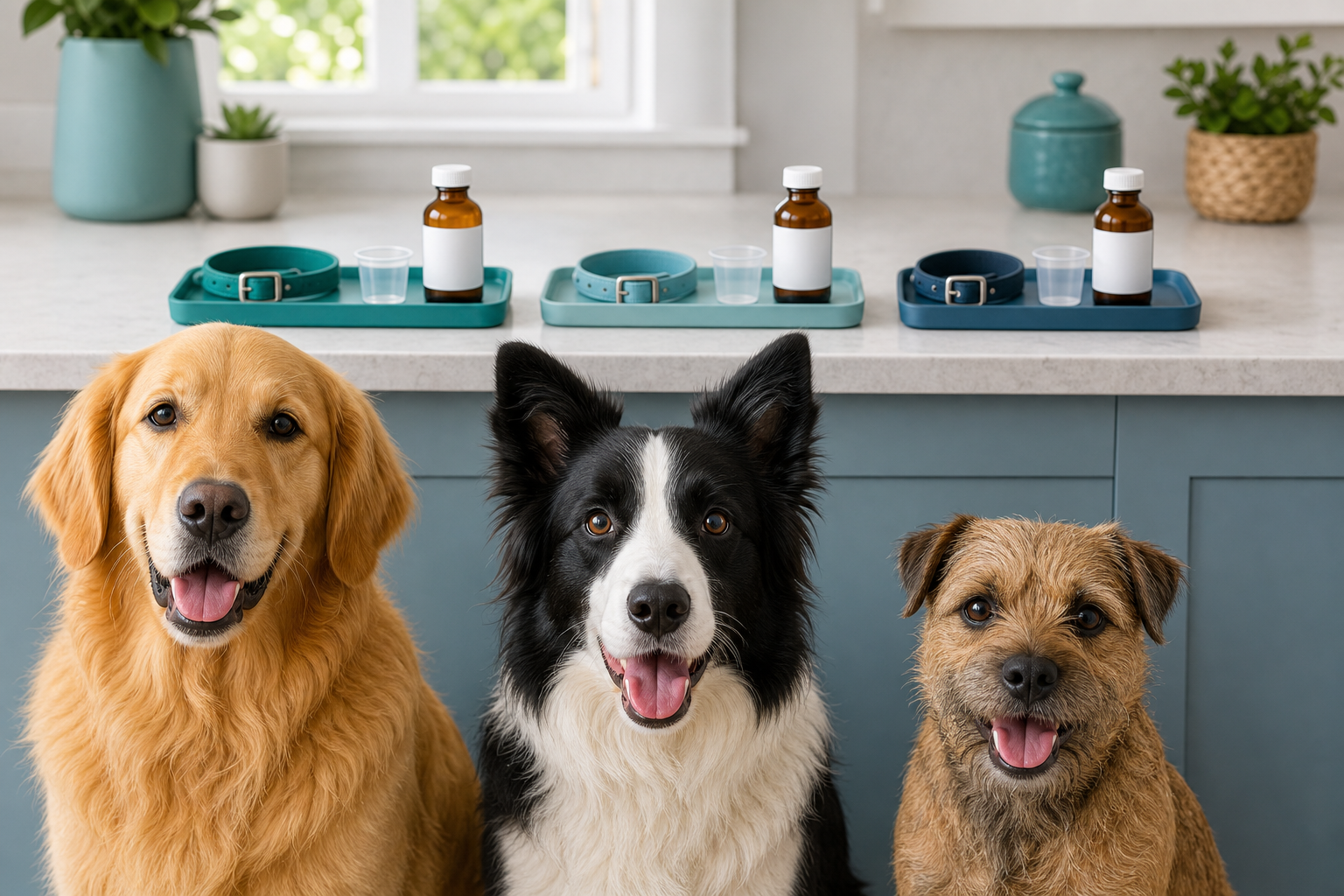
Color can help you find the correct station, but never make color the only identifier. Someone unfamiliar with the system may not know that teal means Milo and blue means Finn, and colors can look similar in poor light. The dog's written name and photo should be the primary check.
Do not combine two dogs' loose tablets in one container, cover the dispensing label, or rely on a handwritten lid when the original bottle is available. AVMA prescription-drug guidelines call for the animal, drug, directions, and other key information to appear on the label. That information is the last check before a dose reaches the dog.
If a product needs refrigeration, light protection, or another special condition, follow its label. You can still keep a dog-specific sealed container in the correct storage location rather than placing everything in the general care station.
Make one current instruction record per dog
Do not put every dog into a dense household spreadsheet if that makes it easy to read across the wrong row. Start with one page or screen per dog.
For every current product, copy the veterinary or pharmacy directions exactly:
| What to record | Example of the detail needed |
|---|---|
| Dog | Full name and identifying photo |
| Product | Medication name and strength from the label |
| Purpose | Why this dog receives it |
| Amount and route | Exact prescribed dose and how it is given |
| Timing | Exact time or interval, plus food instructions |
| Dates | Start, review, and stop dates when applicable |
| Prescriber | Clinic and contact number |
| Next action | Refill request, examination, or monitoring test |
| Problem plan | Who to call about a missed, spat-out, vomited, or uncertain dose |
Write “one tablet by mouth at 8 a.m. with food” if that is the direction. Avoid household shorthand such as “morning pill,” “same as usual,” or “the small one.” Shorthand loses the dog, product, amount, route, and timing, which are the details that distinguish one treatment from another.
If one dog has a complicated treatment plan, How to Manage Medications for an Older Dog explains how to connect the medication list with monitoring, refills, and rechecks. Keep that dog's clinical plan separate from this household-level handoff system.
Use a one-dog-at-a-time dose routine
Make the sequence identical every time:
- Check the shared record to confirm that the dose is still due.
- Bring only the intended dog into the dosing area. Keep the other dogs away from dropped food, open containers, and medicated treats.
- Take out only that dog's care station and only the product being given.
- Read the dog's name, medication name and strength, amount, route, and timing from the label and current instructions.
- Measure and give the product exactly as directed. Do not prepare the next dog's dose at the same time.
- Confirm that administration is complete as directed, then close and return the container to that dog's station.
- Record the actual time and caregiver immediately. Only then bring in the next dog.
This routine may feel slower than laying out every dog's tablets together. In practice, it removes the hardest question after an interruption: which prepared dose belonged to which dog?
If a dog refuses medication, do not leave a tablet in an unattended bowl or assume another dog will ignore it. Separate the dogs, recover the product if it is safe to do so, and follow the administration plan from the prescribing clinic.
Prevent double-dosing when people share care
Choose one named person for each dose window. “Alex handles breakfast medication; Sam handles evening medication” is clearer than “whoever gets there first.” When the usual caregiver is unavailable, explicitly transfer responsibility.
Use a log that records facts rather than intentions:
| Date | Dog | Product and strength | Scheduled time | Actual time | Given by | Note |
|---|---|---|---|---|---|---|
| July 21 | Dog's name | From label | 8:00 a.m. | 8:06 a.m. | Initials | Given as directed |
Follow four rules:
- Never mark a dose complete before giving it.
- Do not treat a dismissed notification or a message saying “I'll do it” as proof.
- Record an actual time, not only a checkmark.
- If the log is blank and nobody can confirm what happened, treat the dose as uncertain and call before repeating it.
Pet Care Reminder can hold separate reminders that begin with the dog's name and include the exact care task. Pair those prompts with the household's dose record so a reminder to act is never confused with confirmation that someone already acted.
Watch for the same-product problem
Two dogs may use the same brand but not the same product. Differences can include:
- Tablet or liquid strength
- Amount prescribed
- Weight range on a preventive
- Frequency or treatment duration
- Formulation or flavor
- Eye, ear, skin, or oral route
- Storage requirements
- Refill directions after a dose change
Keep each container with the dog named on its label. Do not borrow from the other dog's supply, split a larger dose to imitate a smaller one, or swap measuring syringes unless the veterinary clinic or pharmacist confirms that the product and measuring plan are appropriate.
When collecting a refill, compare it with the current written plan before placing it in the station. Check the dog's name, drug, strength, directions, quantity, and appearance. If something differs, ask the clinic or pharmacy to resolve it rather than deciding that the change was probably intentional.
Reset the system whenever a plan changes
A medication start, stop, dose change, new formulation, or new refill creates a high-risk transition. Update the dog's active instruction record on the same day.
Use this reset:
- Read the new directions with the veterinary team and ask what they replace.
- Update the active record and reminders.
- Mark the old direction as discontinued so it cannot be mistaken for current.
- Move stopped or superseded products out of the active care station.
- Ask how to dispose of medication that is no longer needed.
- Tell every caregiver what changed before the next dose window.
Do not keep two conflicting versions in active use. If the bottle, discharge sheet, portal, and spoken instruction disagree, pause and ask the prescribing clinic which direction is current.
What to do when something goes wrong
The correct response depends on the product and the dog. FDA guidance advises owners to get product-specific instructions for missed, spat-out, or vomited doses rather than automatically repeating a dose.
Use these rules:
- You cannot tell whether a dose was given: Check the log and ask the caregivers. If it remains uncertain, call the prescribing clinic before giving more.
- The wrong dog received medication: Call a veterinarian, emergency clinic, or animal poison service immediately, even if the dog seems normal.
- The wrong product or amount was given: Call immediately. Do not wait for symptoms and do not induce vomiting unless a veterinary professional specifically instructs you to.
- A dose was missed, spat out, or vomited: Do not automatically repeat or double it. Ask what to do for that specific medication.
- The dog develops a suspected side effect: Contact the veterinary team promptly and follow the product-specific plan they provided.
Have the dog and all containers with you when you call. Be ready to give the dog's weight, the product name and strength, the prescribed dose, the amount that may have been given, the time, current symptoms, and the dog's other medications.
Difficulty breathing, collapse, unresponsiveness, a seizure, or severe weakness requires immediate emergency veterinary care. Call ahead if possible, but do not delay transport while waiting for a routine message response.
Make sitter and family handoffs dog-specific
Give a temporary caregiver one page per dog, not one long paragraph covering the whole household. Review each dog's photo, care station, exact directions, normal behavior, warning signs, veterinary contacts, and dose log.
Then ask the caregiver to show you the routine with the containers closed:
- Identify the dog.
- Find that dog's station.
- Point to the correct current direction.
- Show where a completed dose will be recorded.
- Explain what they will do if a dose is refused or uncertain.
If the caregiver cannot safely administer a treatment, arrange veterinary help or a different care plan. Do not simplify a prescription or pre-mix unlabeled doses to make the handoff easier.
A 10-minute household check
Once a week, check that:
- Every active container is in the correct dog's station.
- The dog's name, product, strength, and directions are readable.
- No discontinued instruction remains on the active record.
- Dose logs are complete and understandable to another person.
- Measuring devices have not moved between products.
- Refills and monitoring appointments are requested before the supply runs out.
- Emergency and prescribing-clinic contacts are current.
The check is also a good time to remove empty packaging and notice a product that is running low. Do not wait until the last dose to discover that a refill requires an examination or laboratory test.
The simple rule
One dog, one care station, one current instruction record, and one completed-dose log. Handle only one dog's medication at a time, and make every caregiver record what actually happened.
If the dog, product, dose, or record does not match, stop. A brief call to the veterinary team is safer than guessing or giving another dose “just in case.”
Sources
- First opinion practice electronic health records are a useful source of descriptions of medication errors. Peer-reviewed study of medication errors recorded in UK first-opinion veterinary records, including the frequency and types of owner-associated administration errors.
- Guidelines for Veterinary Prescription Drugs. Formal AVMA guidance on animal identification, drug information, directions, cautions, labeling, records, storage, and follow-up for veterinary prescription drugs.
- Medications for Your Pet ... Questions for Your Vet. Official FDA guidance on dose, route, timing, food and storage instructions, interactions, side effects, missed or vomited doses, and overdose response.