
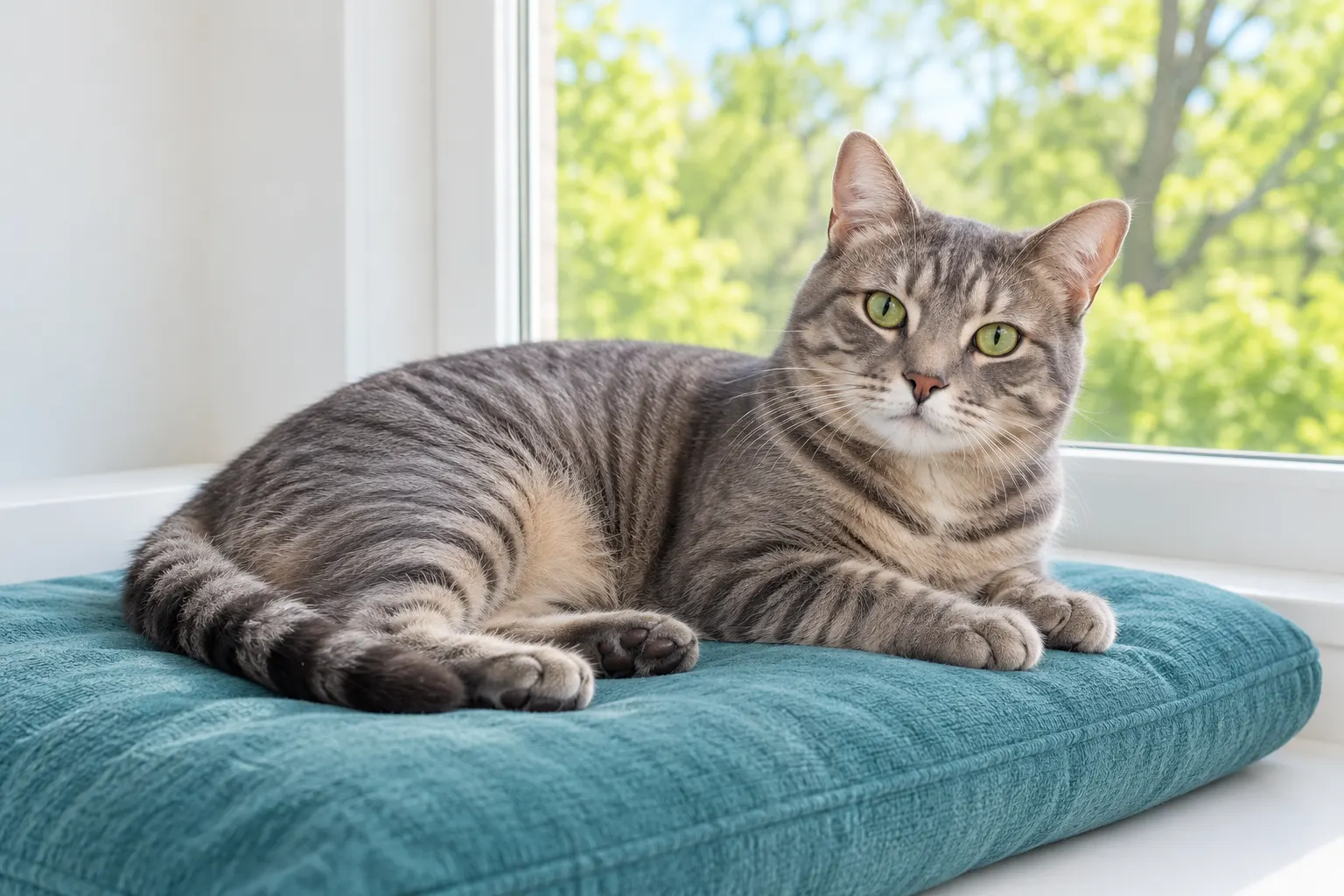
Start with the change you can see
If you suspect spring allergies in your cat, record what changed, where it happened on the body, and when you noticed it, then contact your veterinarian about persistent itching, new bald areas, crusts, or sores. Do not wait until your observation sheet is complete to ask for care.
Cats may remove hair by licking or biting when nobody is watching. A thinning belly can therefore matter even if you have never seen a scratching session. Calling it stress, shedding, or pollen allergy too early can obscure the history the clinic needs.
Use this guide to organize observations for veterinary care, not to diagnose or treat a skin condition at home.
Recognize feline skin clues
The ICADA feline diagnostic guidelines describe several patterns that can occur with allergic skin disease. None identifies the cause by itself:
- Small crusts or scabs: sometimes easier to notice during gentle petting than from across the room.
- Thinning or missing hair: including areas the cat can reach to lick, such as the belly, thighs, or sides.
- Head and neck scratching: which can produce visible skin damage.
- Raised skin patches or lip sores: some lip lesions occur without obvious itching.
These signs can overlap with other conditions. Report what you see rather than assigning a medical name to the spot. A photo labeled “left upper lip, first noticed Tuesday” is useful without a diagnosis attached.
Keep the seasonal history honest
Feline environmental skin allergy can be seasonal or persist throughout the year. A flare during spring does not establish pollen as the cause. The ICADA review also highlights uncertainty in owner reports of seasonal improvement.
For a US household, record your actual location and dates instead of starting from a national “allergy season” calendar. Make a short comparison with previous months:
| Question | Useful answer format |
|---|---|
| When did you first notice the change? | A date, or an honest range such as “sometime during the first week of April” |
| Has this happened before? | Approximate dates and whether the same body area was involved |
| Did it disappear between episodes? | Completely gone, partly improved, or uncertain |
| Was treatment being used during the improvement? | Product and dates, or “record unavailable” |
| Did the household routine change? | Actual dates of travel, outdoor access, cleaning products, food changes, or a new pet |
Do not deliberately repeat an exposure to test your theory. Bring the timeline and let the clinic decide which details matter.
Build a record that accounts for hidden grooming
Start with one brief observation during a familiar quiet part of the day. Keep the setting reasonably consistent, and note how long you actually watched. This is an organizational tool, not a validated itch score or a requirement to supervise your cat all day.
Separate observation from uncertainty
Use three kinds of entries:
- Observed: “Licked the same patch on the right side repeatedly while I watched for five minutes.”
- Not seen during observation: “No licking noticed during ten minutes on the sofa.”
- Unknown: “Away all afternoon; cannot describe grooming during that time.”
“No itching today” says more than you know if the cat spent the day out of sight. If another caregiver contributes, include their name and observation window. In a multi-cat home, keep each cat's entry separate; do not attribute a loose clump of fur to one animal without seeing where it came from.
Compare photographs fairly
If your cat is comfortable, take an overview showing the body area and a closer image. Use similar lighting and distance for later pictures. Name each file with the date, cat, and location, such as April-08-Milo-left-side.
Leave the coat as it is. Do not pull scabs, stretch sore skin, or restrain your cat for a better photograph. Write “could not inspect comfortably” when that is the accurate result. Ask the clinic how it would like images sent.
Copy this observation card
| Field | What to record |
|---|---|
| Cat and observer | Name of the cat and person making the entry |
| Date and observation window | Start time and approximate minutes watched |
| Behavior actually seen | Licking, biting at fur, scratching, or rubbing; body area involved |
| Visible change | Hair coverage, crusts, redness, or a sore; unchanged, larger, smaller, or uncertain |
| Daily activities | Whether rest, meals, or play were interrupted |
| Photo reference | Filename and body area, or why no photograph was possible |
| Care completed | Exact product, time, and whether the prescribed action was completed |
| Uncertainty and next action | Time out of sight, unclear dose history, clinic call, or recheck instruction |
Here is an illustrative handoff, not a real patient case:
“Milo's left side looked thinner on April 8. I saw repeated licking there during five minutes that evening. On April 9, I saw no licking during ten minutes, but the patch looked the same in a photo. Nobody observed him that afternoon. I have the flea product package and last confirmed treatment date. How soon should he be examined?”
The second evening does not prove the problem resolved. The record simply explains what was and was not observed.
Prepare for the clinic's next steps
AAHA's feline diagnostic algorithm puts the history and examination first. The veterinarian may use skin or ear samples, skin scrapings, or fungal testing, depending on the findings. Parasites and secondary infections need consideration, and itch relief can be part of the workup. A supervised diet trial may be another step.
Bring previous skin records and the observation card. Ask:
- Which problems are you checking for first?
- What can we do now to keep this cat comfortable?
- Which observations should continue, and how often?
- What change should trigger an earlier call?
- When is the recheck, and what will you assess then?
Call promptly if scratching is damaging the skin or discomfort interrupts normal activities. Tell the clinic about ear changes, appetite changes, or other new signs rather than assuming everything belongs to one allergy flare. The vet-visit preparation guide can help you assemble the broader history.
Breathing difficulty is a separate emergency. Open-mouth breathing, obvious effort to breathe, or an extended-neck posture with breathing distress needs immediate emergency veterinary care. Keep handling minimal, call the nearest emergency clinic, and do not delay transport to take pictures or complete the log. A peer-reviewed feline emergency review emphasizes how unstable cats with respiratory distress can become.
Keep treatment records specific to your cat
For flea control in the United States, follow the exact product label, including species, age, weight, amount, and precautions. The US EPA warns against applying dog products to cats. Keep the packaging and contact your veterinarian right away about a suspected adverse reaction. If a dose is overdue or uncertain, use the cat missed-flea-treatment guide to gather the details before asking for instructions.
Do not improvise with human allergy medicine, another pet's prescription, or a new skin treatment. Ask your veterinarian about the exact product before using it. FDA medication guidance emphasizes directions, interactions, side effects, and product-specific advice for missed or spat-out doses.
After the appointment, put the written plan beside your observation record. Record the treatment actually given, including any partial or uncertain dose. Ask when improvement should be assessed and whether the clinic wants updated photos. Keep the recheck even if the record becomes quieter, unless the clinic changes the plan.
Pet Care Reminder can help you remember the confirmed care routine. Set reminders from the veterinarian's instructions, and keep the observation card wherever it is easiest to maintain and share. At follow-up, bring both the care dates and the observations so the veterinary team can compare them.
Sources
- Clinical signs and diagnosis of feline atopic syndrome: detailed guidelines for a correct diagnosis. Peer-reviewed ICADA guidelines, published in 2021, describing feline skin presentations, hidden overgrooming, seasonal variation, and diagnostic limitations.
- Figure 6: Diagnosing Allergic Skin Disease in the Feline Patient. Diagnostic algorithm from the formal 2023 AAHA guidelines, covering feline history, examinations, testing, itch management, parasites, infections, diet trials, and rechecks.
- Rational approach to feline medical emergencies: part 1. Peer-reviewed 2026 clinical review supporting urgent assessment and minimal handling for cats with respiratory distress.
- Controlling Fleas and Ticks on Your Pet. US EPA technical guidance on pesticide labels, species restrictions, packaging, and adverse reactions, updated June 10, 2026.
- Medications for Your Pet ... Questions for Your Vet. FDA guidance on medicine directions, interactions, side effects, dose uncertainty, and follow-up questions.