
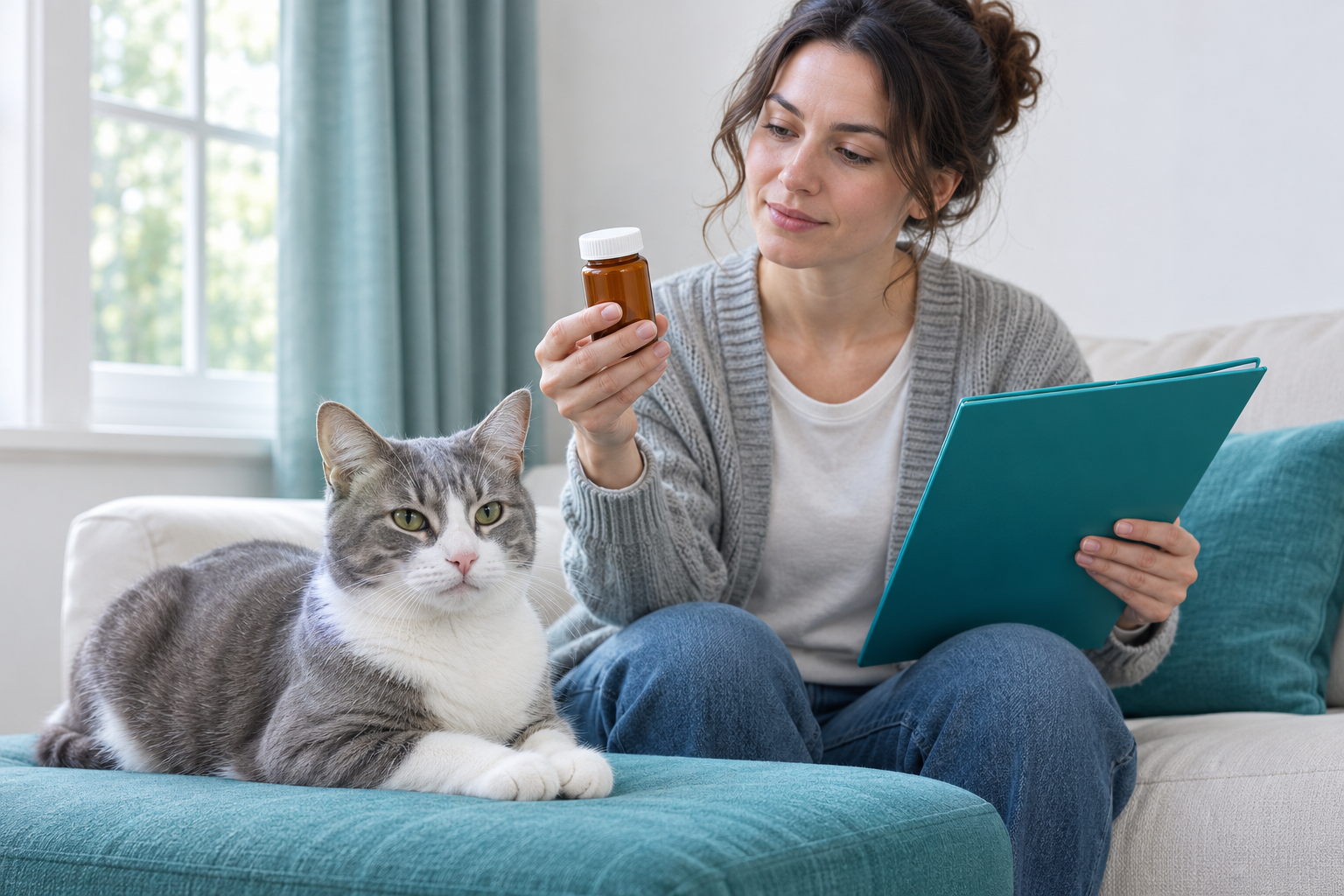
Finish the treatment your veterinarian currently prescribes
Give your cat antibiotics for the duration directed by the prescribing veterinarian, including any later changes. Feeling better is not permission to stop; medicine left in the bottle is not permission to extend treatment. If the instructions are unclear, ask the clinic to confirm the last dose and any separate recheck.
The 2022 AAFP/AAHA stewardship guidelines support reassessing antibiotic treatment as the patient's condition and diagnostic information change. A veterinarian may revise the original plan. There is no universal number of days that fits every cat or infection.
For US cat owners, the useful question is: “What completes this treatment, and what still needs follow-up?” This guide helps organize that conversation; it cannot select your cat's treatment duration.
Separate persistent symptoms from the need for more antibiotics
A cat still sneezing near the end of treatment does not automatically need another bottle. The ISCAID respiratory guideline explains that many acute feline upper respiratory illnesses involve viruses; some also involve bacterial infection. Persistent signs can require further investigation rather than another antibiotic chosen without reassessment.
That does not tell you whether your own cat should stop. Report the current signs and ask the prescriber what they mean for the existing plan.
Make the update specific:
- Which original sign improved, stayed the same, or returned?
- What new change appeared, and when?
- Was each oral dose actually given, or were some attempts uncertain?
- What progress did the clinic ask you to report, and by what date?
“Less sneezing, but eating less since Tuesday” gives the team two observations to assess. “The medicine worked” loses that distinction. Contact the clinic promptly about worsening signs or a possible reaction, and ask what to do about the next dose. Follow any written reaction instructions already provided.
Difficulty breathing, collapse, or unresponsiveness requires immediate emergency veterinary care. Contact an open emergency hospital and arrange transport. For suspected overdose or accidental access to medication, call a veterinarian immediately; do not induce vomiting unless a veterinary professional directs it. Do not delay care to finish a record.
Treat swallowing changes as a separate problem
Cats can retain tablets or capsules in the esophagus, the tube between the mouth and stomach. The ISCAID guideline warns about injury from delayed passage, particularly with certain doxycycline tablets and clindamycin capsules. Ask the clinic to demonstrate the food or liquid follow-up appropriate for the prescribed product. Do not improvise forceful syringe administration.
A published feline case series reported esophageal narrowing after doxycycline treatment, with food coming back up as the main sign. The timing varied. It does not establish how common this complication is, but it is a reason to report new swallowing difficulty or repeated return of food or fluid promptly, even after treatment has ended.
Tell the clinic the antibiotic name, how it was administered, and when the change began. Do not dismiss it as your cat being difficult. If the immediate problem is an uncertain dose, use the cat pill rejection worksheet for the callback.
If your cat received an antibiotic injection
There may be no bottle to finish. First, ask the clinic which drug was injected; “the antibiotic shot” is not a complete medication history.
Cefovecin is one long-acting injectable antibiotic. Wisconsin's public-health antimicrobial safety guidance explains that it cannot be withdrawn after administration if adverse effects develop. Contact your veterinarian about suspected effects. An injection therefore still needs a monitoring and follow-up plan, even when there are no home doses to remember.
Use the branch that matches the treatment record:
| Check before considering treatment complete | Oral antibiotic at home | Antibiotic administered by the clinic |
|---|---|---|
| What was given? | Exact label name, strength, form, and directions | Drug name and administration date from the clinic record |
| What remains to do? | Confirmed remaining doses and last-dose instruction | Monitoring, other prescribed medicines, and any review instruction |
| What needs clarification? | Missed attempts, supply mismatch, or conflicting directions | Whether an old oral prescription still applies and which clinic handles follow-up |
| What should another veterinarian receive? | Label and actual administration history | Injection record, even if there is no take-home medicine |
The table is a records checklist, not a recommendation to replace tablets with an injection or repeat an injection on a set schedule.
Fictional example: Lena's cat receives an antibiotic injection at an urgent-care visit. At a later appointment, Lena says, “No medicines at home,” then realizes that leaves out the injection. She sends the visit record and its administration date. The second veterinarian can now review the treatment history before making a new plan. No treatment outcome is implied by this example.
Resolve leftover or missing supply with the clinic
Do not repeat an uncertain dose, double the next one, or add days to make up for missed attempts without prescription-specific advice. Ask before crushing tablets or changing the preparation. The FDA's medication-error guidance emphasizes clear directions and questions about rejected doses.
If supply is running short before the confirmed endpoint, call before it runs out. If medicine remains afterward, request disposal instructions. Keep it in its original labeled container, securely away from animals and children, until disposal. Do not restart it for a later illness or share it with another cat without veterinary direction.
Send a short treatment review, then record the answer
Keep observations and instructions in separate parts of your note. That makes it easier to see whether the clinic has answered the actual question.
Cat antibiotic treatment review
My observations
- Cat's name:
- Antibiotic name and form, copied from the label or visit record:
- Oral treatment start date or clinic injection date:
- Original reason for treatment, as explained by the clinic:
- Original signs now: improved / unchanged / returned, with details:
- New changes, including eating or swallowing, and when they began:
- Oral doses missed or uncertain, if applicable:
- Current question: endpoint / symptoms / administration / supply / other:
The clinic's answer
- Person contacted and date:
- Exact instruction for the next oral dose, if applicable:
- Confirmed treatment endpoint or next review:
- What to report sooner and after-hours contact:
- What to do with remaining medicine:
- Written instructions saved at:
- Caregiver responsible for the next action:
If an examination is requested, bring this note with the records needed for a vet visit. Leave unknown details marked “clinic to confirm.”
Pet Care Reminder's medication reminders can hold prescribed dose times, course length, and shared medication history. Update them from the clinic's confirmed answer. Record an injection as treatment already received, and keep any follow-up task separate from home-dose reminders.
Sources
- 2022 AAFP/AAHA Antimicrobial Stewardship Guidelines. Formal guideline supporting veterinarian-directed duration, reassessment, and reaction instructions.
- Antimicrobial use Guidelines for Treatment of Respiratory Tract Disease in Dogs and Cats: Antimicrobial Guidelines Working Group of the International Society for Companion Animal Infectious Diseases. Formal 2017 guideline covering feline respiratory illness, treatment review, and tablet or capsule administration. Original journal PDF hosted by AMR Vet Collective.
- Oesophageal strictures in cats associated with doxycycline therapy. Peer-reviewed 2005 case series supporting attention to regurgitation after doxycycline; it does not estimate risk for all cats.
- Treating Your Cat or Dog Using Cefovecin. Wisconsin Department of Health Services drug-specific antimicrobial safety guidance, April 2024, on the long-acting injection and reporting suspected effects.
- Veterinary Medication Errors. US FDA technical safety guidance on administration questions, uncertain doses, storage, and unused medication.
- RECOVER Guidelines: First Aid for Dogs and Cats. Clinical Guidelines. Formal 2026 clinical guideline supporting urgent veterinary care for serious emergencies and professional guidance after suspected overdose.
