
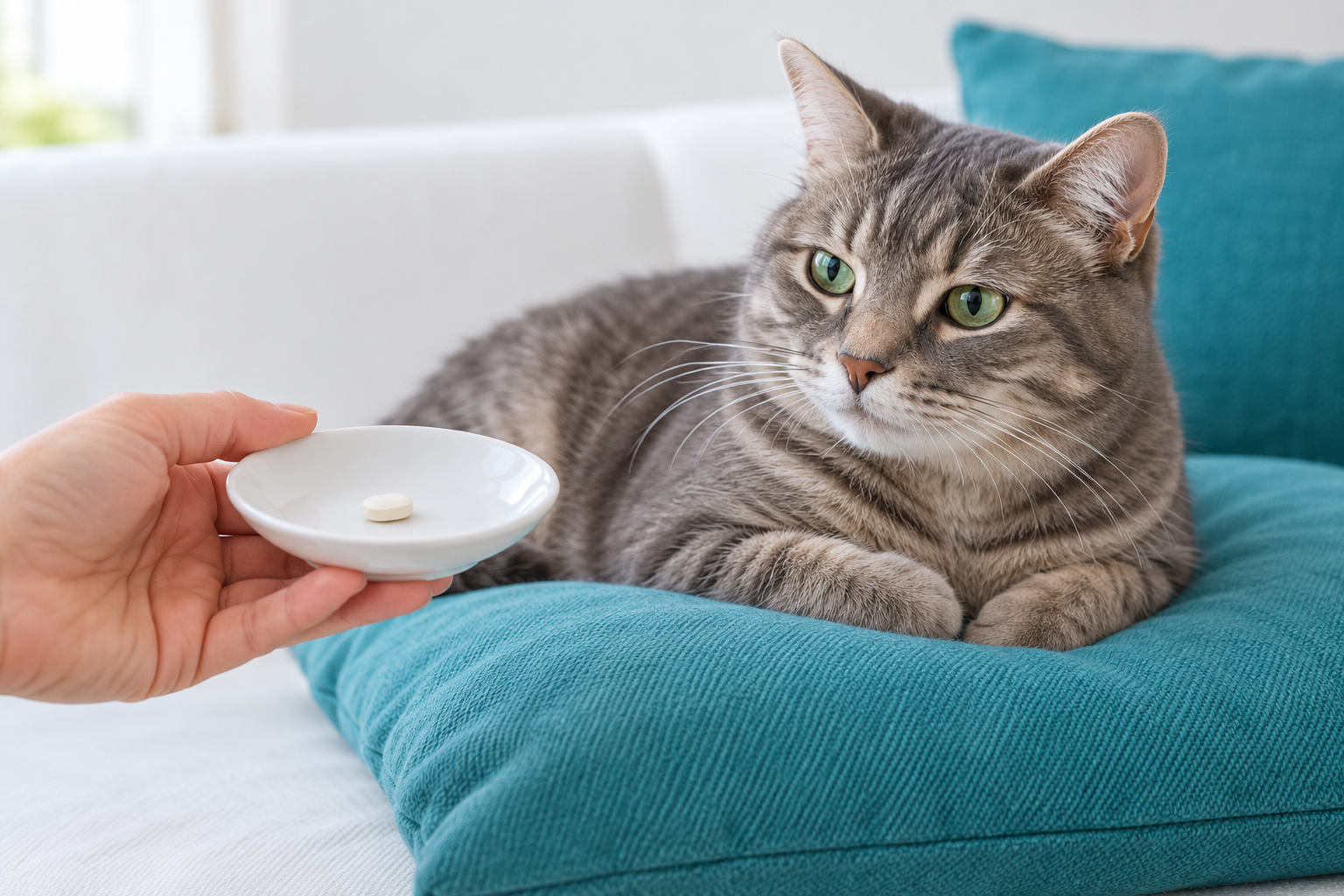
Pause before offering another pill
If your cat spit out a pill, use the prescription's specific instructions for a rejected dose. If those instructions are missing or do not fit what happened, contact the prescribing veterinary team before repeating it. A wet tablet, missing fragment, or unfinished medicated meal cannot tell you how much medicine your cat received.
The US FDA specifically recommends asking your veterinarian what to do when an animal spits out or vomits medication. There is no replacement-dose rule in this article: the clinic needs to decide what happens next for your cat and that product.
Put the medicine and recovered pieces safely out of reach of pets and children. Tell the other caregivers that the outcome is uncertain so nobody makes another attempt independently.
Labored breathing, blue or very pale gums, collapse, or attempts to cough or gag with little sound or squeaky breaths need immediate emergency veterinary help. Call an open emergency hospital for first-aid directions while arranging urgent care. Do not delay for a photo or worksheet, and do not blindly reach into the mouth to find a pill.
A missing pill does not settle the swallowing question
Cats have a particular tablet-administration risk: a tablet or capsule can remain in the esophagus, the tube between the mouth and stomach. The ISCAID respiratory-treatment guideline warns that delayed passage can cause inflammation and scarring that narrows this tube. Doxycycline hyclate tablets and clindamycin hydrochloride capsules are specifically highlighted, although other tablets and capsules can also cause problems.
That is why dry pilling, giving a tablet without an appropriate food or liquid follow-up, deserves a separate conversation with your vet. Ask the team to specify and demonstrate the food or liquid method suitable for this prescription and your cat. Do not improvise a syringe-water technique or force swallowing when your cat is struggling.
If your cat has new difficulty swallowing or keeps bringing food or fluid back up after medication, call the clinic promptly and describe the timing. Do not assume the problem is simply unwillingness to take a pill. The cat vomiting guide can help you describe what you saw, but you do not need to name the cause before calling.
Give the clinic a short account of the attempt
Read the medication name, strength, prescribed amount, and schedule from the original container. Then explain the event in order:
- Before: last confirmed dose, recent food, and whether your cat was already behaving differently.
- During: tablet or capsule, whole or altered, offered in food or directly, and any food or liquid afterward.
- After: what came out, when you found it, and any drooling, gagging, vomiting, or other change.
- Uncertainty: missing pieces, unobserved time, additional attempts, or possible access by another animal.
“I found a softened tablet beside the bowl five minutes later” is more useful than “she got none of it.” Photograph the recovered material if convenient; appearance does not establish a replacement amount.
Call an emergency clinic promptly if an extra dose or another animal's medication may have been swallowed. Do not induce vomiting at home unless a veterinary professional specifically directs it. If the prescribing clinic is closed, use its after-hours service or an open emergency clinic, and say when the next dose is due.
Make the next attempt workable for this cat
A cat pulling away, hiding, hissing, or struggling is giving you information about the method. The AAFP/ISFM interaction guidelines favor cooperative handling and warn that restraint can intensify protective responses. Stop escalating the struggle; ask the team to demonstrate a manageable approach rather than scruffing or holding your cat more tightly.
Describe the exact point where things fail: approaching the cat, touching the face, accepting the food, or swallowing. Ask what to do if that same step fails again.
If food was part of the attempt
Tell the clinic which food you used and how much remains. Ask whether this medicine can go with food, which food is suitable, and how small a separate portion to use. Keep the rest of the meal separate so your record can distinguish ordinary food eaten from the medicated portion.
Do not crush a tablet, open a capsule, or mix a different preparation unless the veterinarian confirms it is appropriate. If permission is given, write it down for this particular product rather than treating it as a rule for every prescription.
If direct administration was the problem
Ask whether a different formulation or route is appropriate and whether an in-person demonstration would help. The interaction guideline discusses changing the route for distressed hospitalized cats; it does not mean every home prescription has an equivalent liquid, injection, or skin treatment. Let the prescriber choose any alternative and provide its new instructions.
For an ongoing prescription change, use the senior cat medication change log to preserve the old direction and the date the replacement begins.
Copy a plan for the callback and next dose
This worksheet keeps your observations separate from the clinic's decisions. Fill the second part only from the veterinary team's response.
Cat pill attempt and next-dose plan
What happened
- Cat's name, age, weight, conditions, and other medicines:
- Product name, strength, form, and prescription directions:
- Last confirmed dose, date and time:
- Attempted dose, date and time:
- Method, including food or liquid before/after:
- Material recovered and time found:
- Behavior, swallowing, breathing, or vomiting changes:
- Other attempts or possible exposure:
- Next scheduled dose and callback contact:
What the clinic instructed
- Person giving advice, date and time:
- Action for this uncertain dose:
- Next dose, exact date and time:
- Approved preparation and food/liquid method:
- Demonstration needed and how to arrange it:
- Point at which to stop an unsuccessful attempt and call:
- Signs requiring urgent care and after-hours contact:
- Caregiver assigned to the next dose:
Illustrative example: At 8:00 a.m., Maya offers her cat a prescribed tablet in an approved food portion. At 8:04, she finds a damp tablet beside the dish. Her note says “tablet recovered; amount received uncertain,” with a photo and the food details. Her partner takes the callback and writes the clinic's instruction in the second half of the worksheet. Neither person converts the tablet's appearance into a dose calculation. This fictional example illustrates recordkeeping, not a treatment decision.
Pet Care Reminder's medication records and reminders can hold the confirmed schedule, while shared notes preserve the failed attempt and clinic response. Record what actually happened before marking a dose given. An overdue reminder is a prompt to check the plan, not an instruction to repeat an uncertain dose.
Sources
- Veterinary Medication Errors. US FDA medication-safety guidance on rejected doses, prescription questions, tablet preparation, labeling, and safe storage.
- Antimicrobial use Guidelines for Treatment of Respiratory Tract Disease in Dogs and Cats: Antimicrobial Guidelines Working Group of the International Society for Companion Animal Infectious Diseases. Formal 2017 guideline; the feline administration section addresses delayed tablet passage, esophageal injury, and accompanying food or liquid. Original journal PDF hosted by AMR Vet Collective.
- 2022 AAFP/ISFM Cat Friendly Veterinary Interaction Guidelines: Approach and Handling Techniques. Formal feline guidelines on cooperative handling, restraint, and individualized administration approaches in clinical care.
- RECOVER Guidelines: First Aid for Dogs and Cats. Clinical Guidelines. Formal 2026 guidelines covering respiratory distress, choking, and first-aid decisions after suspected toxic ingestion.
