
Quick answer
Managing dog and cat medications in the same home starts with a rule that is easy to verify: one identified pet, one labeled product, one current direction, and one recorded outcome at a time.
Use separate closed storage containers for the dog and cat, even if their medicines look different. Keep every product in its original labeled container. Before opening anything, match the pet's name and species, the product and strength, the prescribed amount and route, and the scheduled time. Put the other pet in a separate space until the medicine is given, the container is closed, and the result is recorded.
Never share a prescription, supplement, preventive, measuring device, or medicated treat between a dog and cat unless a veterinarian specifically approves that exact use. A product that is suitable for one species, weight range, or condition may be unsafe or incorrectly dosed for the other.
If the wrong pet may have received a product, or a dose may have been repeated, do not wait for symptoms or try to correct the schedule yourself. Contact a veterinarian, emergency veterinary clinic, or animal poison service promptly with the container in hand.
Why a mixed-pet home needs a species check
It is easy to assume the main risk is confusing two similar bottles. In a dog-and-cat household, the mistake can also happen after the product leaves its container:
- A dog eats food containing the cat's medicine.
- A cat reaches a tablet or flavored chew dropped during the dog's dose.
- One pet licks a fresh topical product from the other.
- A caregiver selects a dog-only parasite product while thinking only about the due date.
- Two products have the same brand name but different species, strength, formulation, or weight range.
- A reminder says "morning medicine" without naming the pet or product.
A 2025 peer-reviewed study found 1,023 medication-error narratives among the veterinary records it manually reviewed. Medication administration was the most frequent error phase, and dosing errors were the largest group within that phase. Errors associated with owners most often involved the wrong dose, frequency, or duration.
The practical response is not a more complicated memory test. It is a routine that requires the caregiver to identify the species and pet before handling the product.
Make one medication map for the household
Start with one current overview that includes every prescription, preventive, supplement, eye or ear product, medicated shampoo, cream, and occasional medicine used for either pet.
Use one row per product:
| Field | What to record |
|---|---|
| Pet | Full name, species, and a clear identifying photo |
| Product | Name, form, and strength or concentration from the label |
| Purpose | Why this pet receives it |
| Amount and route | Exact prescribed amount and how it is given |
| Timing | Clock time or interval, plus food instructions |
| Start and end | Start date, stop date, taper step, or review point |
| Storage | Label or pharmacy requirement |
| Prescriber | Clinic and contact number |
| Next action | Refill request, examination, or monitoring test |
| Problem plan | Who to call after a missed, refused, vomited, wrong-pet, or uncertain dose |
This overview helps a veterinarian see the whole household, but it should not replace a pet-specific instruction page. Give the dog and cat separate records so a caregiver cannot slide across a dense table and read the other animal's direction.
Include non-prescription products. The FDA recommends keeping a complete list that includes prescriptions, over-the-counter products, and supplements. Bring both pets' current lists when a veterinarian needs to assess possible interactions or an accidental exposure.
Separate supplies before you separate schedules
Choose a secure cabinet or other storage area that pets, children, and visitors cannot access. Inside it, create one closed dog container and one closed cat container.
Each container should have:
- The pet's written name, species, and photo
- Only that pet's active products in original labeled containers
- The measuring device supplied for each product
- The current written directions
- The dose record
- Refill, recheck, and monitoring information
- The prescribing clinic's number
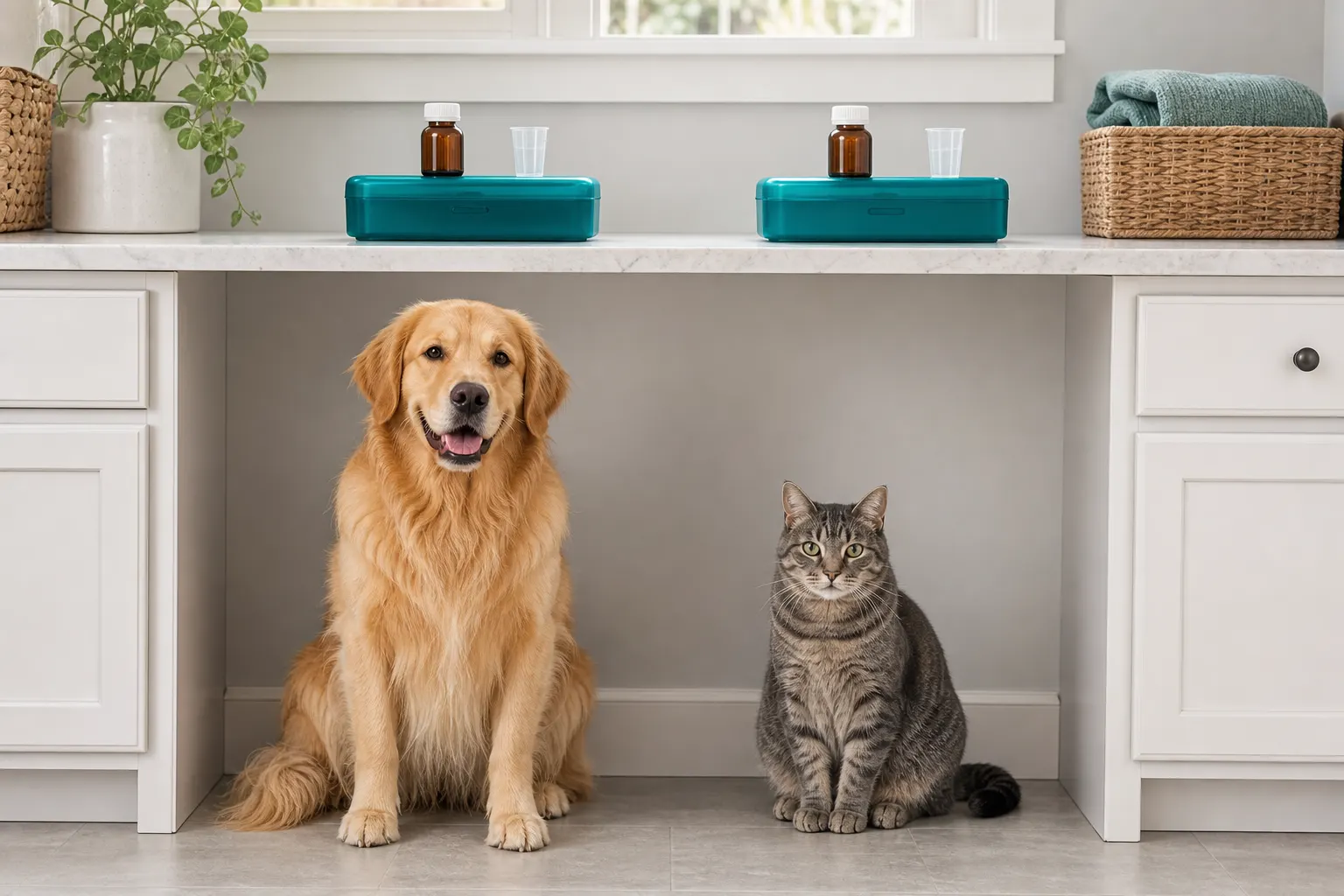
Use both words and a photo as the primary identifiers. Different colors can make the containers faster to find, but color alone does not tell a sitter whether the teal box belongs to the dog or cat.
Do not create a shared pill organizer for both species, move liquids into unmarked bottles, pre-fill several unlabeled syringes, or store loose tablets in a bowl. The FDA advises owners to keep animal medicines in their original labeled containers and not share one animal's drug with another unless a veterinarian says it is appropriate.
Refrigerated or light-sensitive medicine still needs pet-specific separation. Follow the product's storage directions, then place it in a closed, clearly identified container within the correct storage location.
Treat flea and tick products as species-specific
Parasite products deserve an extra check because dog and cat packages can look related while their permitted species and weight ranges differ.
The US Environmental Protection Agency tells owners to use flea and tick products only for the animal species and size or weight stated on the label. It specifically warns not to apply a dog product to a cat, or a cat product to a dog.
Before using any collar, spray, shampoo, powder, or spot-on product, verify:
- The product names the correct species.
- The pet meets the stated age and weight conditions.
- The package and applicator belong together.
- The amount and application directions match the label and veterinary plan.
- Any precautions for sick, older, pregnant, nursing, or medicated animals have been discussed with the veterinarian.
- The pets can be kept apart for any label-directed separation or drying period.
Keep the outer package with individual applicators so the full directions, product details, and incident contact information remain available. Never split a larger dog's product to estimate a smaller amount, and never transfer an applicator into the other pet's storage box.
Use a one-pet preparation zone
Do not line up the dog's and cat's doses together. Prepare and finish one pet's task before taking out the next product.
Use the same sequence every time:
- Check the shared record to confirm that the dose is still due.
- Name the pet and species before opening the storage area.
- Move the other pet behind a closed door or secure barrier.
- Take out only the intended pet's container and one product.
- Read the pet name, product, strength, amount, route, and timing from the current direction.
- Measure with the device supplied for that product.
- Give the medicine exactly as the veterinary team directed.
- Observe whether the dose was fully given, refused, spat out, vomited, spilled, or remains uncertain.
- Close and store the product, clear the area, and record the actual outcome immediately.
- Only then begin the other pet's task.
This sequence prevents an interruption from leaving two tablets or syringes with no reliable patient identity.
The dog and cat may need different administration settings. A dog might take a tablet in the kitchen while the cat needs a quiet closed room. Keep the identity checks the same even when the handling method changes.
For more species-specific routines, see How to Track Care for Multiple Dogs Without Mixing Up Doses and How to Track Care for Multiple Cats Without Mixing Up Doses.
Control medicated food, treats, and topicals
Food can hide both the medicine and the outcome. If the veterinary team approves giving a product with food, use a separate room and watch the intended pet consume the veterinarian-approved portion. Remove leftovers before the other pet enters.
Do not:
- Leave a medicated bowl unattended
- Put both pets' medicated treats on the same surface
- Hide medicine in a full meal without asking whether that method is appropriate
- Assume an empty bowl proves the intended pet ate it
- Leave a refused tablet where the other pet can find it
Record what you actually observed. If the cat ate only part of a medicated portion, or the dog reached it first, the dose is uncertain. Do not give another dose until the prescribing clinic advises what to do.
For a topical product, follow the label and veterinary directions about application, drying, touching, grooming, and separation. Keep the pets apart so the housemate cannot lick the application site or rub against wet product. If unintended contact occurs, use the label's exposure instructions and call for veterinary advice.
Give every dose one responsible caregiver
Shared responsibility often becomes unclear responsibility. Assign one person to each dose window and show the assignment in the same record everyone uses.
| Date | Pet | Product | Scheduled time | Actual time | Outcome | Given by |
|---|---|---|---|---|---|---|
| Aug. 24 | Dog's name | Name and strength | 8:00 a.m. | 8:05 a.m. | Given as directed | Initials |
| Aug. 24 | Cat's name | Name and strength | 8:15 a.m. | 8:22 a.m. | Refused | Initials |
Follow these rules:
- Never mark a dose complete before giving it.
- A dismissed alert or message saying "I'll do it" is not proof of administration.
- Record the actual time and outcome, not only a checkmark.
- Make partial, refused, vomited, spilled, and uncertain outcomes visible.
- Transfer responsibility directly when the assigned person cannot do the task.
Pet Care Reminder can hold separate tasks that begin with the pet's name, such as "Milo dog: morning tablet" and "Luna cat: evening liquid." Use the reminder to prompt the action and the completion history to support the handoff. The prescription label and current veterinary direction remain the source of truth.
6 Mistakes Pet Owners Make With Medication Schedules explains why recording an outcome is safer than recording an intention.
Reset the system after every veterinary change
New prescriptions and changed directions create a period when old and new plans may both be visible. A refill can also change the product's strength, concentration, appearance, or measuring device.
On the day anything changes:
- Ask which old direction the new instruction replaces.
- Confirm when the new plan begins and what happens to the next dose.
- Update the pet-specific record and household overview.
- Update, pause, or remove the old reminder.
- Move stopped or superseded products out of active storage.
- Ask the clinic or pharmacy how to dispose of unneeded medicine.
- Tell every caregiver what changed before the next dose window.
If the label, discharge sheet, portal, and spoken instruction disagree, pause and ask the prescribing clinic to reconcile them. Do not choose the version that seems most convenient.
Bring both pets' medication lists to a shared clinic, but keep each pet's symptoms, test results, and treatment plan separate. How to Prepare for Your Pet's Vet Visit can help you turn the records into a concise appointment handoff.
Connect each product to its refill and monitoring plan
A safe household can still miss treatment when a bottle runs out or a required recheck slips.
For each product, track three different dates when they apply:
- Refill request date: When to contact the clinic or pharmacy, allowing its stated processing time
- Supply end date: When the current quantity should run out at the prescribed schedule
- Review date: The examination, weight check, laboratory test, or other monitoring the veterinary team requires
Do not borrow from the other pet's supply, alter the amount to make it last, or continue stopped medicine because some remains. If the dog and cat see different clinics or specialists, give each team a current list for both pets when a potential exposure or interaction is relevant.
What to do after a wrong-pet or uncertain dose
Treat uncertainty as information to report, not a gap to fill with another dose.
Call the prescribing veterinarian, an emergency veterinary clinic, or an animal poison service promptly if:
- The dog may have received the cat's medicine, or the cat may have received the dog's
- A product was given to the wrong species or weight range
- The wrong product, strength, amount, route, or measuring device was used
- A dose may have been repeated
- One pet ate the other's medicated food or reached a dropped product
- A pet reached a human medicine
Have these details ready:
- The exposed pet's name, species, weight, and current condition
- Every relevant container and outer package
- The product name, strength, and formulation
- The prescribed amount and possible amount received
- The time and route of the exposure
- The pet's other medicines and supplements
- Any symptoms already present
Do not induce vomiting, give a home remedy, or administer another dose unless a veterinary professional specifically directs you to do so.
Difficulty breathing, collapse, unresponsiveness, a seizure, severe weakness, facial swelling with breathing trouble, or very pale, blue, or gray gums requires immediate emergency veterinary care. Call ahead when possible, but do not delay transport while waiting for a routine reply.
For a missed, refused, spat-out, vomited, or uncertain dose without a known wrong-pet exposure, contact the prescribing clinic for product-specific advice. Do not automatically repeat it or double the next dose.
Make sitter and family handoffs species-specific
Give a temporary caregiver one page for the dog and one for the cat. Walk through the system with every medicine container still closed.
Ask the caregiver to show you how they will:
- Identify the dog and cat.
- Find the correct pet-specific storage container.
- Match the label to the current direction.
- Separate the other pet during administration.
- Record a successful, refused, partial, vomited, or uncertain outcome.
- Reach the regular clinic, emergency clinic, and backup contact.
Provide the last confirmed dose and next due time for each pet at the handoff. If the caregiver cannot safely administer one treatment, arrange veterinary help or another care plan instead of simplifying the prescription or preparing unlabeled doses.
Run a 15-minute mixed-pet safety check
Once a week, inspect the system while all products remain closed:
- Every active product is in the correct dog or cat container.
- The original label is readable and matches the active record.
- No product has moved to the other species' storage area.
- Measuring devices remain with their original products.
- Stopped instructions and medicines are no longer active.
- Dose records show actual outcomes and caregiver names.
- Refills, tests, and rechecks are scheduled before supplies run out.
- Parasite products still match the pet's species and weight range.
- Veterinary and emergency contacts are current.
Repeat the check immediately after a refill, hospital discharge, new diagnosis, dose change, or caregiver handoff.
The simple rule
Keep the dog and cat separate in the storage system, the preparation area, and the dose record. Handle only one pet's product at a time, verify the species before opening it, and record what actually happened before moving to the next task.
If the pet, species, product, direction, or outcome does not match, stop. The safest next step comes from the prescribing veterinary team, not from the other pet's schedule.
Sources
- Veterinary Medication Errors. Official FDA safety guidance on original labeled containers, complete medication lists, product sharing, storage, label checks, missed or excessive doses, and accidental exposure prevention.
- Controlling Fleas and Ticks on Your Pet. Official EPA technical guidance on following pesticide labels, matching flea and tick products to species and weight, retaining packaging, and responding to adverse reactions.
- First opinion practice electronic health records are a useful source of descriptions of medication errors. Peer-reviewed study of medication errors documented in UK first-opinion veterinary records, including administration-stage, dose, frequency, duration, and owner-associated errors.