
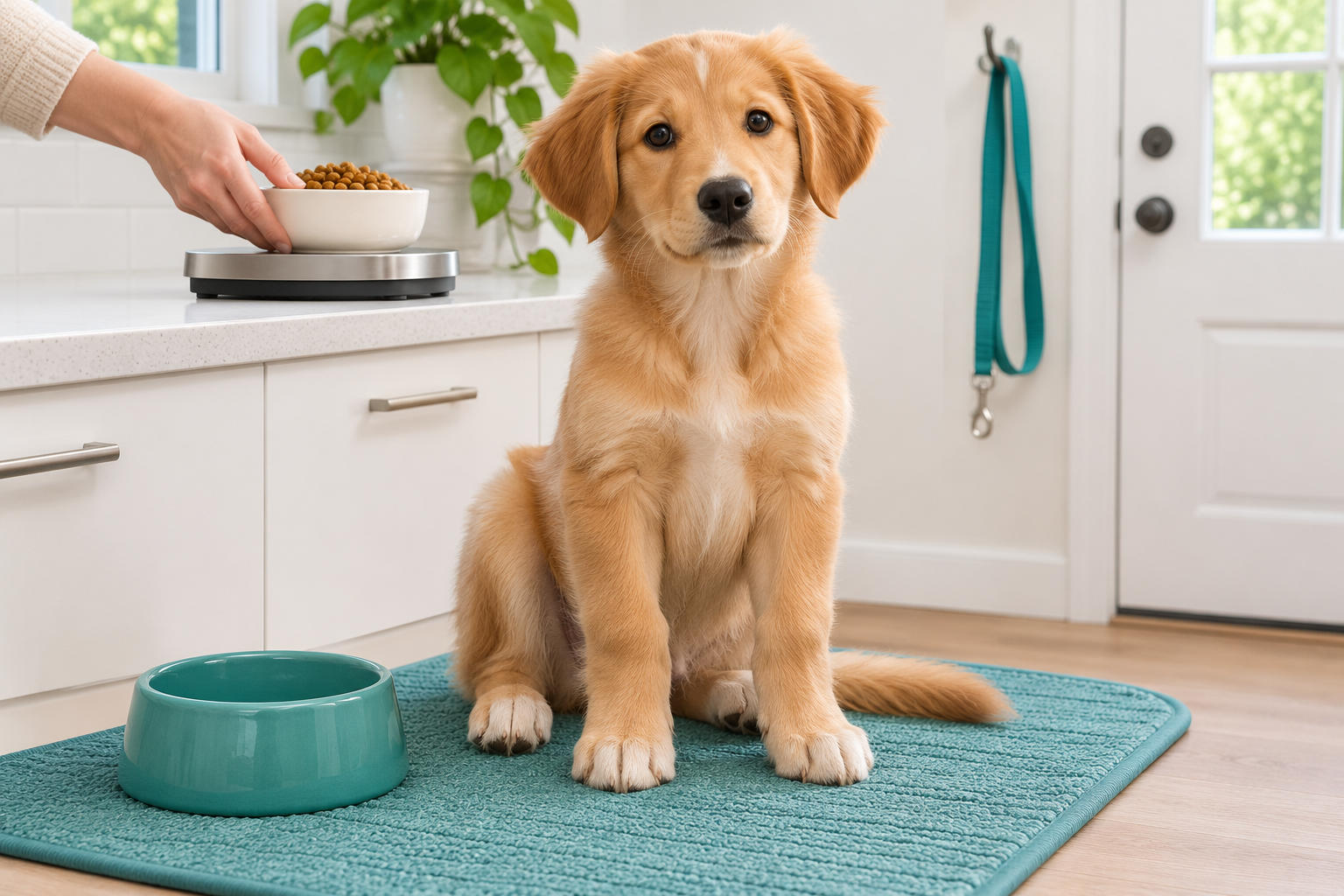
Keep one daily record and a separate weight history
A useful puppy care log records what happened: food actually eaten, pee or poop actually observed, and dated weights with units. Keep your veterinarian's feeding plan above the daily entries so everyone can compare the plan with the result.
Use a short event log for meals and potty trips, plus a separate list of weigh-ins. You should be able to answer “What changed?” without reading a week of messages.
This guide is for weaned puppies eating independently. Newborn, orphaned, or unwell puppies need an individual veterinary feeding and monitoring plan. The record below organizes observations; it does not diagnose a problem or calculate a diet.
Write down the current plan once
Ask your veterinary team to confirm the food, daily amount, meal frequency, allowance for treats, and next nutrition review. AAHA's nutrition guideline recommends an individual feeding plan and a diet appropriate for growth.
At the top of the record, put:
- The puppy's name and birth date, marked estimated if uncertain
- The exact food formula and the date the feeding plan was agreed
- The daily amount and how it is divided, using the clinic's units
- Any food reserved for training and any separate treats
- The agreed weigh-in method, frequency, and next review date
- Who handles each meal, potty outing, and handoff
Keep older versions when the clinic changes the plan. Otherwise, a smaller meal from last month can look like a new loss of appetite when someone reviews the history.
Make weigh-ins comparable
Record date, age in weeks, weight, units, and scale or location. Use the same suitable scale and similar conditions when practical. Note a change of scale, a moving puppy, or an uncertain reading instead of silently treating every number as equally reliable. Ask the clinic to demonstrate a safe method; use clinic weigh-ins if home weighing is difficult.
Ask whether a growth chart fits your puppy. The 2017 study by Salt and colleagues developed charts from healthy dogs' veterinary records, accounting for sex and size. Its size-category charts cover ages twelve weeks to two years and adult weights up to forty kilograms. They are not a universal chart for younger puppies or giant breeds.
A chart helps the veterinary team assess a trajectory. Do not try to feed your puppy toward its middle line or match a littermate's weight. Ask the team to interpret a change in trend.
Body weight and body condition are different. Have the veterinary team show you how to assess body condition and check your interpretation. Do not change portions solely because one weigh-in surprised you.
Count food eaten, including training food
Give each meal a time and observer. Record the amount offered, leftovers, spills, and anything another pet may have eaten. For dry food, a gram-based record can make the arithmetic straightforward; keep wet food and different products separate.
If training kibble comes from the daily ration, write where it was allocated. Do not count it once as part of a full meal and again as extra food. Record separate treats by product and amount rather than merging different foods into one gram total.
Illustrative example, not a feeding recommendation: One meal allocation contains 75 grams of a particular kibble. A caregiver sets aside 10 grams for training and puts 65 grams in the bowl. The puppy leaves 5 grams and eats all 10 training grams. The record is:
| Where the kibble went | Amount |
|---|---|
| Eaten from the bowl | 60 g |
| Eaten during training | 10 g |
| Left in the bowl | 5 g |
| Total eaten from this allocation | 70 g |
If some kibble spilled and nobody measured it, label the eaten amount uncertain. An empty bowl alone cannot tell you whether the puppy ate everything.
Record the result of each potty opportunity
Young dogs need frequent access to a suitable toilet area. Agree on a routine with your veterinary team or qualified reward-based trainer, then record the actual outings. Keep fresh water available; do not restrict drinking to improve the accident count.
Use one short entry: time, context, pee seen, poop seen, and observer. Context might be waking from a nap, a meal, or play. “Outside after breakfast, pee seen, no poop seen” gives the next caregiver more information than “potty done.”
Distinguish “not watched” from “watched an attempt but nothing came out.” If you discover an indoor accident later, record the discovery time without inventing when it happened. Reward appropriate toileting and avoid punishment.
These welfare principles are consistent with England's government dog-care code; its legal provisions are not US requirements. For a new symptom rather than routine tracking, see how to describe changes in your dog's pee or poop.
Copy this puppy care record
Use a new daily entry beneath the current plan. Add weights only on the agreed schedule, rather than making every meal a weigh-in.
Puppy weight, meal, and potty record
- Puppy, date, and current plan version:
- Weight entry, if due: age in weeks; weight and units; scale/location; measurement uncertainty
- Meal entry: time; food; amount offered; amount left or spilled; estimated amount eaten; observer
- Training food and extras: product; amount eaten; taken from ration or additional
- Potty entry: time; context; urine observed; stool observed and description; observer
- Accident discovered: time found; what was seen; what remains unknown
- Other changes: appetite, drinking, energy, comfort, or behavior
- Handoff: last confirmed meal and potty result; next task; person responsible
- Vet contact or review: question; advice received; next action and date
At handoff, resolve one practical question: Does the next person know what still needs doing? A reminder marked complete should not erase leftovers, an unwitnessed outing, or a question awaiting the clinic's reply.
Before the next puppy checkup, share a short summary: the dated weight series, the current food plan, any change in actual intake, and the potty pattern or uncertainty you want reviewed. Keep the raw entries available if the team asks.
Pet Care Reminder's vet visit reminders can help you remember that review and keep visit notes and records together. A paper log works too; choose one place every caregiver will actually check.
Call about changes instead of waiting to finish the log
Contact your veterinarian promptly about reduced or refused food, unexplained weight loss, vomiting, diarrhea, changed drinking, or reduced energy. Tell the clinic your puppy's age, what changed, and when. Do not wait until the scheduled weigh-in or until you have several complete days of entries.
Repeated attempts to pee with little or no urine need emergency veterinary attention. The ACVIM consensus identifies urinary obstruction as an emergency; a home log cannot rule it out.
Seek immediate veterinary help for difficulty breathing, severe bleeding, or suspected poisoning. RECOVER's first-aid guideline supports urgent professional care in these situations. Gathering measurements or finishing a template must not delay getting help.
Sources
- 2021 AAHA Nutrition and Weight Management Guidelines for Dogs and Cats. Formal clinical guideline supporting individual feeding plans, growth nutrition, body-condition assessment, and review of unexplained weight changes.
- Growth standard charts for monitoring bodyweight in dogs of different sizes. Peer-reviewed 2017 study supporting size- and sex-specific growth monitoring, with the age and size limits described above. Its 2024 correction concerns data availability.
- Code of practice for the welfare of dogs. Government technical guidance for England, updated in 2018, supporting toilet access, fresh water, reward-based training, and veterinary contact for health changes; cited for husbandry, not US law.
- ACVIM consensus statement on diagnosis and management of urinary incontinence in dogs. Original 2024 clinical consensus statement, hosted by EBVM in Practice, identifying urinary outflow obstruction as an emergency.
- RECOVER Guidelines: First Aid for Dogs and Cats. Clinical Guidelines. Formal 2026 guideline supporting emergency care for breathing difficulty, severe bleeding, and suspected poisoning.
