When Should a Cat See the Vet for Vomiting?
Quick answer
A cat should see a veterinarian promptly when vomiting happens more than once, stops food or water staying down, or appears with another change such as hiding, weakness, reduced appetite, diarrhea, weight loss, abdominal discomfort, or unusual drinking or urination.
Contact an emergency veterinary clinic immediately if your cat:
- Collapses, becomes unresponsive, has a seizure, struggles to breathe, or has very pale, blue, or grey gums
- Is severely weak, cannot stand normally, seems disoriented, or shows intense pain
- Has a swollen or painful abdomen, or repeatedly retches without producing normal stomach contents
- May have swallowed string, yarn, ribbon, thread, a hair tie, a toy, medication, a toxic plant, a chemical, or another dangerous item
- Vomits a large amount of blood, repeatedly vomits blood, or has blood in the vomit while weak or pale
- Cannot keep water down or is rapidly becoming less responsive
One isolated episode may be suitable for close observation when an otherwise healthy adult cat is alert, comfortable, breathing normally, behaving normally, and able to keep water down, with no possible toxin, medication, plant, string, or foreign-object exposure.
Do not wait for a universal number of hours. A kitten, senior cat, diabetic cat, cat with kidney disease, or cat taking essential medication may need help after a change that would be lower risk in a healthy adult. When the pattern is uncertain, call your veterinary clinic and let the team triage it.
Choose between emergency care, a prompt call, and close monitoring
The number of episodes matters, but the whole cat matters more. Use this first-pass guide while you contact a veterinary professional:
| Level | What you may notice | What to do |
|---|---|---|
| Emergency now | Collapse, breathing difficulty, seizure, severe weakness or pain, abnormal gum color, a swollen abdomen, repeated empty retching, major blood loss, or a possible toxin or swallowed object | Call the nearest emergency veterinary clinic and leave as directed |
| Prompt veterinary advice | More than one vomiting episode, water not staying down, reduced appetite, hiding, lethargy, diarrhea, weight loss, drinking or urination changes, medication concerns, or a higher-risk cat | Call your regular vet, urgent clinic, or emergency service now and describe the full pattern |
| Close observation may be reasonable | One episode in an otherwise healthy adult cat who is bright, comfortable, and keeping water down, with no other change or exposure risk | Record what happened, watch closely, and call if vomiting repeats or anything else changes |
If your regular practice is closed, check its recorded message or website for the designated out-of-hours service. Calling first helps the team choose the right destination, but do not delay when the clinic tells you to travel immediately.
Treat a possible toxin or swallowed object as urgent
Cats can reach risks that are easy to miss, including lilies, human medication, another pet's treatment, cleaners, string, ribbon, thread, elastic bands, small toy pieces, and food packaging.
Call a veterinarian, emergency hospital, or veterinary poison service immediately if an exposure is possible. A cat can look normal before the full effect of a toxin or obstruction is visible. The FDA advises contacting a veterinarian or pet poison control service right away after a pet may have eaten something dangerous.
While you call:
- Move the cat and other pets away from the remaining material.
- Find the package, label, plant, medication container, or a clear photograph.
- Estimate the earliest and latest exposure time and the maximum amount that could be missing.
- Have your cat's current weight, age, conditions, medication list, and symptoms ready.
- Follow the professional's transport and first-aid instructions.
Do not induce vomiting, give hydrogen peroxide, offer a home antidote, or administer medication unless the veterinary professional handling the case directs you to. Do not pull visible string from the mouth or rectum. String can extend through the digestive tract, and pulling may cause injury. A peer-reviewed review of 64 feline thread and sewing-needle cases found that persistent vomiting, reduced or absent appetite, and depression were the most common signs, and some cats had bowel lacerations.
If part of an object appears in the vomit, do not assume the whole item came out. Save a photograph and the remaining matching material, then tell the clinic exactly what you found.
Call promptly when vomiting comes with a second change
Cats often show illness through small changes in routine rather than a dramatic display. Vomiting becomes more concerning when it is paired with any of the following:
- Less interest in food, treats, play, grooming, or social contact
- Hiding, unusual quietness, restlessness, irritability, or a different sleeping place
- Weakness, wobbliness, reluctance to jump, or difficulty standing
- Diarrhea, constipation, black stool, blood in the stool, or repeated litter-box visits
- Drinking much more or less than usual
- Urinating much more or less than usual
- Repeated litter-box visits or a clear increase or decrease in urination
- Weight loss or a visibly changing body condition
- Drooling, repeated lip licking, turning away from food, or trying to bury food
- Abdominal guarding, a tense posture, or resistance to being picked up
- Coughing, rapid breathing, open-mouth breathing, or breathing effort
- Vomiting soon after medication or uncertainty about whether a dose stayed down
Cornell's feline vomiting guidance recommends prompt veterinary evaluation when vomiting occurs with lethargy, weakness, decreased appetite, blood, drinking or urination changes, or diarrhea. You do not need to identify the cause before calling. The combination of signs is the useful information.
Call earlier for kittens, seniors, and cats with medical conditions
Some cats have less reserve or a treatment plan that makes even one episode more important.
Ask for veterinary advice early if your cat is:
- A young kitten
- A senior cat
- Pregnant or nursing
- Diabetic or receiving insulin
- Living with kidney, liver, heart, thyroid, pancreatic, or gastrointestinal disease
- Receiving chemotherapy, immune-suppressing treatment, or another medicine that needs close monitoring
- Recovering from surgery, anesthesia, hospitalization, or a recent procedure
- Underweight, recently losing weight, or already eating less than normal
- Following a veterinary plan that says to call after any vomiting episode
The individual plan always takes priority. If the clinic has already given a threshold for your cat, use it instead of a general online rule.
A hairball is still a vomiting event
Finding a cylinder of hair may explain what came up, but it does not automatically prove that the pattern is harmless.
Record hairball episodes just as you would other vomiting. Call your veterinarian when they become frequent, increase from your cat's usual pattern, or occur with weight loss, appetite changes, skin irritation, overgrooming, constipation, diarrhea, pain, or reduced energy.
A peer-reviewed feline review notes that frequent hairball elimination, particularly in shorthaired cats, can be associated with excessive fur ingestion, skin disease, or altered gastrointestinal movement. Evidence about normal frequency and common home remedies is limited. That is a good reason to report the pattern rather than repeatedly testing unverified treatments.
Do not wait until the next annual visit if the episodes are becoming more common. A calendar showing dates and accompanying changes helps the veterinarian distinguish an isolated event from a recurring problem.
Check whether it was vomiting, regurgitation, coughing, or gagging
The distinction can help the clinic, but it should not delay an urgent call.
Vomiting is active. A cat may lick their lips, drool, crouch, retch, and use obvious abdominal contractions before food, liquid, foam, bile, or hair appears.
Regurgitation is usually more passive. Food or fluid may come up suddenly with little warning and less abdominal effort. The material may look undigested or tube-shaped.
Coughing or gagging may look like an attempt to bring up a hairball, but nothing appears. The cat may stretch the neck, crouch, wheeze, or breathe differently afterward.
Take a short video if another episode begins and recording is safe. Repeated regurgitation, coughing, gagging, or empty retching also needs veterinary attention. Open-mouth breathing or obvious breathing effort in a cat is an emergency.
Make a five-minute observation record
Before calling, collect facts without forcing your cat to move, pressing on the abdomen, or opening the mouth.
Write down:
- Timing: When did the first and most recent episodes occur?
- Count: How many definite episodes did you see, and could there have been others?
- Appearance: Was there food, clear liquid, yellow fluid, foam, hair, foreign material, red blood, or dark granular material?
- Effort: Did you see abdominal contractions, retching, coughing, or a passive return of food?
- Water: Has your cat drunk, and did the water stay down?
- Food: What and how much was eaten before and after the episode?
- Behavior: Is your cat alert and responsive, or hiding, weak, restless, painful, or unusually quiet?
- Litter box: Has your cat urinated and passed stool normally?
- Exposure: Could the cat have reached plants, string, toys, human food, rubbish, medication, chemicals, or another pet's food or treatment?
- Medical context: Which conditions, medicines, recent procedures, diet changes, and previous vomiting patterns matter?
Photograph the material before cleaning if that can be done safely. Wear gloves when a chemical, medication, plant, or infectious material may be involved, and keep other pets away.
Give the clinic a concise first sentence
Lead with the facts that affect urgency:
"My cat has vomited three times in two hours, cannot keep water down, and is hiding instead of coming for food. She is eight years old, has kidney disease, and may have chewed a piece of ribbon."
Then provide:
- Age, weight, sex, and relevant conditions
- Number and timing of episodes
- Current alertness, breathing, gum color, posture, and comfort
- Whether food and water stay down
- Vomit appearance and any diarrhea
- Urination and litter-box changes
- Possible toxin, plant, string, object, unusual food, or medication exposure
- Current medication and the time of the last confirmed dose
- Your location and travel time to the clinic
Ask one clear question: "Should we come to you, travel to emergency, or monitor with specific instructions?"
If your cat changes while you wait, call back. Advice based on one bright, comfortable cat can change when that cat vomits again, hides, becomes weak, or develops breathing or litter-box changes.
Do not improvise treatment at home
Vomiting has many causes, and the same home action is not safe for every cause or every cat.
Unless a veterinarian familiar with the situation instructs you, do not:
- Give human nausea, pain, stomach, or diarrhea medication
- Give another pet's prescription or leftover veterinary medicine
- Induce vomiting or give hydrogen peroxide, salt, oil, milk, or activated charcoal
- Force food or large amounts of water
- Automatically withhold all food or water for a fixed period
- Repeat a medicine because the first dose may have been vomited
- Change insulin or another essential medicine without veterinary direction
- Pull string, ribbon, thread, or yarn from the mouth or rectum
- Assume yellow fluid proves an empty stomach or a hairball proves the problem is harmless
The AVMA's first-aid guidance says not to induce vomiting or give medication after a suspected poisoning unless directed by a veterinarian or poison control center. Cats also have species-specific medication risks. A product that is familiar or safe for a person or dog may be dangerous to a cat.
If vomiting happens after medication, record the product, strength, prescribed amount, dose time, vomiting time, and whether any tablet or liquid was visible. The correct next dose depends on the specific medicine and the circumstances. Guessing can cause a missed dose or an overdose.
How to Track Care for Multiple Cats Without Mixing Up Doses can help households preserve the last confirmed medication outcome, but the prescribing clinic must decide what to do next.
Ask for a specific food and water plan
Repeated vomiting can contribute to fluid loss, but forcing a large drink may trigger another episode. A universal fasting rule can also be inappropriate for a kitten, diabetic cat, underweight cat, or cat with another medical condition.
Ask the veterinary team:
- Whether water should be offered now
- What amount and frequency to use
- Whether food should be offered or paused
- Which food, portion, and timing are appropriate
- What to do with scheduled medication
- Which change means an immediate recheck
The 2024 AAHA fluid therapy guideline emphasizes choosing the route and amount of fluid support from the individual patient's deficit, ongoing losses, clinical status, and ability to take fluids safely. Fluid treatment is a veterinary prescription, not a fixed home formula.
What the veterinary visit may involve
The veterinarian will combine the history with a physical examination and decide which tests or treatments are appropriate. Depending on the cat and the pattern, the visit may include:
- Hydration, circulation, temperature, weight, and pain assessment
- Mouth and abdominal examination
- Blood, urine, or fecal testing
- X-rays or ultrasound when an obstruction, mass, or other internal problem is possible
- Anti-nausea treatment, fluid therapy, pain relief, or nutritional support
- Observation, endoscopy, surgery, or referral when the findings require it
Not every cat needs every test. A clear timeline helps the veterinarian choose the first steps and avoid relying on a vague summary such as "she has been sick a few times."
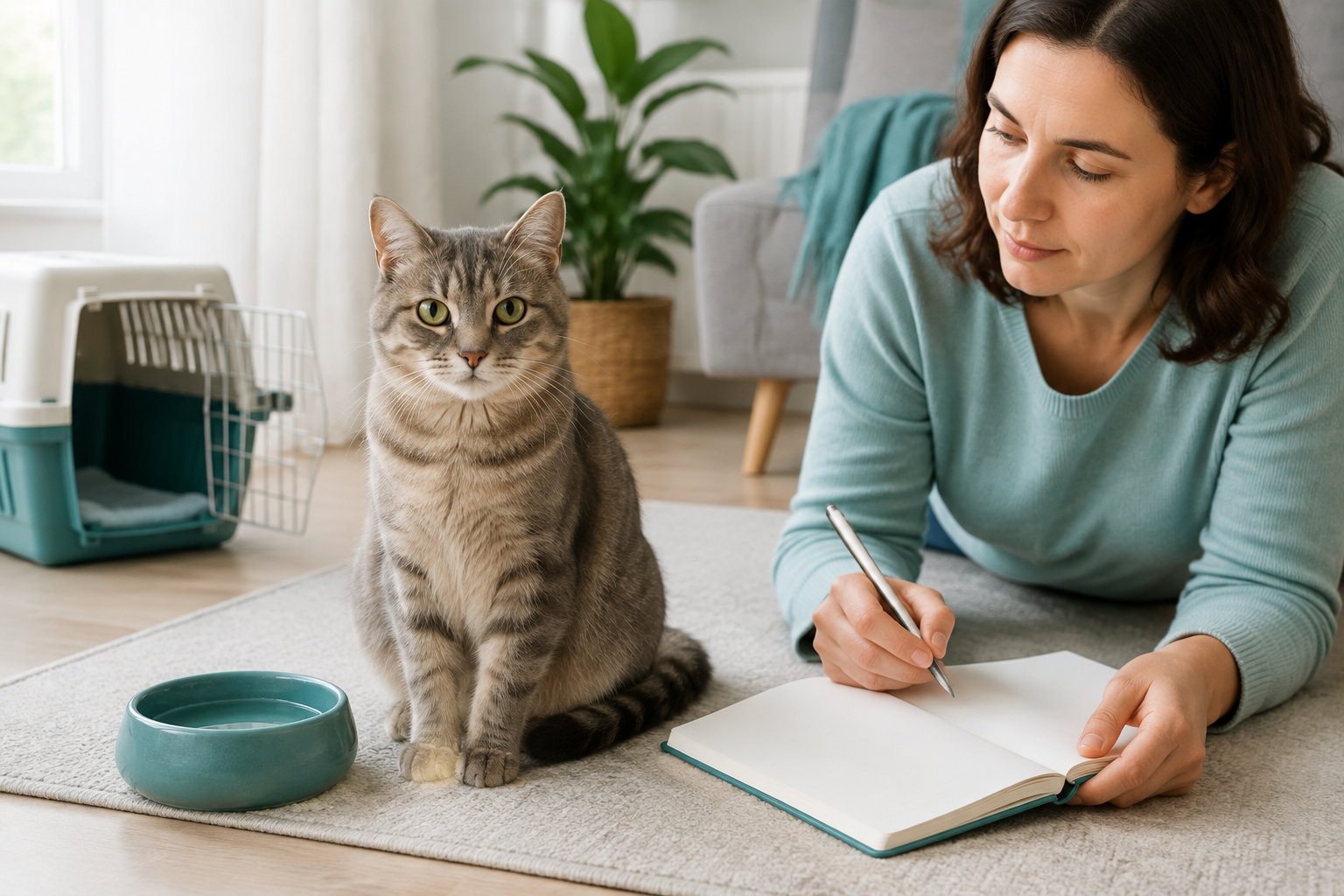
Bring the carrier, photographs or video, current medication containers or label photos, possible product packaging, and relevant records. How to Prepare for Your Pet's Vet Visit can help you organize the history without delaying urgent travel.
For future emergencies, What to Keep in a Cat First Aid Kit explains how to keep a carrier, contacts, records, and simple transport supplies ready.
Track only after the clinic says home monitoring is appropriate
If the veterinary team advises observation at home, write down the exact plan and the point at which monitoring should stop.
Track:
- Every vomiting, regurgitation, coughing, or retching episode
- Food and water offered, plus what stayed down
- Appetite, energy, grooming, hiding, movement, and comfort
- Urination and stool
- Medication instructions and actual outcomes
- The clinic's recheck time and escalation threshold
Pet Care Reminder can hold the observation checks, follow-up call, medication instruction, and recheck appointment once the veterinary team has set the plan. Use it to record what happened and prompt the next agreed action. Do not use a reminder schedule to decide whether vomiting is safe.
Make the handoff explicit when more than one person cares for the cat. Everyone should know the last confirmed episode, what was offered, what the clinic said, and which change means call or travel.
The practical rule
One vomiting episode in a bright, comfortable, otherwise healthy adult cat may be monitored closely when there is no exposure risk and water stays down. Vomiting that repeats, interrupts eating or drinking, or appears with hiding, weakness, diarrhea, weight loss, pain, or litter-box changes needs prompt veterinary advice.
Collapse, breathing difficulty, seizure, severe weakness, major blood loss, a swollen painful abdomen, repeated empty retching, or a possible toxin, string, medication, plant, or foreign object is not a watch-and-wait situation. Contact an emergency veterinary service immediately.
When you are unsure, call. A veterinary team can decide that the situation is lower risk after hearing the full history. Waiting at home cannot provide that assessment.
Sources
- Vomiting. Cornell University College of Veterinary Medicine guidance on prompt evaluation, accompanying signs, common causes, diagnostic history, imaging, and supportive care for vomiting cats.
- Hair Balls in Cats: A normal nuisance or a sign that something is wrong?. Peer-reviewed feline review on the limited evidence around normal hairball frequency and the relationship between frequent hairballs, excess fur ingestion, skin disease, and gastrointestinal problems.
- 2024 AAHA Fluid Therapy Guidelines for Dogs and Cats. Formal veterinary guideline on assessing fluid deficits and ongoing losses, selecting an administration route, individualizing fluid treatment, and reassessing the patient.
- Potentially Dangerous Items for Your Pet. Current FDA safety guidance on dangerous foods, medicines, household items, plants, obstruction risks, and calling a veterinarian or pet poison control center promptly.
- Pet First Aid. The American Veterinary Medical Association's 2025 first-aid statement on urgent veterinary contact, poisoning response, transport, and avoiding owner-directed vomiting or medication.
- Thread and sewing needles as gastrointestinal foreign bodies in the cat: a review of 64 cases. Peer-reviewed case review describing persistent vomiting, partial or complete loss of appetite, depression, bowel lacerations, and outcomes in cats with linear foreign bodies.