
Quick answer
Before the first icy walk, build a simple paw routine:
- Check every pad, nail, and space between the toes while the paws are dry.
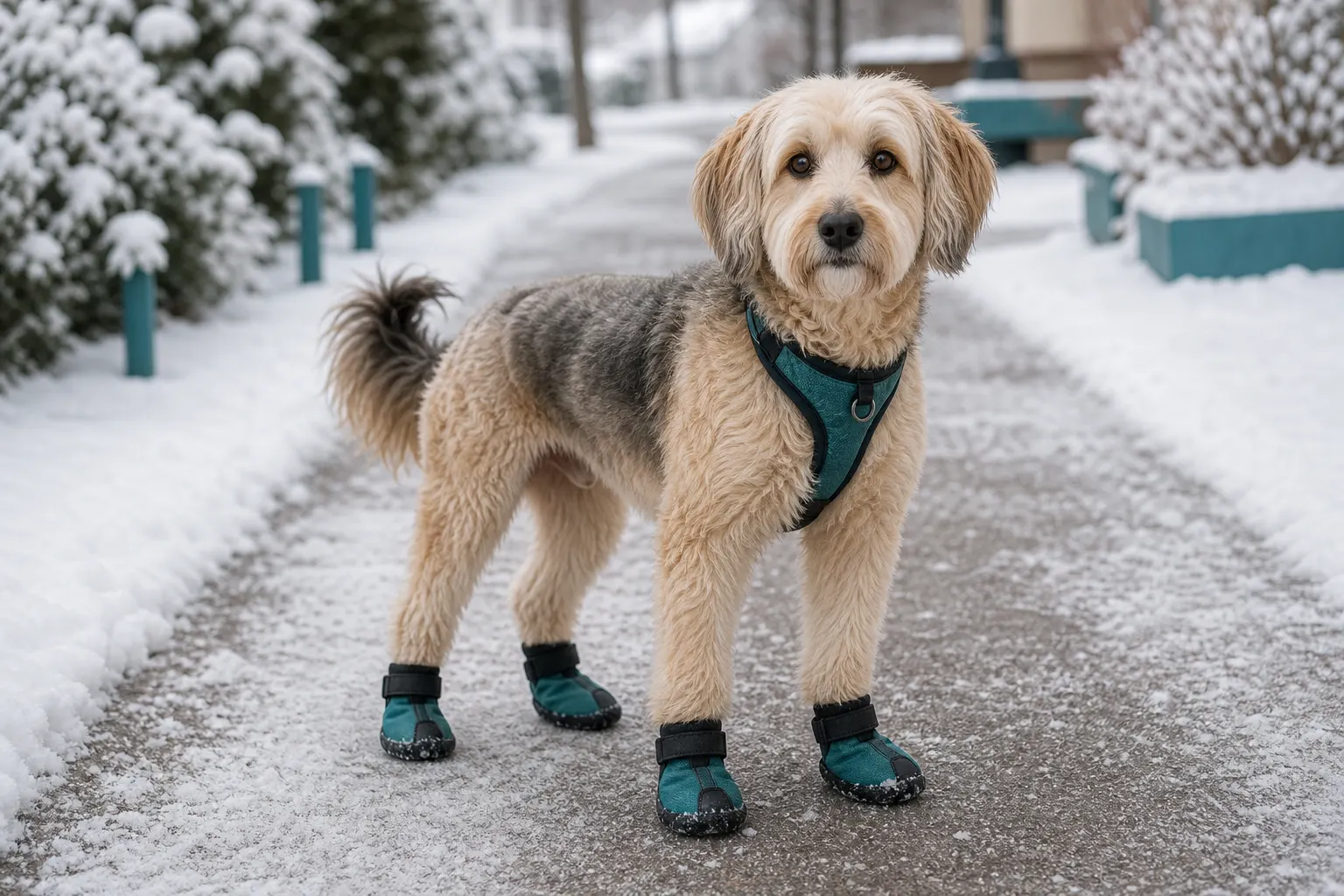
- Choose well-fitting dog boots for heavily salted, rough, or very cold routes, then introduce them indoors before they are needed.
- Keep a bowl or cloth, lukewarm water, and a clean towel by the door.
- Avoid sharp ice, deep crusted snow, and areas with visible piles of de-icer.
- During the walk, turn back if your dog repeatedly lifts a paw, limps, bites at the feet, or refuses to continue.
- After the walk, remove boots, rinse or wipe away salt and grit, dry between the toes, and check for redness, cracks, swelling, cuts, or trapped ice.
Do not assume a product labelled as pet friendly is harmless to lick. If your dog may have swallowed ice melt, antifreeze, or another winter chemical, call a veterinarian or animal poison service promptly and keep the packaging.
Start with a dry-paw baseline
It is much easier to notice a winter injury when you know what your dog's healthy paws normally look and feel like.
In good light, check:
- The large central pad and each toe pad
- The skin and fur between the toes
- The top of each paw
- Every nail, including dewclaws
- Any old scars, thickened areas, or known sensitive spots
Healthy paws vary. Pigmentation can be pink, black, mottled, or change gradually with age. What matters is a new difference such as a split, raw area, swelling, bleeding, discharge, unusual smell, or pain when the paw is handled.
Take a clear photo of the top and underside of each paw before winter conditions begin. A baseline photo can help you compare a new mark without relying on memory, but it cannot show depth, circulation, infection, or pain. Contact your veterinarian if a change is painful, worsening, or difficult to interpret.
If your dog already has a cracked pad, cut, skin infection, nail injury, or persistent limp, ask the clinic about exercise and protection before using boots or balm. Covering an active problem can trap moisture or create friction.
Make long paw fur manageable
Snow can collect on longer fur and form hard clumps between the pads. These clumps may pull on hair, spread the toes, change the dog's gait, and hide irritated skin.
Check the feet during and after snowy walks. If your dog's paw fur regularly gathers ice, ask a groomer or veterinary professional to show you how much can be safely shortened. Do not push scissors into matted fur or between pads when you cannot clearly see the skin.
Nails matter too. Overgrown nails can alter how the toes contact the ground, and slippery winter surfaces already make secure footing harder. Keep your dog's normal nail-care schedule rather than waiting for ice season to solve a long-standing problem. If nail trimming is stressful or the correct length is unclear, get hands-on help.
Government standards-of-care guidance from Ontario specifically notes that ice can accumulate in long paw fur and that winter grooming should include checking for salt, snow, and dirt buildup.
Decide whether your dog needs boots
Boots are most useful when the route has heavy de-icer, sharp ice, abrasive frozen ground, or conditions that repeatedly make your dog uncomfortable. They can also be helpful for a dog with individual protection needs identified by a veterinarian.
A boot should:
- Stay on without squeezing the leg
- Allow a natural step rather than twisting or folding
- Cover the pad without pressing the toes together
- Have enough grip for the walking surface
- Stay dry inside
- Leave no rubbing, swelling, or deep pressure marks
Introduce all four boots on a dry indoor surface. Reward calm investigation, then build from a few steps to a short practice session. A high-stepping gait can happen at first, but the dog should begin moving more naturally as they adjust. Do not force a frightened dog to complete a long session.
Test the boots on a short outdoor walk before bad weather arrives. Stop after a few minutes to check that each boot is still aligned and that no snow, grit, or moisture has entered. Inspect the paws again when the boots come off.
Boots are not a reason to extend a walk when your dog is cold, tired, or struggling. They also do not make thin ice, frozen waterways, traffic, or severe weather safe.
Use paw balm carefully
A dog-specific paw balm may provide a temporary barrier on intact pads, but it is not a substitute for route choice, boots when needed, or cleaning after the walk.
Before using one:
- Ask your veterinarian about it if your dog has allergies, skin disease, a current paw injury, or a habit of licking products.
- Read the complete ingredient list and directions.
- Test a small amount on intact skin.
- Stop if redness, itching, swelling, or increased licking develops.
- Store the container where the dog cannot chew or swallow it.
Do not apply human hand cream, essential oils, medicated ointment, or a numbing product unless a veterinarian has told you it is appropriate for that dog. A product can be unsafe when swallowed even if it seems soothing on human skin.
Wipe away residue after the walk as directed. Balm can collect grit, and it should not hide a pad that needs inspection.
Set up the door before the weather changes
The most reliable paw-care step is the one that can happen immediately after every walk.
Keep these together near the entrance:
- A shallow bowl or clean cloth
- Lukewarm water
- One towel for wet fur
- A smaller towel for drying between the toes
- A washable mat
- A light for checking each paw
- The dog's boots and any dog-specific balm
- The regular veterinarian and emergency clinic numbers
Lukewarm water helps remove salt and loosen small ice clumps without exposing cold skin to sudden heat. Do not use very hot water, rub hard at a painful area, or pull an ice ball away from skin. Melt it gradually and separate the fur gently.
If several people walk the dog, agree on one rule: the walk is not finished until the paws have been cleaned, dried, and checked.
Choose the route, not just the temperature
There is no single outdoor temperature that is safe for every dog. Cold tolerance changes with coat, body size, age, health, acclimation, wind, wetness, activity, and the length of exposure.
The surface may become the limiting factor before the air temperature does. Before leaving, look for:
- Fresh piles or bands of de-icing product
- Sharp refrozen ridges
- Deep snow with a hard crust
- Hidden kerbs, holes, or debris
- Slippery slopes and steps
- Standing slush near roads or car parks
- Frozen ponds, canals, or other waterways
Choose a shorter cleared route when conditions are uncertain. For puppies, senior dogs, dogs with thin coats, and dogs with mobility or health problems, ask your veterinarian how weather should change the exercise plan.
Use your dog's behavior as the limit rather than borrowing a fixed number from another breed or climate. Ontario's technical guidance identifies puppies, geriatric dogs, ill dogs, small breeds, and short-coated dogs as more vulnerable to cold. It also lists lifting a paw, shivering, listlessness, disorientation, and pale extremities among signs of cold-related distress.
Watch the dog during the walk
Do not wait until you reach home to decide whether the paws are coping.
Pause immediately if your dog:
- Repeatedly lifts one or more paws
- Starts limping or taking unusually short steps
- Stops, sits, or tries to turn home
- Bites or licks at a foot
- Develops snow clumps between the toes
- Slips repeatedly or loses confidence
- Becomes slow, weak, anxious, or unusually quiet
Move to a safe dry surface and inspect the affected paw. Remove loose surface grit only if you can do so without scraping or digging at the skin. Melt ice clumps with lukewarm water when practical. If the dog does not return to a normal comfortable gait, end the walk.
Do not encourage the dog to push through pain for exercise. Switch to a brief toilet trip and indoor activity when the route cannot be made safe.
Clean paws before the dog can lick them
De-icing products can remain on pads, between toes, and on lower-leg or belly fur. The Met Office's colder-weather guidance, based on British Veterinary Association advice, recommends wiping paws and the belly after snowy walks to remove ice or salt and checking for pad cracks or redness between the toes.
Use the same order every time:
- Remove one boot at a time and check inside it for moisture, grit, or damage.
- Rinse or wipe the pad and the spaces between the toes with lukewarm water.
- Clean lower-leg and belly fur if it contacted slush or treated ground.
- Pat dry, including between the toes.
- Look for redness, swelling, cracks, cuts, bleeding, or a foreign object.
- Prevent licking until the paws are clean and dry.
Wash reusable boots according to their care instructions and let them dry fully before the next walk. Damp boots can chill the feet and create rubbing.
Treat ice melt as an unknown product
Ice-melting products use different ingredients and concentrations. Appearance alone cannot tell you what is on a path, and marketing language does not make ingestion safe.
At home:
- Keep de-icer in its original labelled container.
- Store it behind a closed door or in a secure cabinet.
- Apply only the amount directed on the label.
- Sweep up loose excess when the surface is safe.
- Prevent access to the bag, spreader, and treated slush.
- Save a photo of the front label, ingredient list, and emergency information.
The FDA lists salt, ice-melting products, and antifreeze among items that may be dangerous to pets. Toxicity depends on the animal, product, and amount, so do not calculate safety from a generic online estimate.
If your dog may have swallowed a de-icer:
- Move the dog away from the product.
- Keep the container or photograph the label.
- Call a veterinarian, emergency clinic, or animal poison service promptly.
- Report the product, estimated amount, time, dog's weight, and current signs.
- Do not induce vomiting or give a home remedy unless a veterinary professional specifically instructs you to do so.
Possible vomiting, diarrhea, marked thirst, weakness, poor coordination, tremors, seizures, or unusual behavior after an exposure require urgent veterinary advice. A published canine case of severe salt intoxication involved vomiting, seizures, and coma, showing why neurologic signs after salt exposure cannot be treated as a minor stomach upset. Do not wait for symptoms if antifreeze may be involved. Treat possible antifreeze ingestion as an emergency even when the dog seems normal.
Know which paw problems need a veterinarian
Minor surface residue may settle after prompt rinsing and avoiding further exposure, but pain or damaged tissue needs a proper assessment.
Contact a veterinarian promptly for:
- A limp that persists after the paw is cleaned and warmed
- A crack that is deep, spreading, or painful
- Redness or swelling that does not settle
- Bleeding, a torn nail, or a cut pad
- A puncture, embedded object, or missing flap of pad tissue
- Blisters, discharge, bad smell, or increasing licking
- A boot rub that has broken the skin
- New discoloration or tissue that remains unusually cold or hard after coming indoors
Go to an emergency clinic as directed for uncontrolled bleeding, severe pain, major tissue loss, inability to bear weight after significant trauma, suspected frostbite, collapse, weakness, breathing difficulty, seizures, or a potentially dangerous chemical ingestion.
Footpad injuries can be more serious than their surface size suggests. A study of 120 traumatic pad injuries in pet and military working dogs found that full-thickness pad lacerations carried a greater risk of major short-term complications in military working dogs. Do not seal, glue, or tightly bandage a pad injury at home unless a veterinary professional has shown you exactly what to do.
For a broader transport and contact plan, use What to Keep in a Dog First Aid Kit.
Build one repeatable winter schedule
Winter paw care works best as a short system rather than a collection of products.
Before each walk
- Check the forecast and route.
- Inspect the paws.
- Put on tested boots when conditions call for them.
- Carry a cloth and water for longer outings.
After each walk
- Remove and inspect boots.
- Rinse or wipe paws, legs, and belly.
- Dry between the toes.
- Check for irritation or injury.
- Record anything that needs monitoring.
Once a week during icy weather
- Inspect boot soles, seams, and fasteners.
- Check nail length and fur between the pads.
- Replace used cleaning supplies.
- Review the route for new salt or surface hazards.
- Confirm emergency contact details.
Pet Care Reminder can hold a seasonal paw-preparation task, recurring boot checks, and follow-up reminders for a paw problem your veterinarian wants monitored. Record what actually happened, such as which paw was affected and whether the limp resolved, rather than relying on a generic reminder alone.
The simple rule
Prepare before the first salted walk, watch the dog while moving, and clean every paw before licking begins.
Use well-fitting boots when they suit the route and the dog, but keep walks responsive to the weather, surface, and your dog's behavior. Rinse away winter residue, dry between the toes, and contact a veterinarian for persistent pain, damaged tissue, suspected frostbite, or chemical exposure.
Sources
- Requirements and guidelines for standards of care for dogs kept outdoors. Government of Ontario technical guidance on winter grooming, ice accumulation between paw pads, nail care, and checking paws for salt, snow, and dirt buildup.
- Looking after your pets during colder weather. Met Office guidance presenting British Veterinary Association advice on cold-weather walks, removing ice and salt, checking paw pads, and avoiding winter toxins.
- Potentially Dangerous Items for Your Pet. FDA safety guidance identifying salt, ice-melting products, and antifreeze as potential pet hazards and advising prompt professional help after possible ingestion.
- Successful treatment of severe salt intoxication in a dog. Peer-reviewed canine case report documenting vomiting, seizures, coma, treatment, and survival after severe salt intoxication.
- Distribution, Complications, and Outcome of Footpad Injuries in Pet and Military Working Dogs. Peer-reviewed study describing 120 traumatic footpad injuries and the complication risk associated with full-thickness pad lacerations.