What to Do If Your Dog Eats Something Toxic
Quick answer
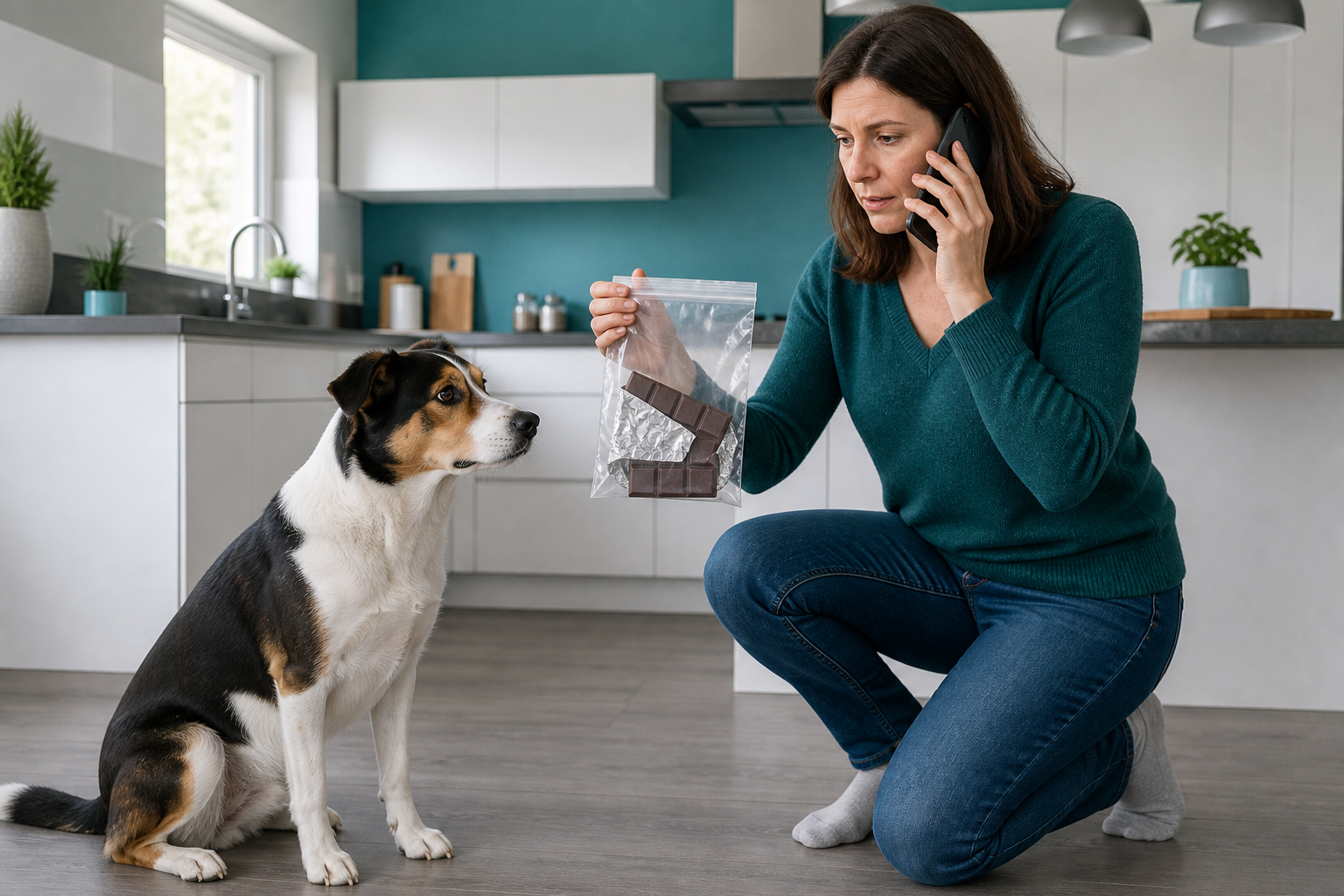
If your dog may have eaten something toxic, move them away from the substance and call a veterinarian, emergency veterinary hospital, or animal poison service immediately. Do not wait for symptoms or try to decide from an online list whether the amount was safe.
While you call:
- Keep your dog and other pets away from the remaining material.
- Find the product, package, plant, medication bottle, or a clear photo of it.
- Estimate the earliest and latest possible exposure time and the most that could be missing.
- Have your dog's weight, age, medical conditions, medications, and current signs ready.
- Do not induce vomiting or give food, milk, oil, salt, hydrogen peroxide, activated charcoal, or medication unless the veterinary professional handling the case specifically tells you to.
- Follow the exact destination and transport instructions you receive.
Go to the nearest emergency veterinary hospital as directed if your dog has difficulty breathing, is choking, collapses, becomes unresponsive, or has a seizure. If another person is available, have them call while you prepare to leave. Do not put anything in the mouth of an unconscious or seizing dog.
This is not a situation to diagnose at home. The right response depends on the substance, concentration, amount, timing, route of exposure, and the individual dog.
Take the first five minutes in this order
The most useful first response is simple: stop, separate, call, identify, and follow instructions.
1. Stop further access
Move your dog to another room, behind a closed door, into a secure garden area, or onto a leash if that can be done safely. Keep children and other animals away too.
Do not spend several minutes cleaning before you know what was involved. First prevent another mouthful. Then preserve the container, label, or remaining material without putting yourself at risk.
If the substance is a chemical, pesticide, cleaner, vape liquid, or unknown powder, avoid bare-hand contact. Do not create fumes by mixing cleaning products. If the area is unsafe for people, leave it and tell emergency services or the veterinary professional exactly what happened.
2. Call immediately
Call one of these, depending on what is available where you live:
- Your regular veterinarian
- The nearest emergency veterinary hospital
- A veterinary animal poison service that handles cases in your country or region
Do not call a human poison line for veterinary treatment advice unless a veterinary professional specifically directs you there. Do not rely on a manufacturer, search engine, social media group, or regulatory agency to assess your individual dog.
The FDA advises calling a veterinarian or pet poison control center right away after a pet may have eaten something potentially dangerous. Calling before signs develop gives the professional the best chance to decide whether observation, decontamination, testing, or immediate hospital care is appropriate.
3. Identify what happened
Give facts, not a guess at the diagnosis. Start with the product and the maximum possible exposure.
| Information | What to report |
|---|---|
| Dog | Name, age, breed or type, current weight, and sex |
| Substance | Exact product or plant name, ingredients, strength or concentration, and form |
| Amount | Package size, amount remaining, amount missing, and the maximum your dog could have reached |
| Time | When the item was last known to be intact and when the exposure was discovered |
| Route | Swallowed, chewed, licked, inhaled, or contacted the mouth, eyes, skin, or coat |
| Current condition | Alertness, breathing, walking, drooling, vomiting, diarrhea, tremors, seizures, or any other change |
| Medical context | Health conditions, pregnancy, recent procedures, prescriptions, supplements, and allergies |
| Actions already taken | Anything offered, washed off, removed, or given since the exposure |
If the amount is uncertain, say so. A useful statement is: "The 100-tablet bottle was full yesterday, 63 tablets remain, and I do not know whether any spilled elsewhere." Do not turn an uncertain maximum into a reassuring estimate.
4. Follow the case-specific instruction
Write down the professional's name, call time, poison-service case number if one is provided, and the exact next step. Ask:
- Should we leave for a clinic now?
- Is there anything I should remove from the mouth or coat before travel?
- May I offer food or water?
- Should any scheduled medication be given, delayed, or changed?
- What should I bring?
- What change means we should call back or go straight to emergency care?
Repeat the instruction back. Poisoning calls are stressful, and a written action is safer than relying on memory.
Do not wait for symptoms
A dog can look normal without the exposure being safe. Appearance alone does not identify the substance, absorbed dose, or what may happen next.
The FDA notes that toxicity varies with the animal, the amount eaten, and, for a plant, the part consumed. Product concentration matters too. One square of one product is not equivalent to one square of another, and one dog's exposure cannot be judged from another dog's outcome.
Do not use a generic "toxic foods" chart to calculate permission to wait. A list can help you recognize a possible hazard, but it cannot replace veterinary triage. If a professional determines that home observation is appropriate, ask for a specific monitoring period and a clear escalation threshold.
Do not induce vomiting unless you are told to
The American Veterinary Medical Association advises owners not to induce vomiting or give medication after a suspected poisoning unless a veterinarian or animal poison center directs it. A peer-reviewed review of poisoned small-animal emergencies likewise treats telephone triage, history, and the choice of decontamination method as clinical decisions.
Whether vomiting is appropriate depends on what was swallowed, when it happened, and the dog's current condition. An unsuitable home attempt can delay care or create another problem.
Unless the professional managing the case tells you otherwise, do not give:
- Hydrogen peroxide
- Salt, mustard, or another homemade emetic
- Activated charcoal
- Milk, oil, butter, or food
- Human antacids, pain relievers, or nausea medicine
- Another pet's prescription
- An extra dose of the dog's usual medicine
- A home antidote found online
Do not put fingers into the throat. Do not force food or liquid into a drowsy, weak, struggling, seizing, or vomiting dog.
If your dog has already vomited, do not automatically assume the danger has passed. Keep your dog away from the material, follow safe handling instructions, and tell the professional what the vomit contained.
Preserve the evidence without delaying the call
The package often answers questions that the product's appearance cannot. Keep or photograph:
- The front and back of the label
- The ingredient list
- Strength or concentration
- Package size and amount remaining
- Directions and warning panel
- Lot or batch number when visible
- A plant's leaves, flowers, berries, and stem in clear photographs
- The damaged container, chewed material, or vomited material if it can be collected safely
The AVMA recommends having the product or container available and sealing chewed or vomited material in a plastic bag to take to the veterinary hospital. Ask the clinic how to package and transport chemicals, pesticides, sharp containers, or contaminated material. Do not carry a leaking or open chemical in the passenger area of a vehicle.
For a medicine exposure, bring the original bottle or a complete label photo. Report the drug name, strength, number that may be missing, and whether it was prescribed for a person, this dog, or another animal. If a dosing mistake may have occurred, How to Track Care for Multiple Dogs Without Mixing Up Doses shows how a per-dog record can make the last confirmed dose easier to establish.
Treat more than food as a possible toxin
Dogs may be exposed through food, medication, household products, the garden, garages, bags, or another pet's treatment. The FDA's examples include:
- Chocolate, grapes or raisins, xylitol-containing products, caffeine, alcohol, onions, garlic, salt, and raw yeast dough
- Human medicine, another animal's medicine, or too much of the dog's own medicine
- Nicotine products, e-cigarettes and refill liquids, and cannabis products
- Antifreeze, ice melt, cleaners, paint, solvents, mothballs, and pool chemicals
- Rodent bait, insecticides, pesticides, lawn products, and fertilizers
- Plants, bulbs, berries, mulch, and mushrooms of uncertain identity
This is not a complete list. A product described as natural, organic, pet friendly, sugar free, or child resistant is not automatically safe for a dog to swallow.
Also tell the clinic about packaging, bones, corn cobs, fruit pits, skewers, batteries, string, toys, or other non-food items. Some swallowed items are dangerous because they can obstruct, burn, cut, or suffocate rather than because they are chemically toxic.
Know when transport cannot wait
Suspected poisoning deserves an immediate call even when your dog looks well. Prepare for emergency transport at once if your dog has:
- Difficulty breathing or obvious choking
- Collapse or inability to stand
- Unresponsiveness
- A seizure
- Rapidly worsening weakness or confusion
- Repeated vomiting with increasing weakness
- A veterinary professional's instruction to come in immediately
Keep your face away from the mouth of a confused, painful, or seizing dog. Even a gentle dog may bite when frightened or neurologically affected. Do not muzzle a dog who is vomiting or having difficulty breathing.
Use a leash, harness, carrier, blanket, or other transport aid suited to the dog's size and condition. Call the hospital before arrival if possible so the team can prepare. What to Keep in a Dog First Aid Kit can help you store emergency contacts, a medication list, gloves, sealable bags, and safe transport supplies before an incident occurs.
If vomiting begins during the incident, When Should a Dog See the Vet for Vomiting? explains what observations help a veterinary team. A possible toxin exposure remains an immediate-call situation regardless of the number of vomiting episodes.
Use a concise poisoning call script
Lead with the exposure, the maximum possible amount, the time window, and your dog's condition:
"My 18-kilogram dog may have eaten dark chocolate between 2:00 and 2:20 p.m. The package originally held 200 grams and about 80 grams remain. I have the full wrapper. She is alert and breathing normally and has not vomited. She takes one prescription medication, and I have not given any food, peroxide, charcoal, or medicine since I found it."
Then answer the professional's questions. Do not omit an action because it feels embarrassing. If you already gave a home remedy or medicine, the clinic needs its exact name, amount, and time.
If you cannot identify the substance, describe the location, container, color, smell without directly inhaling it, missing amount, damaged objects, and anything else nearby. Send photographs if the service accepts them. Do not taste, intentionally smell, or touch an unknown substance to identify it.
Track the handoff and follow-up
Once the immediate plan is underway, create a short factual timeline:
| Time | Event or observation | Instruction or action |
|---|---|---|
| 2:20 p.m. | Torn package found, dog alert | Moved dog away and photographed label |
| 2:24 p.m. | Emergency clinic called | Directed to animal poison service |
| 2:31 p.m. | Poison-service case opened | Told to travel to emergency hospital |
| 2:36 p.m. | Dog still alert, no vomiting | Left home with package and medication list |
Record what actually happened, not what was scheduled. Include every product given by a professional, discharge instruction, recheck time, and warning sign.
Pet Care Reminder can hold a veterinary recheck, medication task, feeding instruction, and follow-up call after the emergency team has set the plan. Put the case number and factual timeline in the note. A reminder should support the professional plan, never postpone the first call.
Prevent the next exposure after the emergency is handled
When your dog is safe and the veterinary plan is complete, review how the item became accessible.
- Return food, medicine, nicotine products, supplements, cleaners, pesticides, and garden products to secure storage.
- Keep products in original containers with readable labels.
- Use a closed cabinet rather than assuming a high counter is unreachable.
- Separate human, dog, and other-pet medications.
- Check handbags, coat pockets, bedside tables, bins, compost, parcels, and visitor luggage.
- Read cleaner and pesticide labels before use and keep pets out of treated areas as directed.
- Save your regular veterinarian, emergency hospital, and regional animal poison service contacts.
- Keep a current weight, medication list, and medical summary available.
The EPA's current pet-safety material emphasizes reading labels to prevent exposure to household cleaners and pesticides. The most useful prevention system combines secure storage, original labels, clear household handoffs, and emergency numbers that are easy to find.
The simple rule
After a possible poisoning, do not test a home remedy and do not wait for proof.
Stop further access, call a veterinarian or veterinary poison service, identify the product and maximum possible amount, and follow the case-specific instruction. Preserve the packaging and record the timeline. Travel immediately when directed or when breathing difficulty, choking, collapse, unresponsiveness, or a seizure occurs.
Fast, accurate information helps the veterinary team choose the next step. It does not make the exposure safe to manage without them.
Sources
- Potentially Dangerous Items for Your Pet. Official FDA safety guidance identifying common edible and non-edible pet hazards, factors that affect toxicity, and the need to call a veterinarian or pet poison control center right away.
- Pet First Aid. The American Veterinary Medical Association's 2025 first aid guidance on suspected poisoning, preserving the product and chewed or vomited material, avoiding owner-directed vomiting or medication, and contacting veterinary help immediately.
- Emergency management and treatment of the poisoned small animal patient. Peer-reviewed review covering initial telephone triage, exposure history, communication, decontamination decisions, and supportive care for poisoned small-animal patients.
- Read the Label First: Protect Your Pets Brochure. Current US EPA guidance on preventing pet exposure to household cleaners and pesticides by reading and following product labels.