
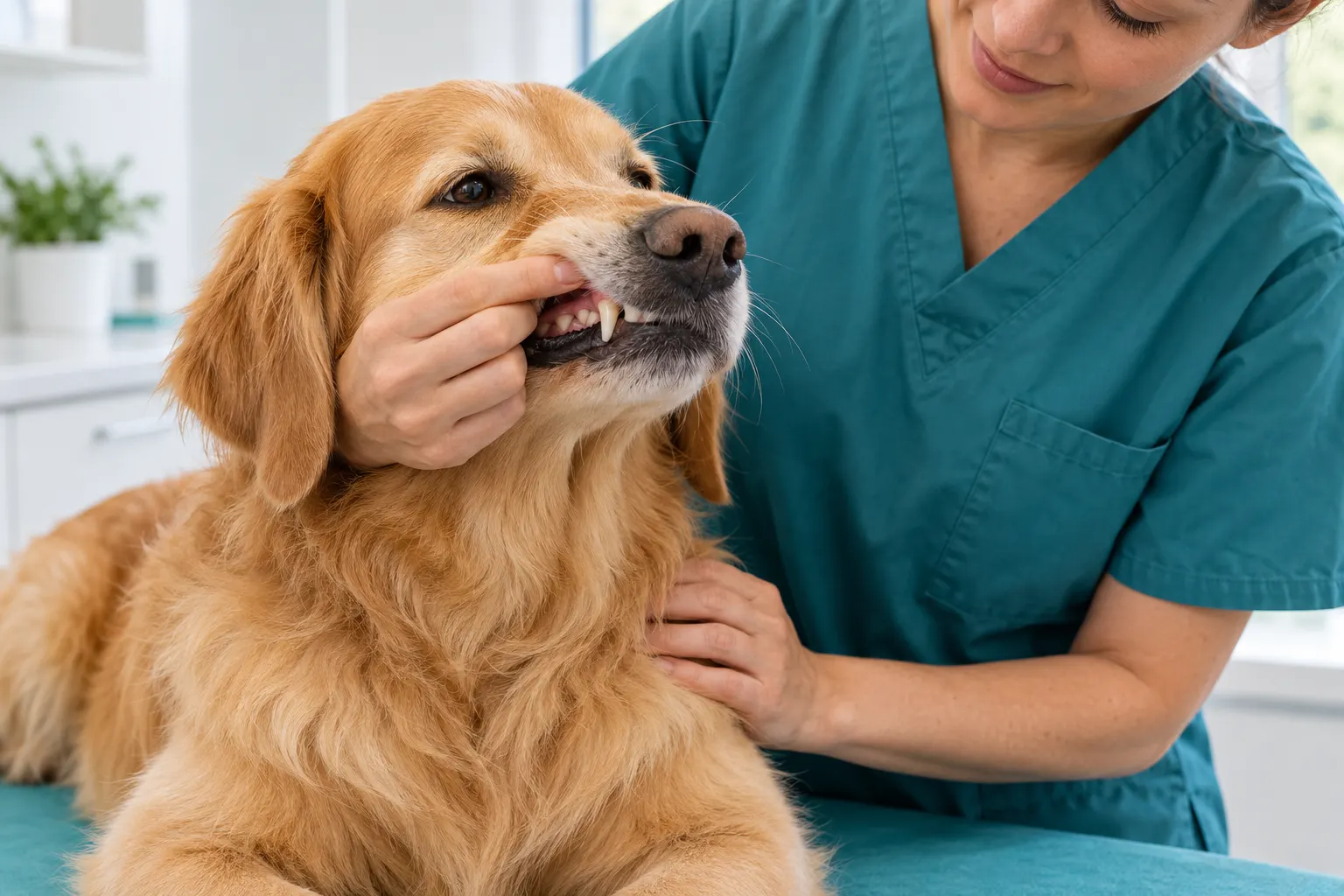
When to call about your dog's teeth
Persistent bad breath, inflamed or bleeding gums, a damaged tooth, or changes in chewing are reasons to call your veterinarian for a dental assessment. These may be signs your dog needs a dental cleaning, but cleaning alone may not address the problem. The examination determines what care is needed.
Do not wait for your dog to stop eating. WSAVA dental guidelines explain that animals can continue eating despite substantial oral pain.
Your first job is to describe what changed. You do not need to identify a diseased tooth or decide which procedure to book.
Changes worth reporting
Use ordinary observations, without trying to examine every tooth:
- Breath and gums: persistent odor, redness, swelling, or bleeding.
- Teeth: a visibly broken, loose, or discolored tooth, or deposits you have noticed.
- Eating: dropping food, chewing on one side, or changing how food is picked up.
- Behavior: avoiding familiar mouth handling, rubbing the face, or losing interest in chew toys.
- Face and saliva: new swelling, a lump, or unusual drooling.
AAHA and WSAVA identify these as relevant oral-health observations. They do not establish a diagnosis at home.
Call the clinic the same day for new facial swelling, an apparent broken tooth, obvious pain, or difficulty eating or swallowing, and ask how soon your dog should be seen. Describe those signs before asking for a routine cleaning slot.
Difficulty breathing, uncontrolled bleeding, or major mouth or jaw trauma needs emergency veterinary care. Contact an emergency clinic immediately and follow its transport instructions. Do not delay to finish the record below.
Build a useful dental call record
Do not force the mouth open, probe a tooth, or keep handling a painful mouth to obtain a photograph. An incomplete observation is useful if you say what you could not see.
Copy these prompts into a note:
| Field | What to write |
|---|---|
| Main change | The one observation that prompted today's call |
| First noticed | Date or honest estimate, plus whether it is worsening |
| Meals | Last usual meal; amount eaten; any change in picking up or chewing food |
| Mouth or face | What you saw naturally, including the side if known |
| Handling | What your dog used to allow and what changed |
| Background | Last dental visit, previous treatment, current medicines, known conditions |
| Unknowns | Areas you could not see or events nobody witnessed |
| Clinic's answer | Appointment timing, interim instructions, and reasons to call again |
Do not mark an unseen area as normal. Write “back teeth not visible” or “could not tell which side” instead. If another caregiver noticed the first change, ask for their own description rather than combining two uncertain accounts into one confident story.
An illustrative call
This is a fictional example, not a patient case:
“Milo usually finishes breakfast without dropping any food. Yesterday and today he dropped several pieces, although he finished the meal. His breath has seemed stronger for about a week. I have not tried opening his mouth. His last dental procedure was last year, and I can send the record. How soon should you examine him?”
The useful details are the comparison with normal, the sequence, and what remains unknown. There is no need to label it an abscess or say that he “just needs a cleaning.”
For the rest of the appointment packet, use our guide to preparing for a vet visit.
Understand the examination and the procedure
An awake examination helps the veterinarian plan, but it can miss disease. AAHA recommends a complete assessment under anesthesia, including dental X-rays and tooth-by-tooth evaluation.
A comprehensive dental procedure includes cleaning above and below the gumline and polishing. Findings may require treatment beyond cleaning. The American Veterinary Dental College's position statement explains why scraping visible tartar from an awake dog cannot replace this care. Do not attempt home scraping.
Ask the clinic to distinguish the initial assessment, the planned procedure, and any additional treatment that might need your authorization. That makes an estimate more useful than a single line saying “dental.”
Questions to settle before booking
Bring the questions that matter for your dog and your practical constraints:
- What are we investigating? Ask which findings are already known and which questions remain open.
- What is included? Ask about full-mouth dental X-rays, assessment, cleaning, and polishing.
- How will anesthesia be planned? Discuss health conditions, medicines, previous anesthesia experiences, testing, and monitoring during recovery.
- What if you find more disease? Agree on how the team will contact you, what you authorize, and what happens if you cannot answer.
- What could change the estimate? Request a written explanation of possible additional treatment and any referral options.
- What should happen before arrival? Get the clinic's specific food, water, and medication instructions.
Anesthesia is not risk-free. AAHA advises individual assessment and says chronological age alone should not rule out an indicated procedure. Raise concerns early so the veterinarian can explain your dog's options.
If scheduling or cost is difficult, ask what the next achievable step is and how urgently it is needed. Keep the clinic's answer beside the estimate so a postponed booking does not become an open-ended delay.
Leave with a follow-up date
After treatment, ask for the findings, procedures performed, home-care instructions, and recheck plan in writing. Confirm when brushing and usual chewing activities can resume.
There is no single cleaning interval to copy from another dog. Ask the veterinarian to set the next assessment based on your dog's findings and ongoing care.
Keep three dates separate: when care was recommended, when it is booked, and when it happened. If the booking changes, preserve the original recommendation and record the clinic's revised advice.
Pet Care Reminder can help you keep the appointment reminder and health documents together. Record the next action while the instructions are in front of you. For preventive care once the mouth is comfortable and your veterinarian approves, see how often to brush a dog's teeth.
Sources
- 2019 AAHA Dental Care Guidelines for Dogs and Cats. Formal guidelines on assessment, individualized anesthesia planning, treatment discussions, and follow-up.
- World Small Animal Veterinary Association Global Dental Guidelines. Formal clinical guidance on oral pain, behavioral changes, continued eating despite pain, and facial trauma.
- American Veterinary Dental College® Position Statement on Anesthesia-Free Dentistry (AFD). Statement adopted in April 2024 on comprehensive dental procedures and the limitations and risks of awake tooth scraping.
- RECOVER Guidelines: First Aid for Dogs and Cats. Clinical Guidelines. Clinical guidelines published in August 2026 supporting urgent veterinary care for breathing distress and severe bleeding.