
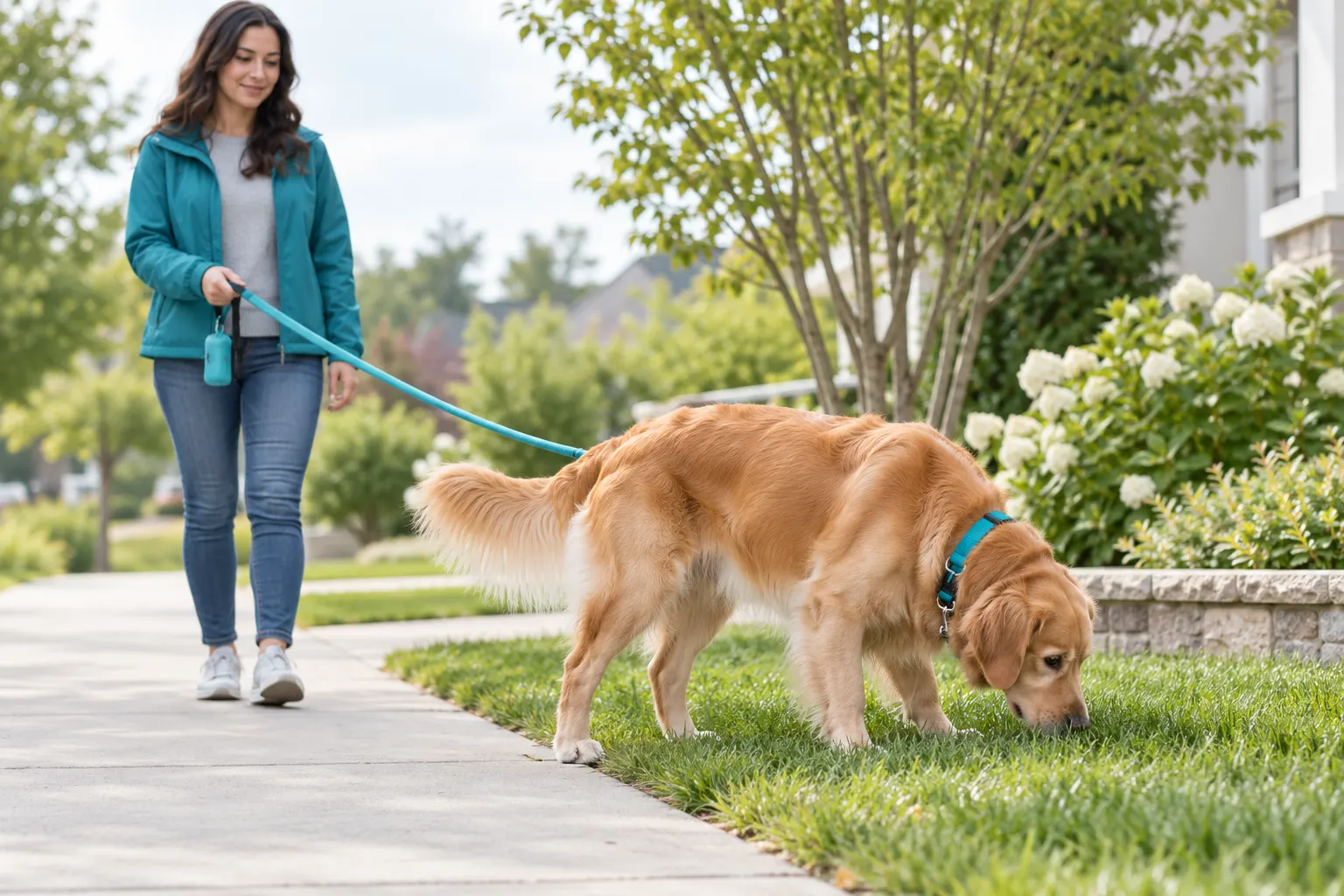
Watch what happens, not just whether the walk happened
To notice dog bathroom changes, compare what your dog actually passes, how comfortably it happens, and what differs from their usual pattern. A completed walk does not confirm that your dog peed or pooped. Record uncertainty instead of filling in the gap.
Repeated straining to pee with little or no urine needs emergency veterinary attention now. A few drops do not rule out a serious problem. Call an emergency clinic and follow its arrival instructions; do not wait for the next scheduled walk or a completed log.
Observation can make a change easier to report, but it cannot prevent every emergency or diagnose the cause. Use this guide to organize what you see and decide when to call.
Know when to stop observing and get help
The ACVIM urinary-incontinence consensus identifies urinary outflow obstruction as an emergency. If your dog repeatedly strains and you cannot tell whether they are trying to pee or poop, tell the clinic exactly that. Do not assume constipation.
Seek emergency care for collapse, difficulty breathing, poor responsiveness, or severe bleeding. The RECOVER first-aid guidelines prioritize prompt veterinary care for these signs. Do not delay to take pictures.
Call your veterinarian the same day about new blood in urine, painful urination, a changed stream, new leakage, or a clear change in frequency or amount. Describe which change you saw; “an accident” alone leaves out useful information.
For stool changes, contact the clinic promptly about blood, repeated diarrhea, persistent straining, or changes accompanied by vomiting, reduced appetite, or reduced energy. WSAVA/ENOVAT guidance assesses acute diarrhea using the dog's overall condition, not stool appearance alone. The existing guide to when a dog should see the vet for diarrhea covers that problem in more detail.
If your dog has an individual veterinary monitoring plan, use its instructions and call thresholds.
Establish a short baseline while your dog is well
Start with a few ordinary observations, not a target number of bathroom trips. The purpose is to make “different from usual” understandable to another person.
Write a short baseline note:
- Usual opportunities: when someone normally takes the dog outside.
- What is usually observed: the bathroom events you actually see on those outings.
- Usual stool description: a simple description you can compare with later.
- Overnight pattern: whether someone usually needs to get up with the dog.
- Coverage gaps: unsupervised yard time or walks where nobody watches closely.
Date the note. “Usually poops on the first walk; afternoon yard time is not observed” is more honest than “normal twice daily” if nobody has counted.
If a change is already happening, skip baseline-building and call as appropriate. You do not need several days of data before asking for help.
Separate four things in the record
Keep these categories distinct so a household checklist does not hide missing information:
| Category | What belongs here | What it does not establish |
|---|---|---|
| Opportunity | Outside at 7:10 a.m. with Sam | That urine or stool passed |
| Attempt | Stopped and took a bathroom posture | What came out, unless someone saw it |
| Observed output | Urine stream seen; stool passed and photographed | A diagnosis or proof that the bladder emptied fully |
| Found afterward | Wet bedding or a stool accident discovered indoors | Exact time, circumstances, or which dog did it if unwitnessed |
The ACVIM consensus distinguishes leakage from conscious urination and recommends a history of the circumstances. A wet bed and a witnessed pee on the floor should therefore get different descriptions.
Use “not observed” when you did not watch. Reserve “attempted, nothing seen” for an attempt you witnessed without visible output. Those phrases mean different things when the clinic reconstructs the timeline.
For multiple dogs, add a name to each observation. Do not assign an unidentified puddle to the oldest dog or the one with a previous urinary problem.
Copy this bathroom-change log
This is an organizational template, not a medical scoring system. Start a new entry for a meaningful change rather than writing a long diary of every sniff.
Bathroom-change log
- Dog and observer:
- Date and time:
- Last bathroom event someone actually witnessed:
- What happened this time:
- What came out, if seen:
- What differed from usual:
- What was not observed or remains uncertain:
- Other changes noticed:
- Clinic contacted, advice, and next action:
Use plain descriptions: “soft but formed,” “liquid,” “three stops in a short outing,” or “wet patch found after a nap.” Record a photo's time alongside the written entry so it does not become an unidentified image in a camera roll.
Note changes in meals, drinking, routine, or medicines around the same time, without deciding that one caused the other. If increased thirst is the main change in an older dog, the senior-dog water-monitoring guide provides a separate measurement process.
Make the handoff explicit
Consider this fictional shared-care example:
Alex marks the 7:00 a.m. walk complete. At 10:00, Morgan finds a wet patch on the dog's bed. Alex confirms that the dog passed stool on the walk, but urination was not observed. Morgan calls the clinic about the new wet bedding and reports both facts, without claiming the dog last peed at 7:00.
The improvement is in the handoff: a task completion stays separate from a health observation. There is no invented diagnosis or missing event filled in from memory.
Agree on who will make a veterinary call and where to save the answer. If two people observed different events, keep both accounts with their times rather than combining them into “acting strange all morning.”
Pet Care Reminder can support scheduled walks and shared household notes. Keep the observation alongside the routine, and mark the walk complete only after it happens. For the rest of the daily sequence, see how to build a morning care routine for dogs.
Leave the call with a specific next step
Read the most important change first, then give the last confirmed event and any gaps. Have your dog's age, known conditions, and current medication list available.
Ask the clinic:
- How soon should my dog be examined?
- What should I watch for while waiting?
- Which changes mean I should go directly to an emergency clinic?
- Do you want a sample, photo, or video, and what collection instructions should I follow?
- When should I update you if the pattern continues?
Write the answers into the same record. A useful log should end with a clear action and a person responsible for it, rather than another reminder to keep watching indefinitely.
Sources
- ACVIM consensus statement on diagnosis and management of urinary incontinence in dogs. Original 2024 journal article, hosted by EBVM in Practice, providing formal guidance on urinary histories, leakage and voiding patterns, and emergency treatment of obstruction.
- Five Steps of Canine Acute Diarrhea Treatment. Formal WSAVA/ENOVAT guideline summary supporting assessment of the dog's overall condition alongside stool changes.
- RECOVER Guidelines: First Aid for Dogs and Cats. Clinical Guidelines. Clinical guidelines published in August 2026 supporting prompt veterinary care for serious systemic and first-aid emergencies.