
Quick answer
If your dog hates tooth brushing, stop trying to finish the whole mouth. First make sure resistance is not being caused by dental pain. If the mouth has been checked and brushing is appropriate, rebuild the routine from the easiest step your dog can handle calmly.
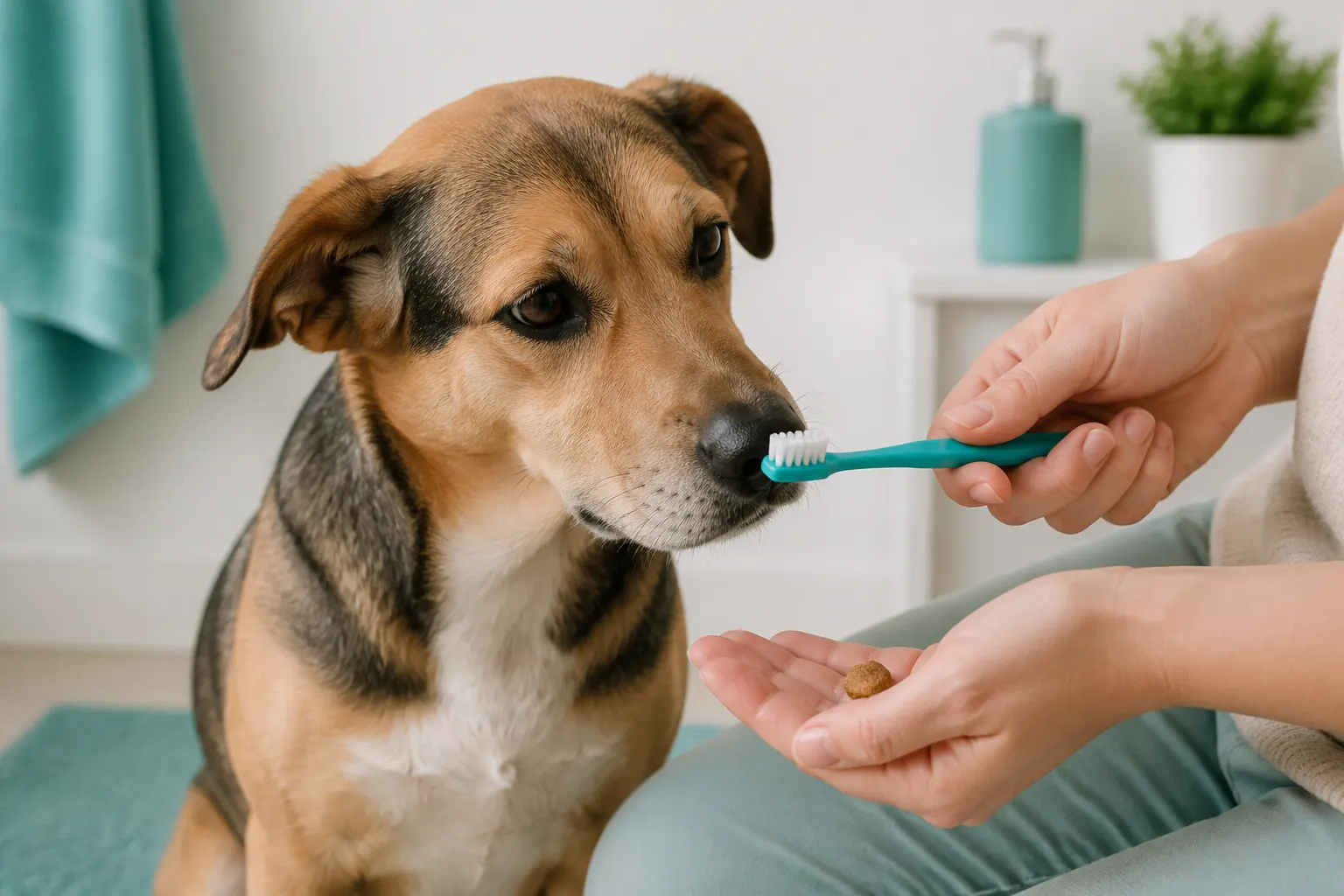
Start with a session that lasts only a few seconds:
- Show the toothbrush from a comfortable distance.
- Give a reward when your dog notices it and stays relaxed.
- Put the brush away before your dog tries to escape.
- Repeat later, then gradually work toward a cheek touch, a one-second lip lift, a bristle touch, and finally one or two gentle strokes.
Let your dog move away. Do not pin them down, pry the mouth open, scold a growl, or keep brushing because you have already started. Reward-based veterinary behavior guidance says dogs should be able to opt out of training, and dental guidance advises moving at the pet's pace.
Call your veterinarian before retraining if the resistance appeared suddenly or you see redness, bleeding, bad breath, tartar, a damaged tooth, drooling, facial swelling, trouble eating, or pain when the face is touched.
First decide whether this is fear, discomfort, or pain
"Hates tooth brushing" can describe several different problems:
- The toothbrush predicts restraint because previous sessions were forced.
- The dog is comfortable with face handling but dislikes the feel of bristles.
- The brush, toothpaste flavor, room, or caregiver position is unfamiliar.
- Sessions last too long or advance too quickly.
- The dog has mouth, jaw, neck, ear, or facial pain.
Training cannot safely solve the last problem. A dog who used to accept brushing and now turns away, freezes, cries, growls, or snaps needs a veterinary assessment before another attempt. The same is true when one side of the mouth is much harder to approach than the other.
Contact the veterinary team if you notice:
- Red, swollen, receding, or bleeding gums
- Heavy yellow or brown deposits along the gumline
- Persistent or newly strong bad breath
- A loose, broken, discolored, missing, or unusually positioned tooth
- Drooling, pawing at the mouth, face rubbing, or reluctance to pick up toys
- Dropping food, chewing on one side, eating slowly, or refusing harder food
- A lump, facial swelling, or discharge from the mouth or nose
- A sudden change in tolerance for touching the face or opening the lips
Brushing is preventive care. It does not remove hardened calculus or treat disease below the gumline. If your dog has had dental work, an extraction, oral surgery, or a mouth injury, follow the discharge instructions and ask when brushing can safely resume.
Major mouth or jaw trauma, uncontrolled oral bleeding, difficulty breathing, collapse, or rapidly increasing facial swelling needs urgent veterinary care.
Reset the goal to one calm repetition
The first goal is not clean teeth. It is a predictable interaction in which your dog stays comfortable enough to learn.
Choose one simple measure of success for each session:
- Your dog looks at the brush without leaving.
- Your dog approaches the usual training spot.
- Your dog accepts one cheek touch.
- Your dog allows the lip to move for one second.
- One tooth is touched with the brush.
End after that success. A five-second session can be productive if it changes what the toothbrush predicts. A two-minute struggle teaches the opposite lesson.
Do not hide the toothbrush, lure your dog close with food, then surprise them by brushing. The brush should be visible before the reward appears, and the dog should remain free to step away.
Set up a session your dog can leave
Small changes in the setup can remove pressure before training begins.
Use:
- A quiet room without another pet crowding the dog
- A non-slip mat or familiar resting place
- Soft, pea-sized rewards your dog can eat quickly, if treats fit their health and diet plan
- A small, soft-bristled brush recommended for your dog
- Dog-safe toothpaste only if your veterinarian recommends it
- A timer or mental limit so the session stays brief
Sit beside the dog rather than leaning over them. Keep your hands visible. Do not corner the dog between your body and a wall, attach a short lead to prevent escape, or ask another person to hold the dog still.
Never use human toothpaste, mouthwash, peroxide, essential oils, baking soda, or a homemade dental mixture. Dogs swallow dental products rather than rinsing and spitting. Ask the veterinary team which brush and product are suitable for your dog's mouth and medical needs.
If food rewards are restricted because of allergy, weight management, gastrointestinal disease, fasting instructions, or another medical plan, ask the veterinary team what reward is appropriate. A favorite toy, access to a sniffing activity, or calm affection may work for some dogs, but the dog decides what is rewarding.
Learn the difference between relaxed, worried, and unsafe
Watch the whole dog, not only the mouth.
| What you see | What it means for this session | What to do |
|---|---|---|
| Loose body, normal breathing, soft eyes, taking food normally, choosing to stay or return | The current step is probably manageable | Repeat it briefly and finish while it is easy |
| Turning the head away, leaning back, closing the mouth tightly, slowing down, lip licking, yawning, paw lift, ears held back, refusing food | The step may be too difficult or the session too long | Pause, create distance, return to an easier step, or end |
| Freezing, hard staring, growling, showing teeth, air snapping, lunging, or trying urgently to escape | There is a bite risk and the dog is over threshold | Stop, give space, and seek professional guidance before another attempt |
No single signal proves exactly how a dog feels. Look at the pattern and the change from normal. A dog who takes food can still be tense, so eating alone is not permission to continue.
Never punish a growl. It is useful warning information. Punishment may increase fear and remove an early warning without making the dog comfortable or safe.
Use a step-by-step retraining ladder
Begin at the first step your dog can complete with a loose body. There is no deadline for moving up. Stay at one level until it looks easy across repeated sessions, and move back whenever the dog's response worsens.
Step 1: The toothbrush appears
Place the brush several feet away or hold it at your side. When your dog notices it without retreating, give a reward and put the brush away.
If your dog leaves as soon as the brush appears, start farther away. Do not follow them with it.
Step 2: The brush moves closer
Hold the brush below the dog's eye level and away from the face. Reward calm attention, then remove it. Over several sessions, decrease the distance only while the dog remains relaxed.
Your dog does not need to lick or bite the brush. Quietly noticing it is enough.
Step 3: Brief face contact
With the brush out of your hand, touch the shoulder, then the side of the neck, then the cheek in separate repetitions. Reward after each comfortable touch.
Do not jump from a shoulder touch to holding the muzzle. If the cheek touch is difficult, go back to the neck or ask the veterinary team whether pain could be involved.
Step 4: A one-second lip lift
Touch the cheek, lift the outer lip for one second, release it, and reward. Keep the jaw closed and do not squeeze the muzzle.
Practice one side at a time. If one side consistently causes a stronger reaction, stop and arrange a dental check rather than training through a possible painful area.
Step 5: One bristle touch
Show the brush, lift the lip, touch the bristles to the outer surface of one canine tooth, then remove the brush and reward. Do not scrub yet.
A finger brush is not automatically easier. It puts your finger inside the bite zone and can feel bulky to a small dog. Ask the veterinary team to demonstrate an appropriate tool.
Step 6: One or two gentle strokes
Touch the outer surface near the gumline and make one or two small, gentle movements. Release the lip, reward, and finish.
The outer surfaces are the practical priority because they can be reached while the mouth stays mostly closed. Do not force the jaw open to reach every surface.
Step 7: Add one small section at a time
Expand from one tooth to two, then to a short section on one side. Add time or coverage, not both in the same session.
Once your dog is comfortable, work toward gentle daily brushing as advised by your veterinarian. How Often Should You Brush a Dog's Teeth? explains the frequency target and full brushing technique. This retraining plan is about making that routine possible without a struggle.
Add a pause that lets your dog answer
After each repetition, move your hands away for a moment. If your dog stays loose, approaches again, or returns to the training spot, you may offer another easy repetition. If they turn away, leave, stop taking rewards, or become tense, end the session.
This pause prevents a common mistake: completing several movements in a row before the dog has time to respond. It also gives you a clear record of the last comfortable step.
Use the same short opening and closing cues each time. For example:
- Put down the mat.
- Show the toothbrush.
- Complete one planned step.
- Reward.
- Move both hands away and pause.
- Either repeat once or say the finishing cue and put everything away.
Predictability is useful. Restraint is not.
Fix the point where the routine breaks
| Problem | Safer next step |
|---|---|
| Your dog leaves when you pick up the brush | Reward at the sight of the brush from farther away, then put it away |
| Face touching is fine, but the lip lift is not | Shorten the lift to a brief movement and release before tension appears |
| The dog accepts a finger near the mouth but avoids bristles | Let the dog see and sniff the brush, then practice a single dry bristle touch |
| The dog tolerates front teeth but not back teeth | Do not push farther; ask the vet to check for pain and demonstrate positioning |
| The first few seconds go well, then the dog struggles | End earlier and build duration in tiny increments |
| One caregiver succeeds and another does not | Match the setup, cues, hand position, reward, and stopping point |
| The dog suddenly refuses a familiar routine | Pause brushing and arrange a veterinary assessment |
| The dog growls, snaps, or has a bite history | Stop home attempts and ask the veterinarian for a safe behavior and dental plan |
Change only one variable at a time. If you change the room, brush, toothpaste, handler, and session length together, you will not know what helped.
What to do while full brushing is not possible
Do not choose between forcing the brush and doing nothing. Ask your veterinarian for an interim oral-care plan while training continues.
Depending on the individual dog, the plan may include a dental diet, chew, wipe, gel, water additive, or another product with evidence for plaque or tartar control. The Veterinary Oral Health Council lists products that have earned its seal for a specific plaque or tartar claim.
An accepted product is not automatically right for every dog. Size, chewing style, swallowing risk, calories, allergies, current dental disease, and other health conditions matter. Supervise chews and follow the label. Avoid bones, antlers, and very hard objects that can fracture teeth.
Alternatives do not remove hardened deposits, treat a painful tooth, or replace veterinary oral examinations. They also should not become a reason to stop cooperative-care training if brushing remains a suitable long-term goal.
Track progress without turning it into pressure
Record the last comfortable step, not whether you completed a perfect brushing session.
A useful log might say:
- Monday: brush visible at two feet, relaxed, three repetitions
- Tuesday: approached mat and sniffed brush, relaxed
- Wednesday: cheek touch accepted twice, turned away on third attempt, stopped
- Thursday: no practice because dog seemed sore around the mouth, called vet
Pet Care Reminder can hold a short recurring practice task and a note about the current step. Mark it complete after the brief session, even if no tooth was brushed. The record helps every caregiver start at the same level and makes a sudden change easier to describe to the veterinary team.
Do not use a missed reminder as a reason to make the next session longer. Resume at the last easy step.
When to ask for professional help
Start with your veterinarian when:
- Resistance is sudden, one-sided, or increasing
- You see any sign of oral disease or pain
- Your dog has had dental treatment and you do not know when to restart
- The dog has a bite history or cannot be approached safely
- Your dog will not progress beyond an early step despite a slow plan
- You need an alternative home-care product or technique
Bring a short video only if it can be recorded without provoking another struggle. How to Prepare for Your Pet's Vet Visit can help you organize the behavior timeline, dental products, and questions.
After medical causes are assessed, the veterinarian may suggest a qualified reward-based trainer or a veterinary behavior professional. Ask what methods will be used. Avoid anyone who recommends dominance, intimidation, flooding, physical correction, or forcing the dog to submit to mouth handling.
The simple rule
When a dog hates tooth brushing, make the task smaller and make the dog safer. Rule out pain, stop before a struggle, reward one calm step, and let the dog leave.
Progress from seeing the brush to face contact, a brief lip lift, one bristle touch, and a few gentle strokes. The pace is set by the dog's comfort, not by the calendar.
If resistance is sudden, one-sided, painful, or unsafe, stop training and contact the veterinary team. A clean tooth is never worth teaching a dog that face handling requires fear or force.
Sources
- 2019 AAHA Dental Care Guidelines for Dogs and Cats. Formal veterinary guidelines covering oral pain, professional assessment, preventive home care, appropriate dental products, and the limits of brushing once disease is present.
- Introducing Toothbrushing. WSAVA Global Dental Committee guidance on gradually introducing face contact, lip lifting, tooth contact, a toothbrush, rewards, and daily care at the pet's pace.
- Position Statement on Humane Dog Training. Formal veterinary behavior statement supporting reward-based methods, environmental management, opt-out opportunities, and veterinary evaluation for medical contributors to behavior change.
- VOHC Accepted Products. Veterinary Oral Health Council list of dog dental products that have earned a plaque or tartar claim under its acceptance standards.