
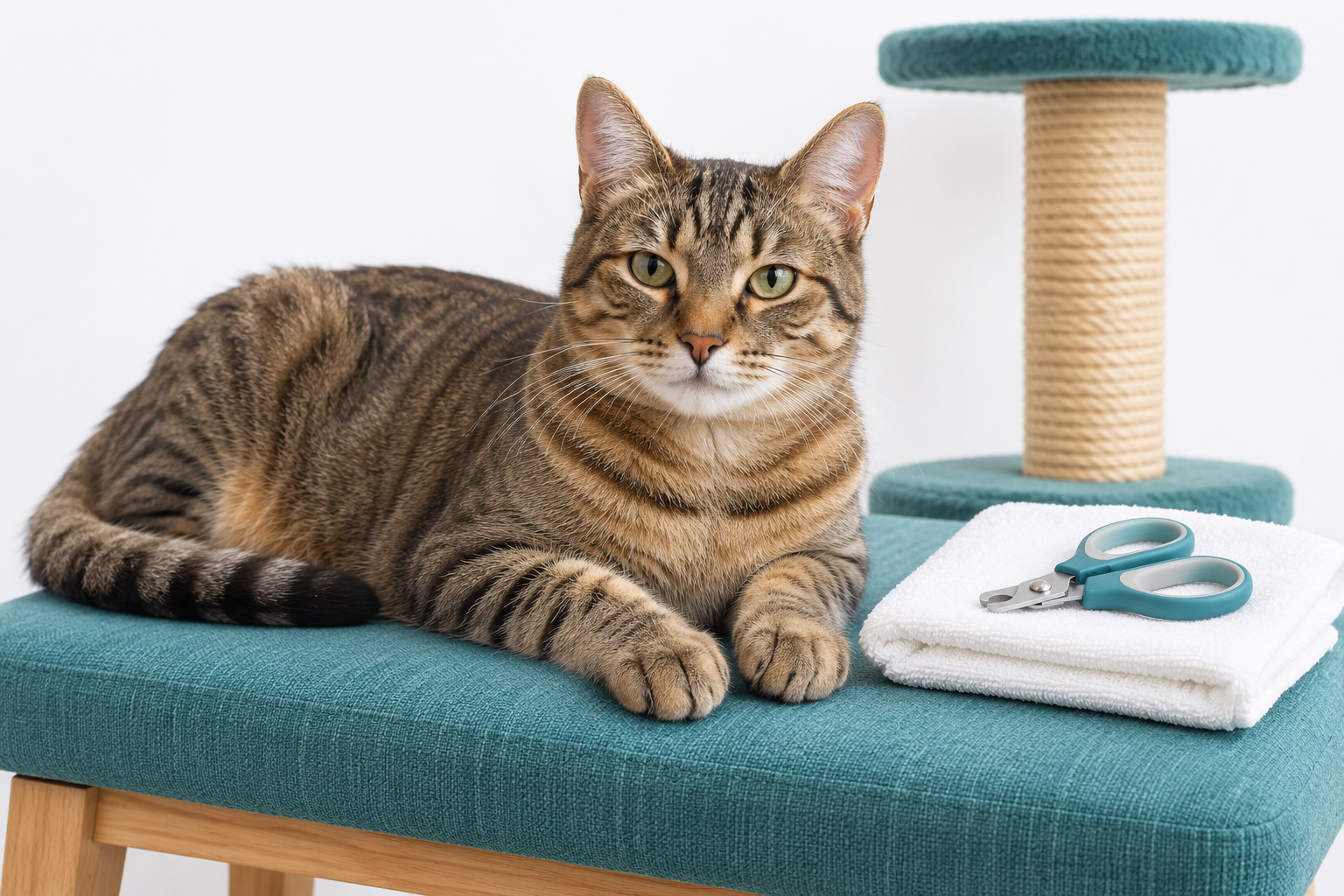
Start with an interval, then adapt it to your cat
A four-to-six-week trimming interval is a useful starting point to discuss with your veterinary team, but your cat's claws and comfort should determine the actual schedule. The Canadian Cat Healthy clinical protocols give this general interval and explain that age and how much nail is removed affect timing. It is not a requirement to cut every claw when a reminder rings.
Ask the clinic to assess your cat's claws, demonstrate safe trimming, and recommend the next check. For home organization, a weekly reminder to look for changes can help you avoid forgetting between trims. That weekly check is a planning suggestion, not a clinical trimming schedule. Follow a more specific plan if your veterinarian has given one.
This guide helps you organize routine care. An injured or painful paw needs veterinary advice, not a more ambitious home trim.
Scratching and trimming do different jobs
Scratching is normal feline behavior. It helps remove the outer claw sheaths and leaves communication marks. A trimmed cat still needs suitable scratching surfaces; trimming does not remove the need to scratch.
Provide stable scratching options your cat actually uses. Note the preferred material, position, and location. “Uses the cardboard pad by the sofa” is more useful for a care plan than “has a scratcher.”
Finding shed claw material does not tell you whether every claw is being maintained adequately. Keep the claw check separate from the scratcher check. Likewise, furniture damage is not a reason to keep cutting a claw shorter. Ask the veterinary team for help with scratching behavior and the environment.
The 2022 scratching study discusses normal claw-sheath removal and environmental management. Its owner survey does not establish an ideal nail-trimming interval.
Change the plan when age or comfort changes
The 2021 AAFP senior-care guideline highlights thickened and ingrown claws in older cats. Arthritis can also make scratching difficult. A cat who stops using a familiar scratching surface needs attention to comfort, not an assumption that nail care has become unnecessary.
Use these situations to prepare a specific question for the clinic:
| What you notice | What to ask or arrange |
|---|---|
| Your cat is new to the household and the last trim is unknown | Request a claw assessment and demonstration before choosing a repeating interval |
| Your cat scratches normally and accepts checks | Confirm which claws need trimming and when to reassess them |
| Claws look thicker, curve toward a pad, or repeatedly catch | Contact the clinic about an assessment and whether the routine should change |
| Your older cat uses the scratching post less | Report the change, along with any difficulty jumping or walking |
| Your cat now resists previously comfortable paw handling | Stop the session and ask about possible pain and a safer care plan |
| You cannot safely see or handle the claws | Arrange professional help rather than repeatedly postponing the task |
For a cat with diagnosed arthritis, the daily home-care routine for feline arthritis helps you track access and ordinary activity alongside the claw plan. A broader monthly senior cat checklist can keep other changes visible.
Make handling practice separate from trimming
The 2022 AAFP/ISFM handling guideline supports gradual, reward-based cooperative care and minimal handling. Ask the team to show you how to expose a claw gently, identify the quick, and use suitable clippers. If you cannot identify the safe cutting area, do not guess.
For a comfortable cat, practice can begin with tolerating a brief paw touch and receiving a reward. Build up only while the cat remains relaxed. A practice session can end without any clipping. Do not scruff, pin down, or keep pursuing a cat who is trying to leave.
If fear or pain prevents care, ask the clinic for an individualized plan. Training should not become a reason to leave a claw problem untreated.
Keep a session card that shows what remains
Short sessions make “nails done” an unreliable description. Use one card for the cat and update the same record after each session. This is an organizational aid, not a cutting diagram or a clinical score.
Cat claw-care session card
- Cat and current plan date:
- Clinic contact and recommended interval:
- Next claw check or professional appointment:
- Scratching surface used and any change in use:
- Date, caregiver, and session goal: observation / practice / trim
- Claws actually checked: identify paw and claw; include any extra toes
- Claws trimmed today:
- Claws still awaiting assessment or trimming:
- Comfort and reason the session ended:
- Question for the clinic and advice received:
- Next action, date, and responsible person:
Keep “not examined,” “examined, no trim advised,” and “trimmed” as separate outcomes. If the clinic identifies a particular claw that needs follow-up, use its description consistently rather than asking the next caregiver to interpret “the sharp one.”
Fictional example: Miso's caregiver notices he has stopped using his tall sisal post and records that change before a scheduled trim. The clinic assesses his comfort and claws and agrees a revised care plan. At home, the family records which scratching surface he chooses and the next claw appointment. They do not treat an unused post as proof that every claw needs cutting, or a completed trim as proof that the mobility concern is resolved.
Pet Care Reminder's vet visit reminders can hold the booking reminder, appointment, and resulting visit notes. Put the clinic's agreed date in the reminder and the actual outcome in the record.
Get veterinary help for injuries or embedded claws
Contact your veterinarian promptly for a claw growing into a pad, a torn claw, swelling, bleeding, limping, or a painful paw. Do not dig out an embedded claw or pull off damaged material. Tell the clinic when the change began and whether your cat can walk comfortably.
Severe or continuing bleeding needs urgent veterinary help. If it is safe, apply direct pressure with a clean cloth while arranging care, following the RECOVER first-aid guideline. Do not risk being bitten to examine the paw or delay transport to complete the care card.
Sources
- Cat Healthy Preventive Healthcare Protocols. Winter 2018 Canadian clinical consensus protocols. The nail-care section describes a general four-to-six-week interval, individual timing factors, professional demonstrations, and scratching surfaces.
- 2022 AAFP/ISFM Cat Friendly Veterinary Interaction Guidelines: Approach and Handling Techniques. Formal clinical guideline supporting cooperative care, minimal handling, and attention to pain during nail care.
- 2021 AAFP Feline Senior Care Guidelines. Formal clinical guideline describing thickened and ingrown claws, arthritis-related difficulty scratching, and professional nail-trim support.
- Unwanted Scratching Behavior in Cats: Influence of Management Strategies and Cat and Owner Characteristics. Peer-reviewed 2022 study of US and Canadian cat owners, with background on scratching, claw-sheath removal, and environmental management.
- RECOVER Guidelines: First Aid for Dogs and Cats. Clinical Guidelines. Formal 2026 guideline supporting prompt care for injuries and safe direct pressure for severe external bleeding while arranging veterinary help.
