How to Build a Morning Care Routine for Dogs That Actually Sticks
Quick answer
A dog morning routine is more likely to last when it follows the same short sequence, even if the exact time changes:
- Take your dog to the toilet and notice how they look and move.
- Refresh the water.
- Give prescribed morning medication exactly as directed, if applicable.
- Serve the measured meal in the order your veterinarian recommends.
- Provide suitable movement, sniffing, play, or training.
- Record completed care and confirm who handles the next task.
Build the routine around events that already happen, such as getting out of bed, starting the kettle, or picking up your keys. Prepare supplies the night before and keep a five-minute fallback version for rushed mornings.
The goal is not a perfect schedule at exactly 7:00 a.m. It is a reliable chain in which important care does not disappear when the alarm is late, the weather changes, or another person takes over.
Use a sequence instead of a strict clock
A clock-only routine breaks easily. If the plan says “walk at 7:00” and you wake at 7:25, the whole morning can feel failed before it starts.
A sequence is more durable:
Wake up → toilet break → water → prescribed care → breakfast → suitable activity → handoff
Keep the order stable while allowing the start time and activity length to change. A 2022 survey-based study that developed the Companion Dog Routine Inventory found an association between more consistent routines, fewer reported behavior problems, and greater owner satisfaction. That does not prove that a rigid timetable causes better behavior. It does support treating consistency as a useful household system rather than relying on memory.
Predictability should not become inflexibility. Puppies, senior dogs, dogs recovering from illness, and dogs with medication or feeding requirements may need a different order or more frequent care. Weather, pain, appetite, and energy can also change what is appropriate that morning.
Decide what is genuinely non-negotiable
Before adding training games, grooming, or a long walk, identify the tasks that cannot safely be skipped.
For many dogs, the core list is:
- A timely opportunity to urinate and pass stool
- Fresh, clean drinking water
- Prescribed medication or treatment due that morning
- A measured meal, if breakfast is part of the feeding plan
- Exercise and enrichment suited to the dog's age, health, and the conditions
- A quick check that the dog is behaving, eating, drinking, breathing, and moving normally
- Clear confirmation that each task was completed
The UK government's Code of Practice for the Welfare of Dogs notes that dogs need regular toilet opportunities, constant access to fresh water, an individual diet, daily exercise unless a veterinarian advises otherwise, and consistent, kind handling. It also emphasizes that individual needs vary. Use your dog's veterinary plan as the authority when it differs from a generic checklist.
Write your core list in one place. If a task is optional, label it optional. This prevents a rushed household from spending five minutes finding a favorite toy while forgetting a prescribed dose.
Build the routine one step at a time
1. Start with the toilet break and a quick observation
Give your dog access to the usual safe toilet area soon after waking. Puppies, older dogs, and dogs with some health problems may need this more urgently or more often than healthy adults.
You do not need to turn every toilet trip into a detailed inspection. Simply notice:
- Did your dog get up and move normally?
- Did they urinate and pass stool as expected?
- Are they unusually restless, slow, weak, stiff, or reluctant to go out?
- Are they coughing, repeatedly retching, vomiting, or having diarrhea?
- Is their breathing comfortable?
Record a change when it is clear enough that another caregiver or your veterinary team would need to know. A note such as “strained three times and passed only a few drops of urine” is more useful than “seemed off.”
Contact a veterinarian promptly about a new or repeated change, especially pain, difficulty passing urine or stool, repeated vomiting or diarrhea, a marked appetite or thirst change, or behavior that is unusual for your dog. Difficulty breathing, collapse, a seizure, severe bleeding, a swollen abdomen with repeated unsuccessful retching, or inability to pass urine requires urgent veterinary help.
2. Refresh the water
Check the bowl rather than assuming yesterday's water is still clean and available. Empty debris, wash the bowl as needed, and refill it with fresh water.
If you have more than one dog, provide enough water stations to prevent crowding or guarding. Do not use an empty bowl as a way to measure whether a dog drank “too much.” Another dog, a spill, evaporation, or a leaking bowl can make the result misleading.
A persistent change in drinking deserves a veterinary discussion. Note the pattern and the date it began instead of trying to restrict water without veterinary instructions.
3. Handle medication as a separate safety step
Do not bury medication inside a vague task called “breakfast.” Keep the medication step distinct so the household can confirm what actually happened.
Before giving a morning product:
- Check the dog's name on the label.
- Check the product, strength, amount, route, and scheduled time.
- Follow food instructions exactly.
- Give the dose to one dog at a time.
- Confirm it was swallowed or administered as directed.
- Record the actual time immediately.
Do not prepare doses for several dogs together. Do not mark a task complete in advance, and do not repeat an uncertain dose because the log is blank. Call the prescribing clinic for product-specific advice about a missed, vomited, spat-out, or possibly duplicated dose.
For a household with several dogs, How to Track Care for Multiple Dogs Without Mixing Up Doses provides a separate-station and dose-record system.
4. Measure breakfast and choose the order with your vet
Use the daily amount and feeding plan set for your dog, then measure the breakfast portion rather than estimating it differently each morning. Account for food used as medication carriers or training rewards when your veterinary team has asked you to manage calories closely.
There is no universal rule that every dog must eat before the walk or after it. The right order can depend on the dog's age, health, feeding schedule, medication directions, activity, and risk factors. The Code of Practice advises against strenuous exercise shortly before or after food, but it does not create one timing interval for every dog.
Ask your veterinarian how to order food and activity for your dog if they are a puppy, a large or deep-chested dog, diabetic, prone to vomiting, recovering from surgery, underweight, overweight, or taking medicine tied to meals. Once you have an individual answer, write it into the routine so nobody improvises.
If your dog unexpectedly refuses breakfast, consider the whole picture. A healthy adult who skips one meal but otherwise seems normal is different from a puppy, a dog with diabetes, a dog who needs food with medication, or a dog who is also painful, vomiting, weak, or unusually thirsty. Call your veterinarian when the change is concerning or the dog's plan makes a missed meal important.
5. Add activity that fits the dog and the day
A morning walk can combine toileting, exercise, sniffing, and a few minutes of reward-based practice. It does not need to be fast or exhausting to be useful.
Choose the activity according to:
- Age and growth stage
- Fitness and usual exercise
- Arthritis, pain, heart, breathing, or mobility limitations
- Weather, temperature, and surface conditions
- Fear, reactivity, and the safety of the route
- The feeding and medication plan
On a normal day, this might be a steady neighborhood walk with time to sniff. On a rushed day, it may be a shorter toilet walk plus a food-search game or calm training indoors. On a hot day, move outdoor activity to safer conditions rather than treating the usual route as mandatory. Summer Pet Safety Tips Every Owner Should Know explains how to adjust exercise before heat becomes dangerous.
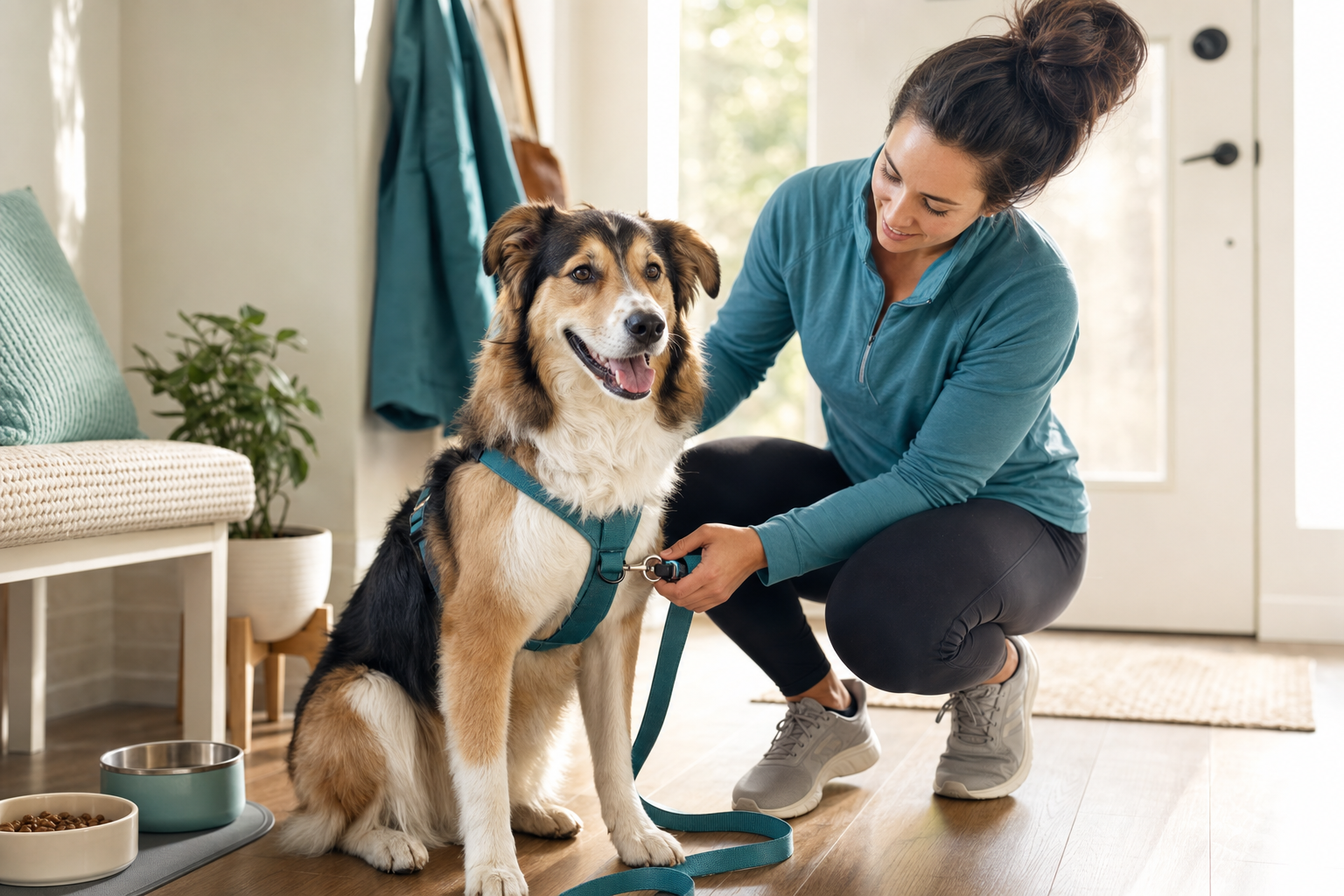
Use rewards to teach the behaviors that make mornings easier, such as waiting while the harness is clipped, moving away from the door, checking in, and settling after the walk. The American Veterinary Society of Animal Behavior recommends reward-based methods for dog training and advises against fear, pain, intimidation, and physical correction.
Do not punish a dog for being slow, afraid, overexcited, or reluctant. A sudden change in willingness to walk, use stairs, wear a harness, or be touched can be a sign of pain or illness and deserves veterinary attention.
6. End with a visible handoff
The routine is not complete until the next person can tell what happened.
Record facts:
| Morning task | Useful completion record |
|---|---|
| Toilet break | Time and any meaningful change |
| Medication | Product, actual time, and caregiver |
| Breakfast | Amount offered and whether it was eaten |
| Walk or activity | Completed, shortened, or replaced |
| Follow-up | Vet call, refill, booking, or observation needed |
Avoid messages such as “I think everything is done” or “I was going to feed him.” If two people share mornings, give each task one owner or use one live record that everyone checks before acting.
Pet Care Reminder can hold separate recurring tasks for medication, prevention, walks, grooming, and appointments. Mark a task complete only after it happens. The history then becomes a handoff record, not just a list of notifications.
Prepare the night before
Reduce the number of decisions required when you are half awake.
Before bed:
- Put the lead, harness, waste bags, and weather gear in one place.
- Check that food and prescribed supplies will last through the morning.
- Confirm which caregiver owns each task.
- Put special instructions where they will be seen.
- Check the weather if it may change the route or timing.
- Add any refill, appointment, or follow-up that surfaced during the day.
Keep medication in its original labeled container and in the storage conditions on the label. Do not leave tablets loose beside a food bowl or preload a dose where a child or animal could reach it.
The setup should make the next correct action obvious. If a system requires searching three cupboards, opening two apps, and asking another person what happened, simplify it.
Create a five-minute fallback routine
Busy mornings are predictable, so plan for them.
A fallback might be:
- Immediate toilet break
- Fresh water
- Prescribed medication and food exactly as directed
- Short safe movement or enrichment
- Confirmed plan for the longer walk or next toilet break
The fallback is not permission to leave a dog without appropriate exercise, company, or toilet access for the rest of the day. It is a bridge that protects the essentials while the household reschedules the flexible parts.
Decide in advance who can take over if you are ill, delayed, or called away. Give that person the dog's instructions and veterinary contacts before an emergency morning occurs.
Fix one failure point at a time
If the routine keeps falling apart, do not redesign the whole day. Find the first point where it fails.
| Problem | Smallest useful fix |
|---|---|
| The walk starts too late | Put the harness and keys beside the first morning cue |
| Nobody knows whether the dog was fed | Use one completion record and log the actual time |
| Medication gets forgotten | Separate it from “breakfast” and give it its own reminder |
| The dog runs away from the harness | Rebuild the step gradually with rewards and check fit or pain |
| Bad weather cancels everything | Prepare one indoor enrichment option and a safe toilet plan |
| The routine is too long | Keep essentials, shorten optional tasks, and move one task later |
Test the change for a week. A routine that works on four ordinary mornings and has a safe fallback for the other three is more useful than an elaborate plan that lasts two days.
If this is a newly adopted dog, start with the baseline and record system in 5 Things Every New Dog Owner Forgets in the First Month. New dogs may need a quieter routine while you learn what is normal for them.
The simple rule
Make mornings consistent in order, not rigid in every detail. Protect the non-negotiable care, attach the steps to cues that already happen, prepare supplies in advance, and keep a fallback for rushed days.
Observe your dog as you go. A routine should make changes easier to notice, not pressure a dog to perform when they are painful, frightened, or unwell. When the usual pattern changes suddenly, pause the checklist and respond to the dog in front of you.
Sources
- Companion Dog Routine Inventory: Scale Validation and the Effect of Routine on the Human–Dog Relationship. Peer-reviewed study developing a routine inventory and reporting associations between routine consistency and owner-reported behavior problems, with behavior problems also associated with owner satisfaction and intention to abandon.
- Code of Practice for the Welfare of Dogs. UK government code covering individual care needs, regular toilet access, fresh water, feeding, exercise, observation of health changes, companionship, and consistent handling.
- Position Statement on Humane Dog Training. Formal veterinary behavior position statement supporting reward-based training, appropriate structure and routines, environmental management, and veterinary assessment when health may contribute to behavior change.