
Connect growth, food, and litter-box observations
A useful kitten care log connects dated weights with what your kitten actually ate and what you observed in the litter box. Record units, times, and who saw each event. When another cat could have eaten the food or used the tray, mark the result uncertain.
This guide is for weaned kittens eating independently. A newborn, orphaned, bottle-fed, or unwell kitten needs an individual veterinary feeding and monitoring plan. The record below helps you describe changes; it cannot diagnose them.
Start by asking your veterinary team what to feed, how much and how often, when to weigh your kitten, and when to review the results. The AAHA/AAFP life-stage guideline recommends discussing actual intake and assessing growth and body condition. Keep those instructions at the top of your record.
If you are still arranging supplies and a starter room, use the first-week kitten checklist first.
Choose words that show how much you know
Give each entry one of three descriptions: observed, estimated, or unknown. These are recordkeeping labels, not health scores.
| Situation | Useful entry | What it does not establish |
|---|---|---|
| You watch the kitten finish their own measured serving | Observed: serving eaten, product and amount recorded | Whether the whole day's feeding plan is appropriate |
| Some food remains, but there was also an unmeasured spill | Estimated intake; spill not measured | An exact amount eaten |
| A shared bowl is empty when you return | Unknown: food gone, eater not identified | That this kitten finished a meal |
| You see the kitten urinate in the tray | Observed: time, kitten, and result | That later deposits belong to the same kitten |
| You find stool during scooping | Found at this time; cat and event time unknown if unwitnessed | The time the kitten passed stool |
A blank field is ambiguous. Write “not checked” when nobody checked and “not seen” when an event was not witnessed. Neither means “nothing happened.”
Build a weight history your clinic can compare
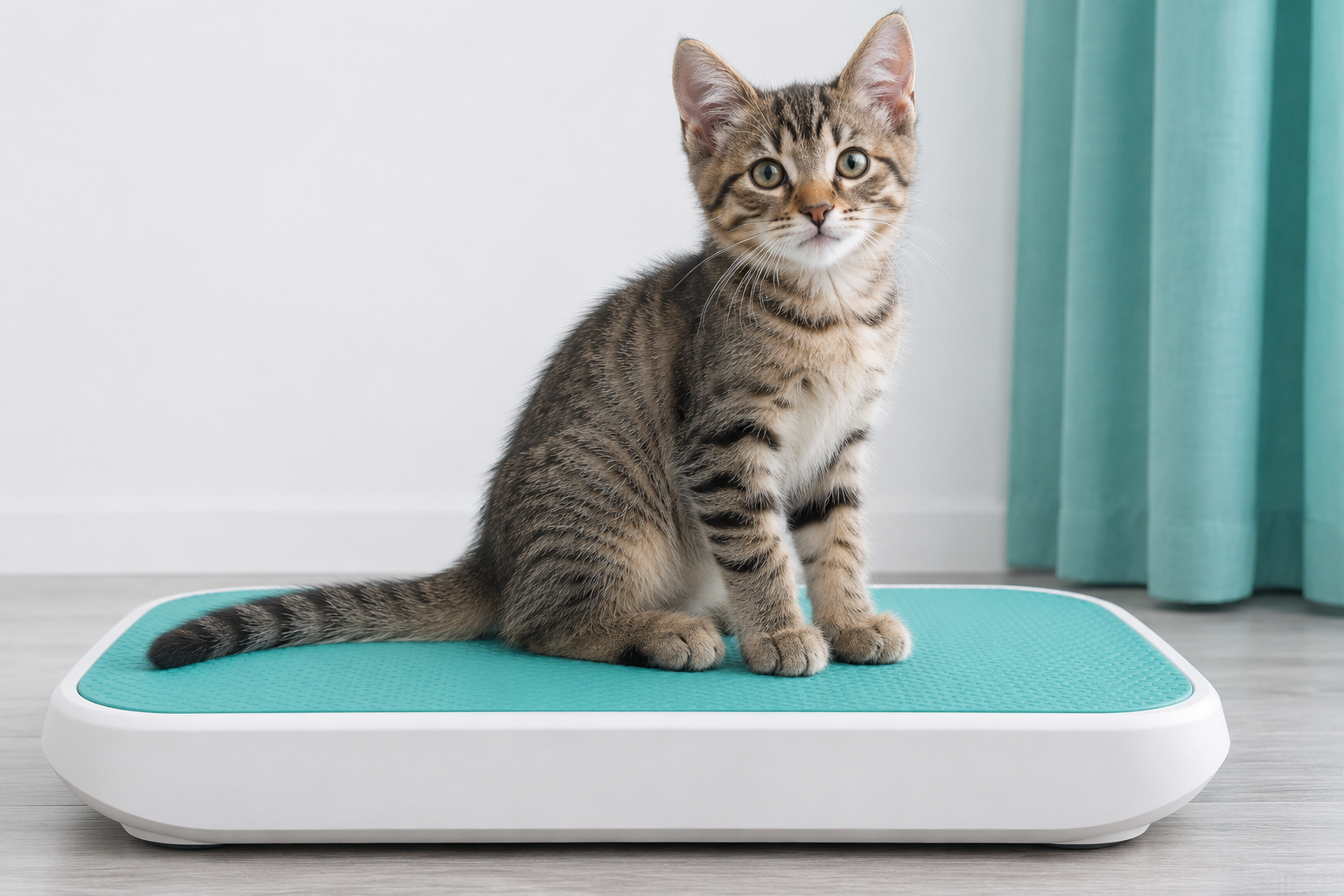
Keep a separate weight list with date, age in weeks, weight, unit, and scale or location. Mark an estimated birth date as estimated. Ask the clinic to demonstrate a safe weighing method and agree on the frequency; use clinic weigh-ins if home weighing is difficult.
Use the same suitable scale and similar conditions when practical. Note a different scale, an unstable reading, or a blanket or carrier included in the measurement. Do not put a doubtful reading into the history as if it were precise.
Ask whether a kitten growth chart is appropriate. The 2022 study by Salt and colleagues developed separate male and female standards for intact domestic shorthair kittens aged 8–78 weeks, using US veterinary records. These are not universal target weights for every breed, age, or neuter status. Have the veterinary team interpret the trajectory rather than trying to feed toward the middle line.
Record the spay or neuter date beside the weight history. AAHA/AAFP identifies neutering as a useful time to reassess nutritional needs and weight-gain risk. Ask for an updated feeding plan rather than applying an automatic portion cut yourself.
Bring the series to your kitten's next veterinary review, along with any changes in the plan. A single number has less context than a dated sequence with the measurement conditions attached.
Separate food offered from food eaten
Keep one line per food product and feeding period. Include the exact formula, amount offered, leftovers, and uncertainty. Record treats and food used in puzzles too. If you add more food to a bowl, record the addition before the earlier amount becomes impossible to reconstruct.
For a mixed wet-and-dry plan, keep the two products separate. Do not treat equal gram amounts of different foods as interchangeable portions; ask the clinic to specify each product's allowance. A photo of both labels can help the team review the plan.
Quiet, individual feeding locations are consistent with the feline life-stage guideline. When another cat can reach the bowl, note that access. Do not turn missing food into a confirmed kitten intake just because you intended the serving for them.
Illustrative record, not a diet recommendation: At breakfast, Mina watches her kitten Olive eat from a separate wet-food dish and records the portion and leftovers. Later, she finds the dry-food bowl empty after the adult cat entered the room. She records “dry food gone; amount Olive ate unknown” instead of adding the entire serving to Olive's total.
Keep the veterinarian's food plan separate from these results. “Meal offered” and “meal eaten” should remain different entries when they describe different things.
Check litter results without assigning every deposit to the kitten
Use an accessible, low-entry tray and keep it clean, as the AAHA/AAFP guideline recommends. Record urine and stool separately during routine checks. For stool, use plain descriptions such as formed, soft, or watery; ask your clinic whether it uses a particular stool-scoring chart.
Write the tray location, check time, and what you found. When you witness use, record the kitten's identity and the event time. In a shared-tray home, unidentified deposits stay unidentified. Do not withhold access to food, water, or a litter box to make the record easier.
Add a note when the litter, tray, location, or cleaning routine changes. “Two clumps found since the last scoop” is a description of the tray, not proof of two normal urinations by this kitten. If you are worried about output, call the clinic rather than waiting to identify every deposit.
Continuing the fictional example: Mina also finds stool in a shared tray. Olive's daily record now has a confirmed wet-food observation, uncertain dry-food intake, and unidentified stool. She can explain those limits at the review instead of reporting “ate everything and pooped normally.” If Olive develops symptoms, she calls sooner.
Copy a short kitten record and clinic handoff
Keep the current plan once, then repeat the observation lines as needed. This is an organizational template, not a validated health assessment.
Kitten growth, meals, and litter record
- Kitten and birth date: confirmed or estimated
- Current clinic feeding plan and date agreed: products, amounts, meal pattern, extras
- Weight plan: method, frequency, next review
- Weight entry: date, age, weight/unit, scale/location, uncertain measurement details
- Spay/neuter date or other plan change:
- Meal entry: time, product, offered, added, left/spilled, observed or estimated intake, observer
- Other access: another pet, shared bowl, puzzle food, or unknown eater
- Litter entry: check time, tray, urine/stool description, kitten witnessed or identity unknown
- Changes noticed: appetite, drinking, activity, comfort, litter access
- Handoff: last confirmed observations, gaps, next caregiver and task
- Clinic summary: weight trend to review; intake change; litter change; what remains uncertain
- Clinic advice: next action, responsible person, review date, reasons to call sooner
Before a review, summarize the change and its timing, then attach the underlying entries. Include the current food labels and the dated weight list. Ask the team which observations to continue and which are unnecessary.
Pet Care Reminder's vet visit reminders can help you remember the review and keep visit notes and documents together. Keep the daily record wherever your caregivers can consistently find and update it.
Call about symptoms before completing the record
Contact your veterinarian promptly for reduced or refused food, unexplained weight loss, vomiting, diarrhea, unusual quietness, or another concerning change. Give your kitten's age and the last confirmed normal observations. Do not wait for the next scheduled weigh-in or several days of complete entries.
England's government cat-welfare code supports veterinary contact for these signs of possible illness; its legal provisions are not US requirements.
Contact an emergency veterinary hospital now if your kitten repeatedly tries to urinate but passes little or nothing. If you cannot tell whether urine is passing, say so and seek immediate advice. Do not assume the straining is constipation or wait for another tray check.
The 2025 iCatCare consensus guideline identifies urinary obstruction as life-threatening and explains that urinary straining can be mistaken for difficulty passing stool. The cat litter-box changes guide helps organize a symptom call, but making that call comes first.
Breathing difficulty also needs immediate emergency veterinary care, consistent with RECOVER first-aid guidance. A good log supports care; it must never delay it.
Sources
- 2021 AAHA/AAFP Feline Life Stage Guidelines. Formal clinical guideline supporting kitten nutrition review, weight and body-condition assessment, feeding arrangements, and litter-box observations.
- Growth standard charts for monitoring bodyweight in intact domestic shorthair kittens from the USA. Peer-reviewed 2022 study developing sex-specific growth standards for intact domestic shorthair kittens aged 8–78 weeks.
- 2025 iCatCare consensus guidelines on the diagnosis and management of lower urinary tract diseases in cats. Formal clinical guideline supporting urgent assessment of unproductive urinary straining and the limits of interpreting signs at home.
- Code of practice for the welfare of cats. Government technical guidance for England, published in December 2017 with the publication page updated in April 2018; supports illness recognition and prompt veterinary contact, not US legal requirements.
- RECOVER Guidelines: First Aid for Dogs and Cats. Clinical Guidelines. Formal 2026 clinical guideline supporting emergency veterinary care for breathing difficulty.
