What to Do If Your Cat Hates Tooth Brushing
Quick answer
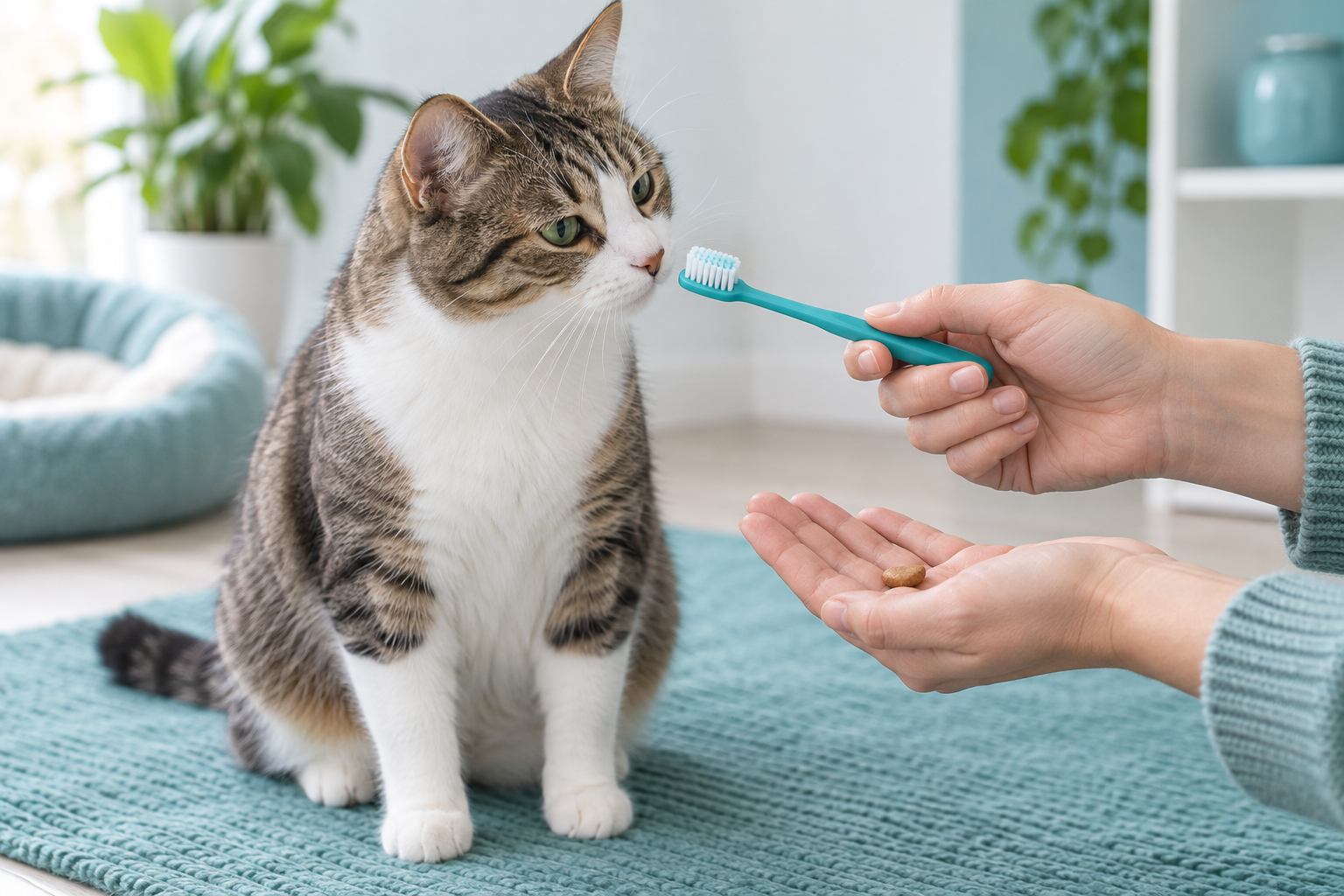
If your cat hates tooth brushing, stop trying to complete a full brushing session. Resistance can come from fear, an uncomfortable setup, or mouth pain. First rule out a health problem, especially if the behavior is new or suddenly worse. Then restart with the easiest interaction your cat can accept calmly.
A first session may be this small:
- Place a familiar mat or towel in a quiet area.
- Let your cat approach it without being carried or held there.
- Show the toothbrush from a comfortable distance.
- Give a preferred reward when your cat notices the brush and remains relaxed.
- Put the brush away before your cat leaves.
That is enough. Over later sessions, work toward a cheek touch, a momentary lip lift, one bristle touch, and finally a few gentle strokes on the outer tooth surfaces.
Do not scruff, pin, tightly wrap, corner, chase, or pry your cat's mouth open. If your cat turns away, crouches, flattens the ears, lashes the tail, freezes, growls, swats, bites, or tries to escape, stop and create space.
Contact your veterinarian before more training if you notice bad breath, red or bleeding gums, visible tartar, drooling, a damaged tooth, face rubbing, food dropping, reduced eating, facial swelling, or a sudden dislike of face handling.
Treat sudden resistance as health information
A cat who has never experienced tooth brushing may simply find the brush, flavor, hand position, or restraint unfamiliar. A cat who previously cooperated and now refuses may be telling you that something hurts.
Feline oral disease is not always obvious at home. Cats can keep eating while changing how they chew, choosing softer food, swallowing pieces differently, or avoiding one side of the mouth. Some painful problems sit below the gumline or affect tooth roots, so a quick look at the front teeth cannot rule them out.
Pause home brushing and call the veterinary clinic if you see:
- Red, swollen, receding, or bleeding gums
- Yellow or brown deposits along the gumline
- Persistent or newly strong mouth odor
- A loose, broken, discolored, missing, or oddly positioned tooth
- Drooling, jaw chattering, pawing at the mouth, or rubbing the face
- Chewing on one side, dropping food, or walking away from meals
- Avoiding hard food, eating less, or taking much longer to eat
- Reduced grooming, hiding, irritability, or less interest in play
- Swelling around the face or discharge from the mouth or nose
- A stronger reaction when one particular side of the face is approached
Do not press on a suspicious tooth or force a better view. The 2025 FelineVMA guideline explains that a complete assessment may require anesthesia and dental radiographs. Brushing cannot remove hardened calculus, treat tooth resorption, repair a fracture, or reach disease below the gumline.
If your cat recently had an extraction, dental cleaning, mouth injury, or oral surgery, follow the discharge plan and ask when brushing may safely resume.
Difficulty breathing, major mouth or jaw trauma, uncontrolled bleeding, collapse, or rapidly increasing facial swelling needs urgent veterinary care. A significant reduction in eating also deserves prompt veterinary advice. Do not give human pain medicine or apply a numbing product to the mouth.
Work out where the routine first becomes difficult
"Hates brushing" is too broad to guide the next attempt. Watch for the earliest step that changes your cat's body language.
| Earliest difficult moment | What it may tell you | Safer next step |
|---|---|---|
| Your cat leaves when the brush appears | The brush already predicts an unpleasant event | Show it from farther away, reward calm noticing, then remove it |
| The brush is fine, but a hand near the head is not | The handling or caregiver position may feel threatening | Sit to the side and reward a brief shoulder or cheek touch |
| Cheek touching is accepted, but lifting the lip is not | The movement may be too large, too long, or uncomfortable | Make the movement smaller, or stop and ask the vet about pain |
| One side is easy and the other causes avoidance | There may be pain or a strong handling history on that side | Stop progressing and arrange an oral check |
| The cat accepts a bare brush but rejects toothpaste | The flavor, smell, or texture may be the problem | Ask the vet about a suitable cat product and introduce it separately |
| The first stroke is accepted, then the cat struggles | The session is lasting too long | End after one stroke and build coverage gradually |
| Resistance has appeared after weeks of easy brushing | A medical or environmental change may be involved | Pause brushing and contact the veterinary clinic |
This approach prevents you from repeating the hardest part and hoping the cat eventually gives up. Giving up is not the same as feeling safe.
Read the whole cat, not just the mouth
Cats often communicate discomfort before they hiss or swat. Look at posture, ears, eyes, whiskers, tail, movement, and willingness to remain nearby.
| What you observe | What to do now |
|---|---|
| Upright or comfortably settled posture, neutral ears, soft face, normal breathing, taking the reward normally, choosing to stay | Repeat the same easy step once, then finish |
| Head turning, leaning away, crouching, ears rotating sideways or back, tail flicking, skin twitching, pupils enlarging, stopping the reward | Move your hands away and end or return to an easier step later |
| Freezing, hard staring, growling, hissing, swatting, biting, or urgent escape | Stop immediately, give space, and seek professional guidance before another attempt |
A cat can eat a treat while tense, so taking food is not automatic permission to continue. Freezing is also not calm cooperation. When the cat becomes still while the muscles, eyes, or whiskers look tense, remove the pressure.
The 2026 FelineVMA positive reinforcement toolkit notes that fear, pain, and frustration can interfere with learning. Cooperative care is intended for healthy, non-painful cats who are able to participate without protective behavior.
Build a setup your cat controls
Use a location your cat already chooses, such as a stable mat, broad perch, or favorite chair. The surface should not slide. Keep the route away open and separate other pets during practice.
Set out only what you need:
- A small, soft-bristled toothbrush suitable for your cat
- A cat-safe dental product recommended by the veterinary team, if one is part of the plan
- Tiny food rewards that fit your cat's diet, or another reward your cat genuinely values
- A clean mat or other familiar station
- A container for storing the brush after the session
Position yourself beside the cat rather than directly over or in front of them. Keep your movements slow and visible. Do not bring the cat to a bathroom, close the door, and block the exit simply because the toothbrush is stored there.
Never use human toothpaste, mouthwash, peroxide, baking soda, essential oils, or a homemade dental mixture. Cats swallow dental products instead of rinsing and spitting. Ask the veterinary team which product, brush size, and technique fit your cat's mouth and health.
A finger brush is not automatically easier. It can feel bulky in a small mouth and places your finger close to the teeth. If your cat has bitten, swatted, or shown intense defensive behavior, do not put a finger in the mouth. Ask the veterinary team to demonstrate a safer plan.
Rebuild brushing as a cooperative sequence
Start at the first stage your cat can complete without leaning away or becoming tense. Advance only when that stage remains easy across several brief sessions. If comfort worsens, move back.
Stage 1: Choose the station
Place the mat or prepare the familiar spot. Reward your cat for approaching, stepping onto it, or settling there. Then release the cat by ending the session.
Do not carry the cat onto the station. The useful behavior is choosing to arrive, not staying after being placed there.
Stage 2: Let the brush predict something good
Show the toothbrush at a distance. When your cat notices it and remains relaxed, give the reward and put the brush away.
If your cat leaves, start farther away next time. Do not follow with the brush or hide it behind your back before suddenly bringing it to the face.
Stage 3: Practice one brief face touch
With the brush put down, touch an area your cat already enjoys, such as the side of the cheek. Remove your hand immediately and reward.
Keep the touch lighter and shorter than ordinary petting. Some cats become overstimulated by repeated touch even when the first contact was welcome.
Stage 4: Make the smallest possible lip movement
Touch the cheek, move the outer lip just enough to glimpse one tooth, release, and reward. Keep the jaw closed and the head free to turn away.
If the cat ducks, stiffens, or backs away, the movement was too difficult. Return to a cheek touch. If one side repeatedly produces a stronger reaction, stop training and ask the veterinarian to examine the mouth.
Stage 5: Introduce a dry bristle touch
Show the brush, touch the bristles to the outer surface of one canine tooth for an instant, remove it, and reward. Do not scrub or attempt several teeth.
The purpose is to make contact predictable. One comfortable touch is more useful than a completed row that ends in escape.
Stage 6: Add one gentle stroke
Lift the lip, make one small gentle movement along the outer tooth surface near the gumline, release, and reward. Avoid jabbing the gum.
Keep the mouth mostly closed. The outer surfaces are the practical priority for home brushing, and forcing the jaw open adds handling pressure.
Stage 7: Expand one variable at a time
Add a second stroke or one nearby tooth. Do not increase the duration, pressure, number of teeth, and number of repetitions together.
Daily brushing is the long-term target when the mouth is healthy and the cat can cooperate. How Often Should You Brush a Cat's Teeth? covers the frequency goal, equipment, and full brushing technique. This article focuses on rebuilding the skill after avoidance.
Use a pause as the cat's answer
After every repetition, move both hands away for a moment. Your cat's next choice tells you whether to continue.
- If the cat stays loose, remains at the station, or approaches again, offer one more easy repetition.
- If the cat turns away, leaves, stops taking the reward, or shows tension, end the session.
- If the cat freezes, hisses, swats, or bites, create distance and do not restart that day.
Use the same short sequence each time:
- Prepare the station.
- Show the brush.
- Complete one planned action.
- Move your hands away.
- Reward.
- Pause for the cat's response.
- Repeat once or use a consistent finishing cue and put the equipment away.
Predictability reduces surprises. It does not mean continuing after the cat says no.
Avoid the fixes that usually create a bigger problem
Do not:
- Wait until the cat is asleep and surprise them with the brush
- Smear food on the brush, lure the cat close, then grab the head
- Scruff or tightly wrap the cat to finish faster
- Have one person restrain the body while another forces the mouth open
- Punish hissing, growling, swatting, or leaving
- Chase the cat for a second attempt after they escape
- Brush harder to remove visible tartar
- Use a missed day as a reason to make the next session longer
- Keep testing a painful-looking area
These tactics may produce a few brush strokes, but they can make the brush, station, caregiver, or reward predict loss of control. They also raise the risk of injury to the cat and caregiver.
If a session goes badly, make the next planned step easier. A return to simply seeing the brush is progress when it restores calm participation.
Keep a tiny progress record
Record the last step your cat accepted comfortably, not whether the entire mouth was brushed.
Useful notes look like this:
- Monday: chose the mat, watched brush at arm's length, relaxed
- Tuesday: cheek touch accepted twice, finished there
- Wednesday: brief lip movement accepted on left, leaned away on right, stopped
- Thursday: no practice, right side still sensitive, called clinic
- Friday: followed veterinary advice, returned to brush-at-a-distance step
Pet Care Reminder can hold one short recurring practice task and a note naming the current comfortable stage. Mark the task complete after the planned brief session, even if no tooth was brushed. That record helps another caregiver avoid skipping ahead and makes a sudden change easier to describe to the veterinarian.
Attach practice to a calm, dependable part of the day, but do not insist on brushing when the cat is hiding, playing intensely, eating, or dealing with another stressor. How to Build a Morning Care Routine for Cats That Actually Sticks can help you choose a repeatable cue without crowding several care tasks together.
What to do while brushing is not possible
Do not force brushing, and do not assume that any product marketed for dental health will substitute for it. Ask your veterinarian for an interim plan based on your cat's mouth, diet, medical conditions, and ability to use the product safely.
The plan may include a dental diet, treat, wipe, gel, water additive, or another product with evidence for a specific plaque or tartar claim. The Veterinary Oral Health Council maintains a cat-specific accepted products list. Check whether the seal applies to plaque, tartar, or both, and follow the product directions.
An accepted product is not appropriate for every cat. Calories, food allergies, chewing behavior, swallowing safety, kidney or urinary diets, medication, and current dental disease can change the choice. Do not replace a prescribed diet or add a water product without checking with the veterinary team.
Alternative home care does not remove hardened calculus, treat a painful tooth, or replace an oral examination. It can be part of the plan while cooperative brushing skills develop.
When to ask for professional help
Start with your veterinarian when:
- Resistance began suddenly or keeps getting stronger
- One side of the face or mouth is consistently harder to approach
- You see any sign of oral pain or disease
- Your cat recently had dental treatment and you do not know when to restart
- The cat hisses, swats, bites, or cannot be approached safely
- You need help choosing a brush, dental product, or reward
- Progress stops even after you make the task smaller
Bring your short training record, the products you have tried, and a video only if it can be recorded without provoking another struggle. How to Prepare for Your Pet's Vet Visit can help organize the timeline and questions.
After pain and oral disease have been assessed, the veterinary team may recommend a qualified feline behavior professional or reward-based trainer. Ask how the professional protects choice and responds when the cat shows fear or wants to leave.
The simple rule
When your cat hates tooth brushing, make the task smaller before you make it longer. Check for pain, remove restraint, let the cat approach, reward one calm step, and stop at the first sign of tension.
Build from seeing the toothbrush to a cheek touch, a tiny lip movement, one bristle contact, and a gentle stroke. Let comfort set the pace.
If resistance is sudden, one-sided, painful, or unsafe, stop home attempts and contact the veterinary team. Preventive care should protect your cat's mouth without teaching them that care requires a struggle.
Sources
- 2025 FelineVMA feline oral health and dental care guidelines. Feline-specific practice guideline covering hidden oral pain, common dental diseases, caregiver education, home preventive care, oral assessment, and dental radiography.
- Introducing Toothbrushing. WSAVA Global Dental Committee guidance on gradual face handling, lip lifting, tooth contact, brush introduction, daily care, rewards, and stopping when a pet is uncomfortable.
- Positive Reinforcement Training Educational Toolkit. FelineVMA guidance on feline body language, distress and learning, preferred rewards, cooperative care, agency, safe training environments, and reducing restraint.
- VOHC® Accepted Products for Cats. The February 2026 Veterinary Oral Health Council list of cat products accepted for specified plaque, tartar, or combined claims.