
Quick answer
A useful cat first aid kit helps you do three things: call for professional guidance, protect your cat during transport, and carry a few basic supplies without improvising treatment.
Keep these essentials together:
- Contact details for your regular veterinary clinic
- The address, route, and phone number for the nearest emergency hospital
- A veterinary poison line that operates where you live
- A current medical summary and medication list
- Microchip details and a current photograph
- Disposable gloves
- Sterile saline
- Nonstick sterile dressings
- Rolled gauze and self-adhering wrap
- Medical tape
- Several clean towels
- Scissors with blunt tips
- A small flashlight
- Sealable bags
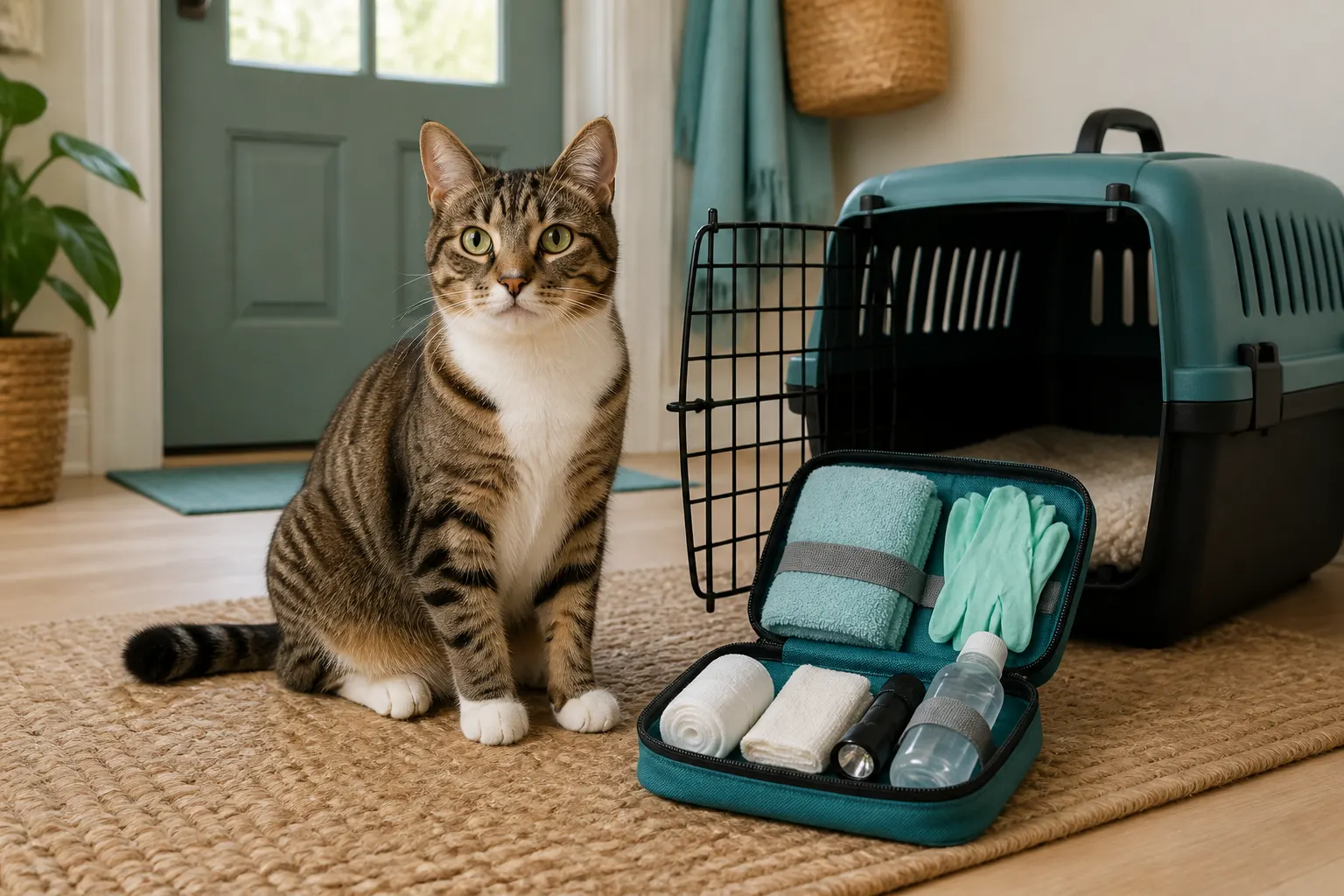
- A secure, ready-to-use cat carrier
Ask your veterinarian to adjust the list for your cat's health and show you how to use anything unfamiliar. First aid may help during the trip to a clinic, but it is not a substitute for veterinary care.
Build the kit around the carrier
For a cat, the carrier is part of the emergency plan even though it will not fit inside the supply pouch.
Store the pouch near a sturdy carrier that is large enough for your cat to lie down and turn around. Keep a clean towel or familiar washable bedding inside or beside it. Check that the door, handle, fasteners, and ventilation are sound. Do not bury the carrier behind boxes or dismantle it for storage.
If your cat hides when the carrier appears, work on calm carrier familiarity during ordinary weeks. Leave it accessible in a quiet area, offer treats or play nearby, and ask your veterinary team about a low-stress transport plan. An emergency is not the time to chase a frightened cat through the house or learn how an unfamiliar carrier closes.
The 2022 AAFP/ISFM feline interaction guidelines emphasize adapting handling to the individual cat and protecting both feline and human safety. In practice, that means using the least force needed, moving quietly, and avoiding a struggle that could worsen fear or injury.
Do not scruff, pin, or tightly wrap an injured cat based on a written tutorial. Pain and fear can make any cat scratch or bite. Keep your face away from the cat's mouth, use the carrier as the main containment tool, and follow the emergency clinic's directions.
Put the emergency card where you can grab it
Place a paper card in a waterproof sleeve at the top of the pouch. Save the same details in your phone and share them with anyone who cares for your cat.
Include:
- Your contact details and a backup number
- Your cat's name, age, sex, color, current weight, and photograph
- Your regular clinic's number
- The closest emergency hospital and a backup option
- A poison service that serves your location
- A transport helper or backup caregiver
- Your cat's microchip number and registry contact
- Any condition that changes emergency care
Confirm clinic opening hours and routes before you need them. Do not assume the closest clinic provides overnight emergency care.
The FDA advises owners who need urgent veterinary guidance to call their veterinarian, an emergency animal hospital, or an animal poison control center. A regulatory agency or general internet search cannot diagnose your cat or provide an individual treatment plan.
When you call, state what happened, when it happened, what signs you see, and whether you are already travelling. Put the phone on speaker if that lets you prepare the carrier while another adult listens and writes down instructions.
Keep a one-page medical summary
An emergency team needs the current facts, not a folder full of unsorted paperwork.
Prepare one page with:
- Current weight and the date it was measured
- Important diagnoses and previous surgeries
- Allergies or past medication reactions
- A full medication list with each product's strength, dose, route, and timing
- The time of the most recent dose
- The prescribing clinic's contact details
- Vaccination information
- Relevant test history, including FeLV or FIV status if known
- Individual emergency instructions from your veterinarian
For a cat with diabetes, seizures, heart disease, kidney disease, asthma, a bleeding disorder, severe allergies, or another ongoing condition, ask which details should appear first.
Keep copies rather than the only originals. The CDC's pet preparedness guidance includes veterinary records, prescriptions, a medical summary, recent photos, microchip information, and an appropriate carrier among the items owners should prepare.
If you want a repeatable way to collect the information before an appointment, use the checklist in How to Prepare for Your Pet's Vet Visit.
Pack simple supplies with clear limits
Choose supplies that can protect you, cover a wound, or support safe transport. Keep sterile items sealed and choose sizes that suit your cat.
| Supply | Practical use | Important limit |
|---|---|---|
| Disposable nitrile gloves | Protecting your hands and keeping supplies cleaner | Replace torn or contaminated gloves |
| Sterile saline | Flushing debris when a veterinarian tells you to | Use plain sterile saline, not a medicated wash |
| Nonstick sterile dressings | Placing a clean barrier over an injury | Never push against an object lodged in a wound |
| Rolled gauze | Adding padding or keeping a dressing in place | Stop if the material begins to tighten or slip |
| Self-adhering wrap | Holding only the outside layer for a short trip | Never stretch it firmly around any body part |
| Medical tape | Keeping loose dressing material together | Do not make a tight ring around skin or fur |
| Clean towels | Adding carrier padding, warmth, gentle containment, or pressure | Keep the nose and mouth completely clear |
| Scissors with blunt tips | Trimming tape and dressing material | Cut only when the cat is still and controlled |
| Small flashlight | Lighting the scene and checking the carrier | Do not shine it continuously into the eyes |
| Sealable bags | Carrying packaging or material the clinic requests | Label them and keep them away from food |
For visible bleeding, cover the site with a clean dressing or towel and hold steady pressure as someone calls the emergency clinic. Leave the first layer in position if it becomes soaked and place another layer over it. Heavy bleeding or blood that will not stop requires urgent veterinary care.
Do not probe a wound, remove an embedded object, or attempt a splint unless a veterinary professional has trained you and directs you to do it. The AVMA cautions that a poorly applied bandage or splint can cause more harm.
Use towels for calm support, not force
Two clean towels are especially useful in a cat kit. They can line the carrier, add padding, cover a simple wound, absorb fluid, or give a cat a place to hide.
A towel is not permission to wrestle with an injured cat. If your cat becomes more distressed, struggles to breathe, or you cannot handle them without risking a bite, stop and call the emergency clinic. Ask how to move the cat with the people and equipment available.
Avoid tying gauze around the mouth or improvising a muzzle. Never restrict the face or neck of a cat who is vomiting, unconscious, having a seizure, or showing breathing difficulty. A carrier or ventilated rigid container is generally the safer transport plan, but the veterinary team may give different instructions for a particular injury.
Keep the carrier level during transport. Secure it so it cannot slide, and do not open it outdoors, in a parking area, or inside an unsecured vehicle.
Make a poisoning plan before an exposure
Do not fill the kit with home remedies. Put the correct phone numbers at the top and leave treatment decisions to a veterinarian or veterinary poison service.
If your cat may have swallowed, inhaled, or contacted something harmful:
- Move the cat away from the source if you can do so without exposing yourself.
- Call a veterinarian, emergency hospital, or veterinary poison service immediately.
- Keep the product packaging, plant sample, medication container, or a clear photograph if it is safe to collect.
- Note the possible amount, route of exposure, and time.
- Follow the professional's instructions and prepare for transport.
Do not induce vomiting, give food or milk, apply a household chemical, or administer medicine unless the veterinary professional handling that exposure specifically tells you to. Do not delay the call while searching for symptoms online. A cat may need advice before visible signs appear.
Keep medicines out unless they belong to your cat's plan
Do not add human painkillers, medication prescribed for another animal, loose tablets, expired prescriptions, activated charcoal, or a generic rescue drug to the kit.
If your veterinarian wants a prescribed medicine kept with the emergency supplies:
- Leave it in the original labelled container.
- Record the exact indication and instructions.
- Check its storage conditions.
- Track the expiry date and remaining amount.
- Make sure every caregiver knows who is allowed to give it.
Do not give an extra dose when the last dose is uncertain. Check the record and call the prescribing clinic. In a multi-cat home, keep each cat's medication and emergency summary clearly separated. How to Track Care for Multiple Cats Without Mixing Up Doses explains how to use a single completion record and household handoff.
Separate first aid from evacuation supplies
A first aid pouch is not a complete disaster kit.
The first aid pouch contains contacts, records, basic protective supplies, and wound-covering materials. An evacuation kit also needs food, water, bowls, litter, a litter tray, regular medications, cleaning supplies, identification, bedding, and enough carrier capacity for every cat.
Storing the small pouch in the evacuation bag can work if it remains clearly marked and instantly removable. If you have several cats, plan one secure carrier per cat unless your emergency plan and veterinary team advise otherwise. Frightened cats who normally rest together may behave differently during transport.
For car journeys or supervised outdoor time, make a smaller travel pouch with the emergency card, gloves, saline, dressings, gauze, wrap, tape, a towel, and sealable bags. The carrier still matters more than adding many extra products.
Check the kit every three months
A first aid kit becomes unreliable when contact numbers change, sterile packages open, or the carrier no longer closes properly.
Use a recurring review:
- Confirm emergency clinic hours, numbers, and routes.
- Update your cat's weight, medication list, conditions, and photo.
- Replace opened, used, damaged, or expired supplies.
- Check sterile seals and saline integrity.
- Test the flashlight and inspect the scissors.
- Check the carrier door, handle, ventilation, bedding, and size.
- Confirm that every caregiver can find the kit and carrier.
- Repack the pouch in the same order.
Pet Care Reminder can hold the quarterly review and separate expiry reminders for prescribed emergency medication or time-sensitive supplies. Mark each reminder complete only after the item has been checked.
Know when the kit should stay closed
Do not delay transport because you want to use every supply. Call an emergency veterinary hospital and follow its directions for:
- Open-mouth breathing, obvious breathing effort, blue or very pale gums
- Collapse, unresponsiveness, or sudden extreme weakness
- An active seizure, repeated seizures, or abnormal recovery
- Severe or continuing bleeding
- A vehicle strike, fall, crush injury, burn, or other major trauma
- Suspected poisoning, a wrong medication, or an uncertain overdose
- An eye injury
- A deep wound, bite wound, or embedded object
- Repeated attempts to urinate with little or no urine
- Sudden paralysis, inability to stand, or severe pain
Urethral obstruction is a true medical emergency. Cornell's feline health guidance advises immediate veterinary attention when a cat may be obstructed, which can present as repeated straining, frequent attempts to urinate, and little or no urine.
If the scene involves traffic, fire, electricity, floodwater, chemicals, or an aggressive animal, protect yourself and contact the appropriate emergency service. Your cat still needs help, but an unsafe rescue can create another casualty.
A practical cat first aid rule
Think call, contain, carry:
- Call the veterinary professional who can guide the next step.
- Contain your cat with the least stressful safe method available.
- Carry the essentials and move promptly when veterinary care is needed.
Start with the carrier, emergency card, and medical summary. Add straightforward supplies with clear limits, remove products that invite guessing, and review the setup regularly. The best cat first aid kit makes the right next action easier without pretending that home supplies can replace a veterinarian.
Sources
- Pet First Aid. The American Veterinary Medical Association's 2025 brochure covering first aid supplies, immediate responses, safe transport, poisoning, bleeding, and owner safety.
- 2022 AAFP/ISFM Cat Friendly Veterinary Interaction Guidelines: Approach and Handling Techniques. Peer-reviewed feline handling guidance focused on adapting interactions to the individual cat while protecting feline and human safety.
- Who Do You Call if You Have a Pet Emergency?. FDA information identifying the veterinary professionals and poison services that owners should contact for time-sensitive advice.
- Build a Pet Disaster Preparedness Kit. CDC guidance on records, medication information, identification, carriers, and supplies to prepare for pet emergencies.
- Feline Lower Urinary Tract Disease. Cornell University College of Veterinary Medicine guidance identifying suspected urethral obstruction as a medical emergency requiring immediate veterinary attention.