
Quick answer
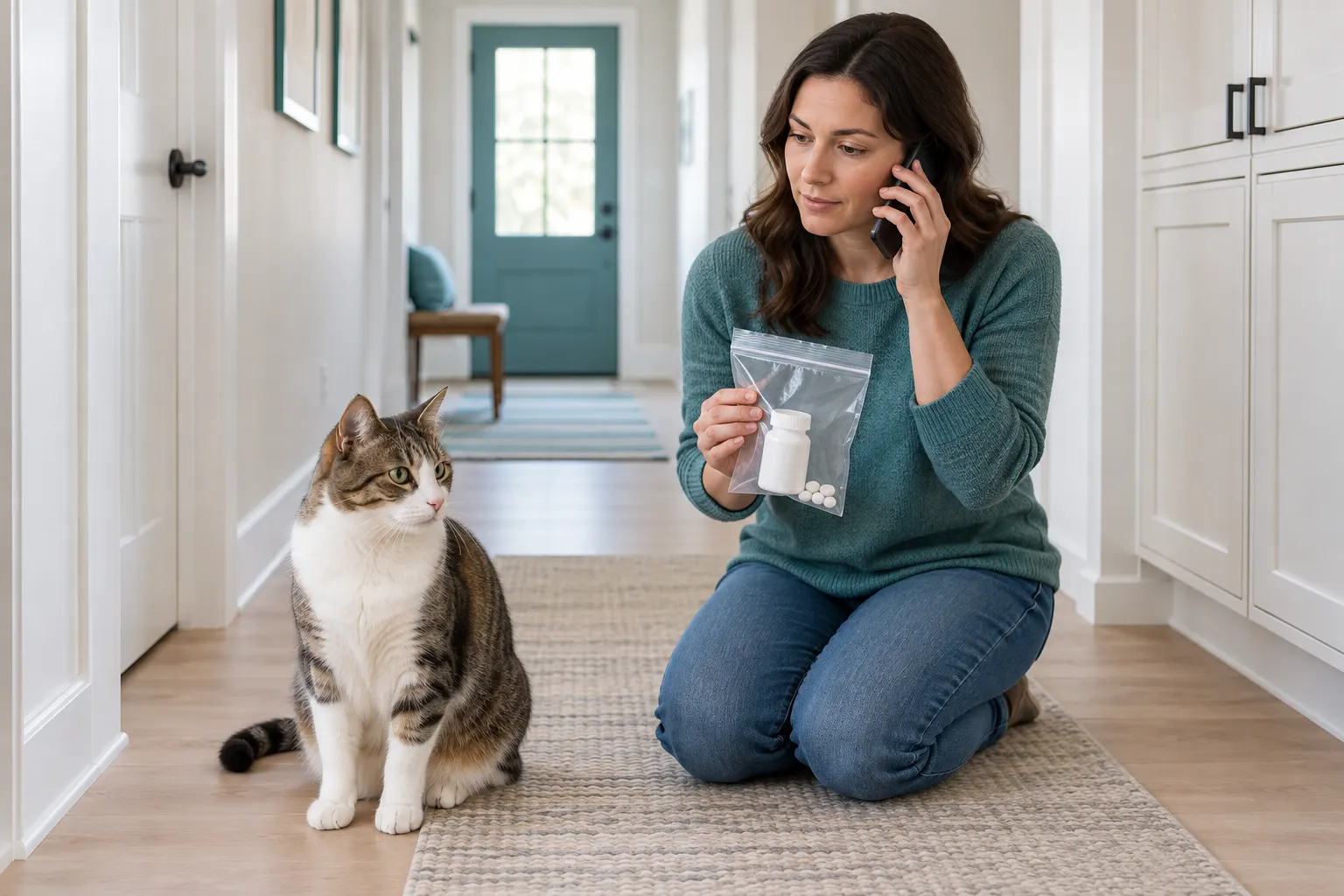
If your cat may have swallowed a toxic substance, secure the cat away from it and get immediate advice from a veterinarian, emergency clinic, or veterinary poison service. A normal appearance does not justify waiting, and a generic toxicity chart cannot assess this exposure.
While you call:
- Put your cat in a safe room or carrier away from the substance and other pets.
- Prevent licking or grooming if anything may be on the coat or paws.
- Locate the original container, plant, medicine packet, or a clear image that identifies it.
- Estimate the exposure time and the maximum amount that could be missing.
- Have your cat's weight, age, health conditions, medications, and current signs ready.
- Give nothing by mouth and do not try to make the cat vomit unless the professional responsible for the case provides that instruction.
Breathing difficulty, collapse, loss of responsiveness, inability to stand, marked tremors, or a seizure requires emergency transport as directed. When two adults are present, one can contact the clinic while the other gets the carrier ready. Keep hands and objects out of the mouth of a cat who is unconscious or seizing.
Urgency cannot be judged from appearance alone. Species, product strength, possible dose, exposure route, elapsed time, and the cat's own health all affect the response.
Use the first five minutes well
The safest first response is separate, call, identify, and follow instructions.
1. Separate your cat from the source
Move your cat calmly into a secure room or carrier. Close the door and keep other animals and children away. If the substance is on the floor, counter, or another pet, prevent your cat from returning to it.
Do not chase a frightened cat through the home if you can close off the contaminated area instead. A towel may help guide a calm cat into a carrier, but do not scruff, pin, or tightly wrap a struggling cat. Pain, fear, and neurologic effects can make any cat bite or scratch.
If a chemical, powder, pesticide, smoke, or fumes could also harm people, move everyone to fresh air or a safe area first. Avoid bare-hand contact and do not mix cleaners while trying to tidy the scene.
2. Call for case-specific advice
Contact one of these services right away:
- Your regular veterinarian
- The nearest emergency veterinary hospital
- A veterinary poison service available in your region
The American Veterinary Medical Association advises immediate contact after a pet may have swallowed or contacted something harmful. A poison service may charge a consultation fee, so have a payment method available if that applies where you live.
A human poison line is not a substitute for veterinary triage unless the veterinary team asks you to use it. Product manufacturers, regulators, search results, and social posts also cannot create an individual treatment plan for your cat.
3. Identify the substance without delaying the call
Bring the exact object into the conversation. Read the label to the professional or send photographs if the service accepts them.
Useful evidence includes:
- The front and back of the package
- The ingredient list and product name
- Strength or concentration
- Package size and amount remaining
- The species and weight range printed on a flea or tick product
- A plant's leaves, flowers, stem, and container
- The damaged bottle, blister pack, tube, sachet, or wrapper
- A photograph of vomited or chewed material, if present
Never taste or deliberately inhale an unidentified material. Avoid skin contact too. If a container leaks, keep it out of the vehicle's passenger space and ask the clinic for safe packaging directions.
4. Report the maximum possible exposure
Give facts rather than a reassuring guess.
| Information | What to report |
|---|---|
| Cat | Age, current weight, sex, and relevant breed or type |
| Substance | Product or plant name, active ingredients, concentration, and physical form |
| Amount | Original quantity, amount remaining, and maximum that could be missing |
| Time | Last time the item was definitely intact, discovery time, and any witnessed contact |
| Route | Eating, chewing, licking, breathing it in, or contact with the eyes, mouth, skin, fur, or feet |
| Current condition | Alertness, breathing, walking, drooling, vomiting, tremors, seizures, or any other change |
| Medical context | Conditions, prescriptions, supplements, allergies, and recent procedures |
| Actions taken | Anything removed, rinsed, washed, offered, or given since discovery |
If the amount is unknown, say so. For example: "The bottle held 30 tablets when it was dispensed, 18 remain, and I do not know how many were used before today." An uncertain maximum is more useful than an unsupported estimate.
5. Follow the exact instruction you receive
Note who handled the call, when it occurred, any case reference, where to go, and what to do first. Useful questions are:
- Should we leave for a clinic now?
- Should anything be removed from the mouth, coat, or paws before travel?
- May I offer food or water?
- What should happen with the next scheduled medication?
- What packaging or sample should I bring?
- Which change means we must call back or travel immediately?
Read the plan back to confirm it. Stress makes verbal details easy to lose, so write each action in order.
Do not wait for symptoms
Visible signs cannot tell you that an exposure was harmless. Some toxins cause damage before an owner sees a clear change, and cats often hide early illness.
Call even when your cat appears comfortable if they may have reached:
- Human medication, another pet's medicine, or too much of their own prescription
- A lily or another unidentified plant
- A dog-only flea or tick product
- Antifreeze, rodent bait, insecticide, fertilizer, or another garden or garage product
- Nicotine products, e-cigarette liquid, cannabis products, or alcohol
- Cleaners, disinfectants, essential oils, liquid potpourri, paint, or solvents
- Chocolate, caffeine, onion, garlic, raw yeast dough, or another questionable food
Many other hazards exist. FDA guidance explains that species, quantity, concentration, and the part of a plant involved can change toxicity. Marketing words such as natural, organic, pet friendly, sugar free, and child resistant do not establish feline safety.
Drooling, vomiting, hiding, unusual quietness, agitation, weakness, wobbliness, twitching, tremors, seizures, breathing changes, unusual gum color, or a sudden change in drinking or urination can all matter. Do not use the absence of one expected symptom as permission to wait.
Cats can be poisoned without eating from a bowl
Cats groom their coats and paws, so a substance on the body can become an oral exposure. They may also drink from a vase, lick a spill, chew a plant, contact a recently treated dog, or walk through a product and swallow it later during grooming.
Tell the veterinary professional about every possible route. If material may be on the coat or paws:
- Prevent grooming as safely as you can.
- Protect yourself from the substance.
- Call immediately and name the exact product.
- Follow the product-specific decontamination and transport instruction.
Do not apply oil, alcohol, solvent, another cleaner, essential oil, or a home neutralizing mixture. Washing is not the same for every exposure, and a struggling cat can inhale liquid, become chilled, or injure you.
One important exception has specific regulatory guidance. If a dog-only spot-on containing permethrin was mistakenly applied to a cat, the UK's Veterinary Medicines Directorate instructs owners to wash the product off immediately with water and a mild detergent and seek immediate veterinary treatment. If you cannot do that safely or it would delay urgent transport, tell the emergency clinic and follow its direction. Do not assume that instruction applies to every pesticide or chemical.
Treat these cat-specific hazards as immediate-call situations
Human pain medicine
Never give a cat medication from a human medicine cabinet unless a veterinarian has prescribed that exact product and dose for that cat. The FDA identifies acetaminophen as fatal to cats and warns that common human anti-inflammatory medicines may also be harmful to pets.
If a tablet may be missing, bring the original package and report the active ingredient, strength per tablet, maximum number missing, and time window. Do not wait to see whether your cat becomes sleepy or vomits.
Lilies and unidentified plants
Treat access to a lily or an unidentified plant as urgent. Preserve the plant name, florist label, receipt, or clear photographs, but do not delay the call while trying to identify it perfectly.
Report whether your cat chewed the plant, contacted pollen, drank nearby water, or may have groomed material from the coat. Keep the plant away from every pet and bring it or a photograph only if the clinic says to do so.
Dog flea and tick products
Never apply a dog flea or tick product to a cat unless a veterinarian has explicitly directed that exact use. Products containing concentrated permethrin can cause severe poisoning in cats. Exposure can also happen when a cat grooms or has close contact with a recently treated dog.
Keep the package and report the active ingredients, concentration, dog weight range, application time, amount used, and whether the cat contacted the treated dog. Tremors, twitching, drooling, agitation, difficulty walking, or seizures after exposure require emergency care, but the call should happen before those signs appear.
The cat's own medication
An extra dose, an uncertain dose, the wrong strength, or a medicine prescribed for another animal can all require urgent advice. Do not skip or repeat the next dose to balance the mistake yourself.
Review the most recent confirmed entry, then distinguish the planned dose from the known outcome and any uncertainty. How to Track Care for Multiple Cats Without Mixing Up Doses shows how separate completion records can preserve this information for each cat.
Do not induce vomiting or improvise an antidote
AVMA first aid guidance tells owners to avoid both owner-induced vomiting and medication unless directed by a veterinarian or poison center. A peer-reviewed feline toxicology review describes important metabolic differences between cats and dogs and explains why decontamination must be chosen for the individual toxin and patient.
Without an explicit case-specific instruction, avoid all of the following:
- Hydrogen peroxide, salt, mustard, or another homemade emetic
- Activated charcoal
- Milk, oil, butter, food, or a large drink of water
- Human pain, nausea, stomach, allergy, or diarrhea medicine
- Another pet's prescription
- An extra dose of the cat's regular medication
- A home antidote found online
Never reach into the throat. A cat who is weak, resisting, vomiting, drowsy, or seizing must not be force-fed food or liquid.
Vomiting does not prove that the toxin is gone. Take a photograph, stop the cat from reaching the material again, and describe it during the call. When collection is safe, AVMA guidance recommends sealing chewed or vomited material in a plastic bag for the veterinary hospital.
Prepare the carrier while help is being arranged
Place a clean towel in a secure carrier and keep the carrier level. If your cat is alert and can be handled safely, guide them inside with the least force possible. Do not open the carrier outdoors, in a parking area, or inside an unsecured vehicle.
Bring:
- The product or plant, if the clinic says it is safe to transport
- Clear photographs of every label panel
- The poison-service case number
- Your cat's medication containers or a current medication list
- A brief timeline of the exposure and every action taken
- A towel, gloves, and sealable bags kept away from food
Whenever time permits, alert the hospital that you are coming. What to Keep in a Cat First Aid Kit covers advance storage of phone numbers, health records, protective gloves, sealable bags, and transport supplies.
If the cat vomits, When Should a Cat See the Vet for Vomiting? lists useful observations to capture for the clinic. Suspected poisoning still calls for immediate advice after one episode, several episodes, or no vomiting at all.
Use a concise poisoning call script
Lead with the substance, maximum possible amount, time window, and current condition:
"My four-kilogram cat may have chewed a human medication blister pack during the past 30 minutes. Two tablets could be missing. I have the package and can read the drug name and strength. She is alert and breathing normally, and I have not given food, peroxide, charcoal, or medicine."
Then answer questions directly. If you already washed the coat, offered something, or gave a remedy, report the exact product, amount, and time. The veterinary team needs the complete history, not a version edited to sound less worrying.
If the substance is unknown, describe where it was found, the container, color, physical form, missing amount, damaged objects, and everything else nearby. Do not intentionally inhale an unknown vapor or handle a powder to improve the description.
Record the handoff and follow-up
Once the first call and travel plan are underway, make a short factual timeline:
| Time | Event or observation | Instruction or action |
|---|---|---|
| 6:10 p.m. | Open packet found, cat alert | Cat secured in carrier, package photographed |
| 6:14 p.m. | Emergency clinic called | Directed to regional animal poison service |
| 6:22 p.m. | Poison service supplied a case reference | Emergency hospital visit advised |
| 6:27 p.m. | No vomiting, cat remains alert | Departed with evidence and medicine record |
Log completed actions rather than intentions. Add treatment directions, discharge medicines, feeding guidance, follow-up timing, and the signs that should trigger another call.
After the clinic defines the care plan, Pet Care Reminder can organize medicines, observation times, calls, and recheck appointments. Store the case reference and objective timeline in the notes. Set reminders only after seeking help, never as a reason to delay it.
Prevent another exposure after the emergency is handled
Once the immediate danger and veterinary instructions have been addressed, work out how the cat reached the hazard.
- Keep human and animal medicines in separate, closed storage.
- Leave products in original containers with readable labels.
- Do not rely on a high shelf or counter because cats climb and jump.
- Exclude lilies and other known high-risk plants from a cat household.
- Check that every flea and tick product names the correct species before opening it.
- Separate cats from dogs treated with a dog-only product for the full label-directed period.
- Store cleaners, pesticides, nicotine products, cannabis products, antifreeze, and garden chemicals behind a secure door.
- Check bags, bedside tables, bins, deliveries, visitor luggage, garages, and sheds.
- Save your veterinarian, emergency hospital, and regional animal poison service contacts.
- Keep a current weight, medication list, and medical summary ready.
The useful system is simple: secure storage, original labels, species-specific products, clear household handoffs, and emergency contacts that every caregiver can find.
The practical rule
After a possible cat poisoning, do not wait for proof and do not test a home remedy.
Secure the cat, stop coat or paw grooming when that is relevant, and obtain veterinary poison advice at once. Supply the best identification and upper-bound amount you can, retain the packaging, ready the carrier, and carry out the instructions for this case.
Good information speeds veterinary decisions, but it cannot turn suspected poisoning into a home-diagnosis problem.
Sources
- Pet First Aid. The American Veterinary Medical Association's 2025 first aid brochure covering urgent contact, evidence collection, and actions owners should not attempt without professional direction.
- Potentially Dangerous Items for Your Pet. Current FDA safety guidance on dangerous foods, human and animal medicines, pesticides, household products, plants, species-specific risk, and prompt veterinary or animal poison service contact.
- Feline Toxicological Emergencies: When to Suspect and what to do. Peer-reviewed feline clinical review covering cats' distinctive toxicology, exposure through grooming, urgent stabilization, and the need to tailor decontamination and treatment to the toxin and patient.
- Permethrin: don’t put your cat at risk. UK Veterinary Medicines Directorate guidance on avoiding dog-only permethrin spot-ons in cats, preventing contact with recently treated dogs, and responding immediately to accidental application.